@farman4x Robot = x
Pikachu= y
Dinosaurs = z
3x = 36 -> x = 12
2x + y = 30 -> 24 + y = 30, y = 6
y + 2z = 26 -> 6 + 2z = 26, z = 10
Dinosaurs weight 10 kg
When you start a chess game, you have 20 possible moves available. After the first full move (White then Black), there are already over 400 possible positions. By the third move, that number jumps to around 8,900, and after the fourth it reaches nearly 200,000.
By the time you get to move #40, the total number of possible games explodes to roughly 10⁴⁰, a number comparable to the total number of atoms in the observable universe.
@itsm_hope 68 - 64 - 56 - 40 - 8. The pattern is difference between two adjacent number is twice the pervious diff.
68-64 = 4
64-56 = 8
56-40 = 16
40-8 = 32
Dunia pendidikan di Sulawesi Selatan tengah menjadi sorotan setelah ratusan kepala SMA dan SMK mengundurkan diri dari jabatannya.
Pengunduran diri tersebut disebut berkaitan dengan temuan Badan Pemeriksa Keuangan (BPK) mengenai dugaan penerimaan cashback dalam pengadaan buku yang bersumber dari Dana BOS.
Berdasarkan penjelasan Dinas Pendidikan Sulsel, terdapat 326 kepala sekolah yang masuk dalam temuan tersebut, terdiri dari dua gelombang pemeriksaan. Temuan itu kemudian menjadi bahan evaluasi bersama antara Dinas Pendidikan, Inspektorat, dan Badan Kepegawaian Daerah.
Pihak Disdik menilai kasus tersebut berkaitan dengan penyalahgunaan kewenangan dalam pengelolaan anggaran sekolah. Sementara itu, DPRD Sulsel meminta agar persoalan ini diselesaikan secara bijak dan tidak menimbulkan gejolak yang dapat mengganggu dunia pendidikan. Kasus ini pun memicu perhatian publik karena menyangkut pengelolaan Dana BOS yang selama ini menjadi salah satu sumber utama pembiayaan kegiatan pendidikan di sekolah.
Sc: kualimerahputih
Correct me if Im wrong ya.
Ini hasil ngobrol sama admin pajak ku, mengenai pajak 22% untuk PT.
Disclaimer on!
Mari kita asumsikan setiap perusahaan memiliki persentase laba bersih sebesar 10% dari omset.
1. PT Abu (Omset Rp3 Miliar)
Karena omset PT Abu di bawah Rp4,8 Miliar, perusahaan memiliki dua pilihan mekanisme perhitungan pajak:
A: Menggunakan PPh Final UMKM 0,5% (PP 55/2022)
Jika PT Abu masih dalam jangka waktu yang diperbolehkan menggunakan PPh Final (maksimal 3 tahun sejak berdirinya PT):
Mekanisme: Langsung dikalikan dari omset bulanan.
Hitungan: Rp3 Miliar × 0,5% = Rp15 jt
B: Menggunakan Tarif Umum 22% + Fasilitas Pasal 31E
Jika masa berlaku PPh Final sudah habis, PT Abu wajib menggunakan pembukuan. Karena omsetnya di bawah Rp4,8 Miliar, maka seluruh laba bersih mendapatkan diskon tarif 50% (jadi hanya bayar 11%).
Laba Bersih (10%): Rp300 jt
Hitungan Pajak:
Rp300 jt× 11% = Rp33.000.000.
Ribet!
2. PT Nia (Omset Rp10 Miliar)
Omset PT Nia berada di antara Rp4,8 M sampai Rp50 M. Maka, perhitungannya wajib menggunakan Fasilitas Pasal 31E (Diskon Proporsional).
Artinya, bagian laba bersih yang setara dengan omset Rp4,8 M mendapat diskon tarif (bayar 11%), sedangkan sisa laba bersihnya dikenakan tarif penuh 22%.
Asumsi Laba Bersih (10%): Rp1 M
Langkah 1: Hitung bagian Laba yang Dapat Fasilitas Diskon dengan rumus
(Rp4,8 M ÷ Omset ) × Laba
(4,8 M ÷ 10 M )x 1 M = Rp 480 jt
Pajaknya: Rp480 jt× 11% = Rp 52.800.000
Langkah 2: Hitung sisa Laba yang Tidak
Rp1 Miliar (Laba) - Rp480 jt (langkah 1) = Rp520 jt
Pajaknya: Rp520 jt × 22% = Rp114.400.000
Total Pajak PT Nia:
Rp52.800.000 + Rp114.400.000 = Rp167.200.000.
Ribet!
3. PT Eri (Omset Rp51 Miliar)
Karena omset PT Eri sudah melewati Rp50 Miliar, PT Eri tidak berhak mendapatkan fasilitas pengurangan tarif apa pun. Seluruh laba bersih langsung dikenakan tarif penuh 22%.
Asumsi Laba Bersih (10%) = Rp5,1 Miliar
Langsung dikalikan tarif 22%.
Hitungan Pajak: Rp5.1M× 22% = Rp1,122 Miliar.
Initinya! Pajak naik😬
Sekali lagi yg patuh pajak diperes. 😁
Sementara pengusaha yg nggak pakai PT, yg jualannya di trotoar. Lolos pajak 🤣
@TGTM_Official Elon Musk made Tesla's technology "open source" in 2014 by pledging not to sue anyone using the company's patented electric vehicle (EV) technology in "good faith". The goal was to encourage other automakers to build EVs and accelerate the transition to sustainable transport.
A máquina que supera o Universo.
⚙️ Criada por Daniel de Bruin, a "The 100-Gear Exponential Machine” (ou simplesmente a máquina das 100 engrenagens) é composta por 100 engrenagens, cada uma com uma relação de redução de 10:1 em relação à anterior.
🔄 Isso significa que, para cada 10 voltas de uma engrenagem, a próxima gira apenas 1.
Quando essa redução é repetida 100 vezes, o resultado é extremo:
⚙️ Para que a última engrenagem complete uma única volta, a primeira precisaria girar 10¹⁰⁰ vezes — um número chamado googol.
Para comparação: O Universo observável contém cerca de 10⁸⁰ átomos. Ou seja, o número necessário para mover a última engrenagem é muito maior que a quantidade de átomos existentes no cosmos.
Se a primeira engrenagem girar uma vez a cada 3,5 segundos:
A 5ª já levaria horas para completar uma volta.
A 8ª levaria cerca de um ano.
Após 4,6 bilhões de anos (idade da Terra), a 18ª mal teria completado meia volta.
Mesmo após 13,8 bilhões de anos (idade do Universo), a 21ª praticamente não teria se movido de forma significativa.
Forçar a última engrenagem exigiria velocidades e energia que ultrapassam limites físicos fundamentais — incluindo os impostos pela relatividade.
⚛️ Essa máquina é uma representação concreta do poder do crescimento exponencial e dos limites da física.
Às vezes, o impossível não está na força aplicada — está na matemática envolvida.
Elon Musk just told a story that should terrify every AI company on Earth.
His son Saxon is autistic.
Saxon couldn’t understand why the family went to restaurants.
You can get the same food delivered.
You can call your friends over.
You can eat better at home for half the price.
So why go?
Musk: “He had an epiphany and said, ‘Oh, the reason people go to restaurants is to hang out with strangers.’”
A kid who takes the world literally just decoded something the rest of us never thought to question.
We like being around people we’ll never know.
Look at what we already built.
Delivery apps so you never wait in line.
Remote work so you never share an office.
Self-checkout so you never talk to a cashier.
Every innovation of the last 20 years was a bet against human proximity.
Every one paid off.
Until it didn’t.
Loneliness is now a public health emergency.
Depression has doubled since the smartphone.
The average American has fewer close friends than any generation in history.
We didn’t remove friction.
We removed the thing friction was hiding.
Now look at what’s coming.
AI agents that handle your emails.
AI companions that replace your conversations.
AI assistants that make every human interaction optional.
Same playbook. Same bet.
Except this time we’re not engineering out strangers.
We’re engineering out humans entirely.
The coffee shop where nobody knows your name.
The subway where no one speaks.
The restaurant where you’ll never see that couple again.
Those aren’t failed connections.
They’re the background radiation of belonging.
We don’t just need people who know us.
We need to exist in rooms full of people who don’t.
That’s what a kid understood at a dinner table that billion-dollar companies still can’t grasp in a boardroom.
We spent 20 years building a world you never have to show up to.
AI is about to finish the job.
And nothing it builds will ever replicate sitting in a room full of strangers and not feeling alone.
🚨GOOGLE JUST SILENTLY DOWNLOADED A 4GB AI MODEL TO YOUR COMPUTER WITHOUT ASKING.. WITHOUT TELLING YOU.. AND WITHOUT ANY WAY TO STOP IT..
If you use Chrome.. There's a good chance a 4 gigabyte file is sitting on your hard drive right now that you never agreed to download..
It's called Gemini Nano.. Google's on-device AI model.. A security researcher just proved it installs itself with zero clicks.. Zero prompts.. Zero notifications..
Alexander Hanff set up a completely fresh Chrome profile.. Didn't click anything.. Didn't scroll.. Didn't type a single keystroke.. Just opened the browser and watched..
14 minutes and 28 seconds later.. Chrome had silently scanned his hardware.. Read his GPU, RAM, and storage.. Then wrote a 4GB file to his hard drive.. No permission dialog.. Nothing..
Chrome's own logs show the download begins BEFORE the settings page where you could opt out is even loaded.. The file starts installing before the refusal button exists..
As of Chrome 148.. Any website you visit can trigger this download.. One line of JavaScript.. You click a link to read a blog post.. That click counts as "user activation".. And Chrome silently pulls 4GB in the background..
No install prompt.. No consent dialog.. Google's own docs admit this..
Your laptop overheats.. Storage disappears.. Battery drains.. And you have no idea why..
The model doesn't even work well.. Cloud requests take 1.3 seconds.. The local model at worst case takes over 9 minutes for a single response..
Google is using your storage, electricity, and bandwidth to run an AI that's 40 times slower than their own servers..
And the "AI Mode" button in Chrome's address bar.. Doesn't even use the local model.. It sends everything to Google's cloud anyway..
You pay the storage penalty.. The heat penalty.. The bandwidth penalty.. And the visible AI feature ignores the local file entirely..
Because Chrome fails to clean up old versions.. Users are finding 12GB or more of duplicate AI files stacked on their drives..
Palo Alto Networks found a vulnerability where a browser extension could hijack the local AI model's permissions.. Accessing your webcam.. Microphone.. Local files.. Through an AI you never installed..
Here's how to check if it's on your machine..
Windows.. C:\Users\[YourName]\AppData\Local\Google\Chrome\User Data\Default\OptGuideOnDeviceModel\
Mac.. ~/Library/Application Support/Google/Chrome/Default/OptGuideOnDeviceModel/
If there's a file called weights.bin.. Google downloaded their AI to your computer without asking..
To stop it.. Type chrome://flags.. Search "optimization-guide-on-device-model" and disable it.. Search "prompt-api-for-gemini-nano" and disable that too.. Restart Chrome.. Then manually delete the folder..
If you don't disable the flags first.. Chrome redownloads the 4GB file on next launch..
Firefox requires explicit opt-in for AI.. Apple Intelligence requires explicit consent.. Chrome just takes your hard drive..
Google didn't ask to use your storage.. Your electricity.. Your bandwidth..
They just took it.
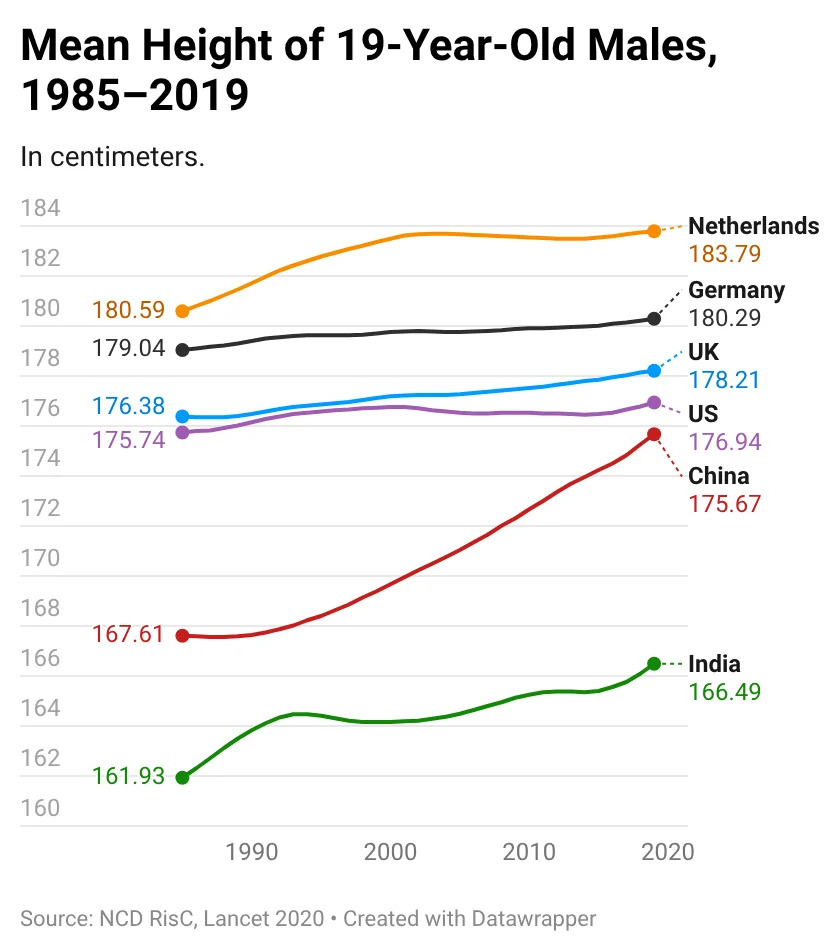
Over the past 34 years the average Chinese man became, on average, 3 inches taller than his grandfather.
But entire population can't rewrite its DNA in 35 years.
So what made them grow so fast? The answer might surprise you.
This is the video of the Horrific daycare abuse in Yogyakarta: 53 toddlers tied up, drugged & neglected. 13 suspects arrested.
https://t.co/B7yu9eWsxe
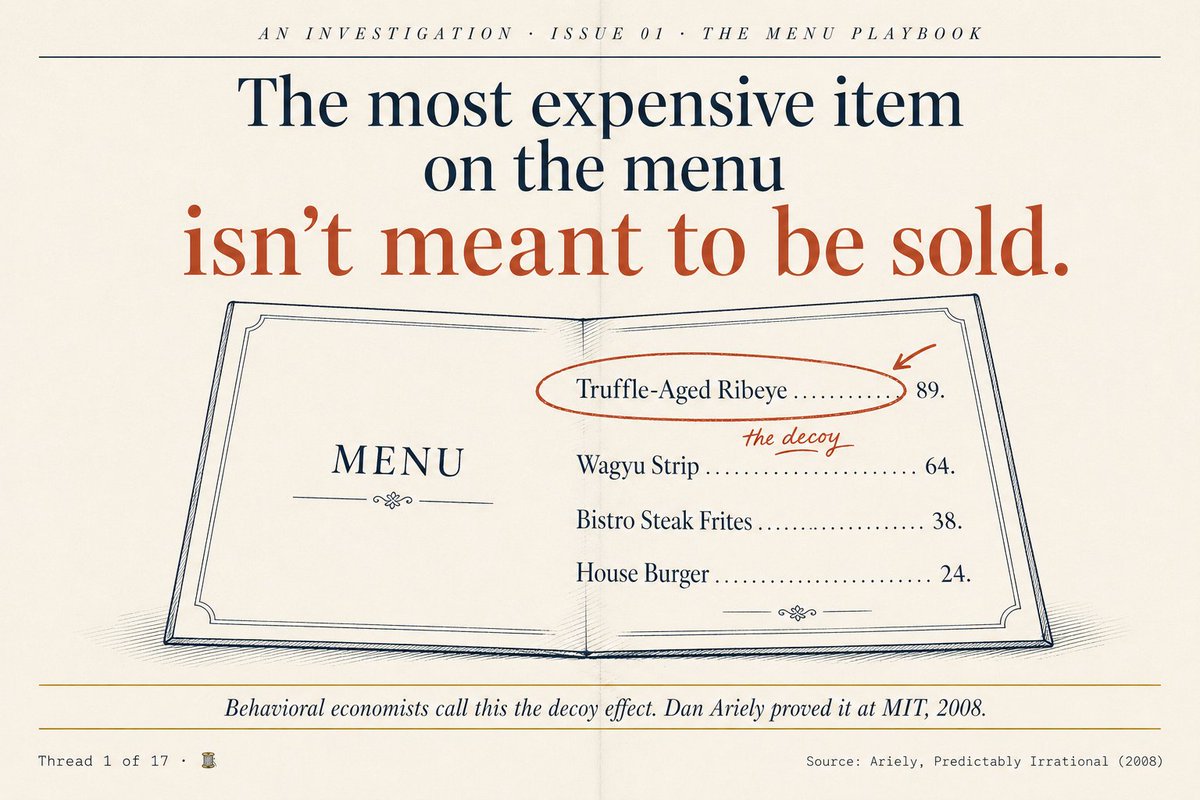
The most expensive item on a restaurant menu isn't meant to be sold.
It exists to make the second-most-expensive item look reasonable.
Behavioral economists call this the decoy effect. Dan Ariely proved it at MIT in 2008.
Every menu you've eaten from this year uses it. Plus 10 more tricks.
I pulled the playbook. Here's how each one hijacks your brain. 🧵
Kasus kekerasan yang terjadi di Daycare Little Aresha Yogya.
Ternyata owner dan jajaran kepengurusannya yoo bukan orang sembarangan juga.
Barusan cek di PDDIKTI:
1. Rafid Ihsan Lubis: Dia adalah lulusan S1 Hukum di UGM.
Saat ini sedang menjalani studi S2 Ilmu Hukum di Universitas Brawijaya dan lebih mengejutkannya lagi dia adalah seorang Hakim Pratama di Pengadilan Negeri Tais.
2. Cahyaningrum Dewojati: Dosen di UGM.
🤦🤦🤦🤦🤦
Sekali lagi.. Pinter boleh, keblinger jangan.
A Soviet psychologist walked into a café in 1927 and watched a waiter do something impossible.
He remembered every open order at every table. Perfectly. Without notes. Without effort.
Then a table paid their bill. She asked him to repeat the order.
He couldn't remember a single item.
She spent the next two years figuring out why. What she found is now the operating system underneath every platform fighting for your attention.
Her name was Bluma Zeigarnik, and she was a graduate student at the time, sitting with her professor Kurt Lewin, watching the waiters work the room. What caught her attention was something so ordinary that it had been happening in restaurants for centuries without anyone asking why.
The waiters could remember every open order with perfect accuracy. Table four wanted the schnitzel with no sauce. Table seven had changed their wine twice. Table twelve owed for three coffees and a dessert. Every detail, held without effort, without notes, without any visible system at all.
But the moment a table paid their bill, the information vanished. Completely. Lewin tested it on the spot. He called a waiter back minutes after a table had settled up and asked him to recite the order. The waiter could not do it. Not partially. Not approximately. The information was simply gone.
Zeigarnik went back to her lab and spent the next two years turning that observation into one of the most replicated findings in the history of psychology.
Here is what she proved, and why it changes how you think about attention, memory, and almost every piece of media you have ever consumed.
She gave participants a series of tasks. Some tasks they were allowed to finish. Others were interrupted before completion. Then she tested recall across both groups.
The unfinished tasks were remembered at nearly twice the rate of the completed ones.
Not slightly better. Nearly twice. The brain was holding the incomplete work in a state of active tension, returning to it, keeping it warm, refusing to file it away. The finished tasks were closed, archived, released. The unfinished ones were still running.
She called it the resumption goal. When the brain commits to a task and cannot complete it, it opens a file that stays open until resolution arrives. That open file consumes a portion of your cognitive bandwidth whether you are thinking about it consciously or not. It surfaces in idle moments. It pulls at the edge of your attention during other work. It is the thing you find yourself thinking about in the shower when you were not trying to think about anything at all.
This is not a flaw in human cognition. It is a feature. The brain evolved to finish things. An open loop is a signal that something important is unresolved. Keeping that signal active increases the probability that you will return to it and complete it. In an environment where most tasks had real survival stakes, this was an extraordinarily useful mechanism.
In the modern world, it is the most exploited vulnerability in human attention.
Netflix did not invent the cliffhanger. But it industrialized it in a way no medium before it ever had. When a show ends on an unresolved question, it does not just create curiosity. It opens a file in your brain that stays active until the next episode closes it. The autoplay countdown that begins at 15 seconds is not a convenience feature. It is a precise calculation about how long the average person can tolerate an open loop before the discomfort of not knowing overrides every other intention they had for the evening. One more episode is not a choice. It is your brain doing exactly what it was designed to do: return to what is unfinished.
The writers who built Lost, Breaking Bad, and Succession understood this intuitively without ever reading a psychology paper. Every episode ended on an open question. Every season finale answered three things and opened five more. The entire architecture of prestige television is a Zeigarnik machine running at industrial scale.
But television is not where this gets dangerous.
Every notification on your phone is an open loop. Every unread email is an open loop. Every task you wrote on a list and have not yet crossed off is an open loop. Each one is consuming a small but real portion of your available attention, pulling fractionally at your focus, degrading your capacity to be fully present in whatever you are actually doing right now. TikTok's algorithm does not just serve you content you like. It serves you content that ends one loop and immediately opens another, keeping the resumption system permanently activated so the cost of stopping always feels higher than the cost of continuing.
The research on this accumulation effect is striking. Psychologists studying cognitive load have found that unfinished tasks do not sit passively in memory. They actively interrupt. They surface at the wrong moments. They are the reason you are reading something and suddenly remember an email you forgot to send. The brain is not malfunctioning. It is running its resumption system exactly as designed. It is just running it across forty open loops simultaneously, in an environment that generates new ones faster than any human nervous system was built to process.
The most important practical implication Zeigarnik's research produced is one that most people use backwards.
David Allen built his entire Getting Things Done system on the insight that the only way to close a cognitive open loop is to either complete the task or make a trusted commitment to complete it later. Writing something down in a system you actually trust has the same effect on the brain as finishing it. The file closes. The bandwidth is released. This is why writing a task down feels like relief even before you have done anything about it. You have not solved the problem. You have simply told your brain that the loop is registered and will be returned to, which is enough for the resumption system to stand down.
The inverse is equally true and far more destructive. Every task that lives only in your head, unwritten and unscheduled, is an open loop burning cognitive resources around the clock. The mental cost is not proportional to the size of the task. A tiny nagging obligation consumes the same active tension as a major project. Your brain does not discriminate by importance. It discriminates by completion.
Zeigarnik published her findings in 1927. The paper sat in academic literature for decades before anyone outside psychology paid attention to it.
Then television got good. Then the smartphone arrived. Then the entire attention economy was engineered, largely by people who understood intuitively what she had proven scientifically: an open loop is the most powerful hook available to anyone who wants to hold human attention.
Netflix knew it. Instagram knew it. Every designer who ever made a notification badge red instead of grey knew it.
The café in Vienna is long gone.
The mechanism she discovered there is now the operating system underneath every platform fighting for your time.
Every "to be continued."
Every unread notification.
Every thread that ends with "part 2 tomorrow."
All of it is the same waiter, the same unpaid bill, the same brain refusing to let go of what it has not yet finished.
Zeigarnik noticed it over coffee in 1927.
A century later, it is the most valuable insight in the history of media.
And nobody taught it to you in school.
Here is the full chronological list of the 37 miracles recorded across the four Gospels:
1 Turning Water into Wine
2 Curing the Nobleman's Son
3 The Miraculous Catch of Fish
4 Casting out an Unclean Spirit
5 Healing Peter's Mother-in-Law
6 Healing Many Sick at Evening
7 Cleansing the Leper
8 Healing the Centurion's Servant
9 Healing the Paralytic
10 Healing the Withered Hand
11 Raising the Widow’s Son at Nain
12 Calming the Storm
13 Curing the Gerasene Demoniac
14 Healing the Woman with the Issue of Blood
15 Raising Jairus’ Daughter
16 Healing Two Blind Men
17 Curing a Mute Demoniac
18 Healing at the Pool of Bethesda
19 Feeding the 5,000
20 Walking on Water
21 Healing Many in Gennesaret
22 Healing the Syrophoenician
23 Woman’s Daughter
24 Healing the Deaf and Mute Man
25 Feeding the 4,000
26 Healing the Blind Man of Bethsaida
27 Healing the Boy with an Unclean Spirit
28 The Coin in the Fish’s Mouth
29 Healing a Blind Man from Birth
30 Healing a Spirit-Oppressed Woman
31 Healing a Man with Dropsy
32 Cleansing the Ten Lepers
33 Raising Lazarus from the Dead
34 Healing Blind Bartimaeus
35 Cursing the Fig Tree
36 Healing the High Priest’s Servant's Ear
37 The Second Miraculous Catch of Fish
"And there are also many other things which Jesus did, the which, if they should be written every one, I suppose that even the world itself could not contain the books that should be written." — John 21,25
Jesus rose from the dead and the first person He went to was His brother who thought He was crazy.
Not Peter. Not John. Not the twelve.
James.
His kid brother. The one who grew up sharing a room with God and didn’t know it.
Think about James for a second. His older brother is Jesus. Not “Jesus the Christ.” Not “Jesus the Savior.” Jesus the guy who worked in the carpenter shop and came home smelling like sawdust and sweat. Jesus who snored. Jesus who ate too fast. Jesus who their mother treated different and James never understood why.
Because Mary kept her mouth shut.
Luke 2:19. She kept all these things and pondered them in her heart. Angels showed up at His birth. Shepherds fell on their faces. Wise men brought gold. And Mary told nobody. She just watched her firstborn grow up in a ghetto in Nazareth and kept the secret in her chest like a coal she couldn’t put down.
James didn’t know his brother was God.
He knew his brother was weird.
He knew his mother looked at Jesus different. He knew Joseph moved the whole family to Egypt when they were little and never fully explained why. He knew that one time his parents lost Jesus at the temple and found Him three days later arguing with rabbis like He owned the place. Twelve years old. Already gone.
Then Jesus grew up. Worked the shop. Paid the bills.
Because Joseph died — the Bible doesn’t say when but Joseph disappears from the story — and in Jewish custom the eldest son takes over. So Jesus wasn’t posing for paintings in that carpenter shop. He was feeding His family. Putting bread on the table for His mom and His brothers and sisters in a town so poor Nathanael said “can anything good come out of Nazareth?”
Then one day He left.
Walked away from the shop. Walked away from the family. Left James holding the hammer and the bills and the responsibility for a widowed mother.
James was pissed.
Mark 3:21. His own family went to collect Him because they said He was out of His mind. That’s James. That’s the brothers. Showing up to bring the crazy one home before He embarrasses the family worse.
John 7:5. His brethren did not believe in Him.
His own blood. Ate dinner with Him for thirty years. Didn’t believe.
Then Wednesday happened.
The brother James thought was insane got arrested at night by temple guards. Got beaten until His face swelled shut. Got whipped until His back looked like raw meat. Got nailed to wood and hung up on a garbage hill outside the city.
And James had to stand somewhere — maybe in the crowd, maybe at home, maybe hearing it secondhand — and process the fact that the brother he called crazy just died like a criminal.
Three days and nights of silence.
Three days of James sitting with the guilt of every eye roll. Every argument. Every time he told people “I don’t know what’s wrong with Him.” Every time he showed up to drag Jesus home because He was embarrassing the family name.
Then Sunday morning.
Jesus rose. Conquered death. Walked out of the tomb.
And He went to James.
1 Corinthians 15:7. He appeared to James.
Not in a crowd. Not at a distance. He went to His brother. The one who didn’t believe. The one who thought He was crazy. The one who was pissed that He left the family behind.
He showed up and let James see the holes in His hands.
Matthew 28:10. Go tell my brethren. Not my servants. Not my followers. My brethren.
John 20:17. My Father and your Father. My God and your God.
He rose to the highest position in the universe and His vocabulary didn’t change.
Most men get a promotion and stop returning phone calls. Jesus conquered death and called the brother who doubted Him family.
James went from “He’s out of His mind” to leading the church in Jerusalem.
James went from trying to drag Jesus home to writing a book of the Bible.
James went from skeptic to martyr. They threw him off the temple wall and when he survived the fall they beat him to death with a club. He died for the brother he once thought was insane.
That’s what happened when Jesus showed up after the resurrection and said brother.
One word changed everything.
He’s not calling you servant today.
He’s not calling you subject.
He’s calling you what He called James.
Brother.
The same James who didn’t believe. Who rolled his eyes. Who showed up to take Him home. Who sat in the dark for three days choking on regret.
He went to THAT guy first.
If He went to James, He’ll come to you.


![EvanLuthra's tweet photo. 🚨GOOGLE JUST SILENTLY DOWNLOADED A 4GB AI MODEL TO YOUR COMPUTER WITHOUT ASKING.. WITHOUT TELLING YOU.. AND WITHOUT ANY WAY TO STOP IT..
If you use Chrome.. There's a good chance a 4 gigabyte file is sitting on your hard drive right now that you never agreed to download..
It's called Gemini Nano.. Google's on-device AI model.. A security researcher just proved it installs itself with zero clicks.. Zero prompts.. Zero notifications..
Alexander Hanff set up a completely fresh Chrome profile.. Didn't click anything.. Didn't scroll.. Didn't type a single keystroke.. Just opened the browser and watched..
14 minutes and 28 seconds later.. Chrome had silently scanned his hardware.. Read his GPU, RAM, and storage.. Then wrote a 4GB file to his hard drive.. No permission dialog.. Nothing..
Chrome's own logs show the download begins BEFORE the settings page where you could opt out is even loaded.. The file starts installing before the refusal button exists..
As of Chrome 148.. Any website you visit can trigger this download.. One line of JavaScript.. You click a link to read a blog post.. That click counts as "user activation".. And Chrome silently pulls 4GB in the background..
No install prompt.. No consent dialog.. Google's own docs admit this..
Your laptop overheats.. Storage disappears.. Battery drains.. And you have no idea why..
The model doesn't even work well.. Cloud requests take 1.3 seconds.. The local model at worst case takes over 9 minutes for a single response..
Google is using your storage, electricity, and bandwidth to run an AI that's 40 times slower than their own servers..
And the "AI Mode" button in Chrome's address bar.. Doesn't even use the local model.. It sends everything to Google's cloud anyway..
You pay the storage penalty.. The heat penalty.. The bandwidth penalty.. And the visible AI feature ignores the local file entirely..
Because Chrome fails to clean up old versions.. Users are finding 12GB or more of duplicate AI files stacked on their drives..
Palo Alto Networks found a vulnerability where a browser extension could hijack the local AI model's permissions.. Accessing your webcam.. Microphone.. Local files.. Through an AI you never installed..
Here's how to check if it's on your machine..
Windows.. C:\Users\[YourName]\AppData\Local\Google\Chrome\User Data\Default\OptGuideOnDeviceModel\
Mac.. ~/Library/Application Support/Google/Chrome/Default/OptGuideOnDeviceModel/
If there's a file called weights.bin.. Google downloaded their AI to your computer without asking..
To stop it.. Type chrome://flags.. Search "optimization-guide-on-device-model" and disable it.. Search "prompt-api-for-gemini-nano" and disable that too.. Restart Chrome.. Then manually delete the folder..
If you don't disable the flags first.. Chrome redownloads the 4GB file on next launch..
Firefox requires explicit opt-in for AI.. Apple Intelligence requires explicit consent.. Chrome just takes your hard drive..
Google didn't ask to use your storage.. Your electricity.. Your bandwidth..
They just took it.](https://pbs.twimg.com/media/HHllpnRbUAA7IOT.jpg)


![EvanLuthra's tweet photo. 🚨GOOGLE JUST SILENTLY DOWNLOADED A 4GB AI MODEL TO YOUR COMPUTER WITHOUT ASKING.. WITHOUT TELLING YOU.. AND WITHOUT ANY WAY TO STOP IT..
If you use Chrome.. There's a good chance a 4 gigabyte file is sitting on your hard drive right now that you never agreed to download..
It's called Gemini Nano.. Google's on-device AI model.. A security researcher just proved it installs itself with zero clicks.. Zero prompts.. Zero notifications..
Alexander Hanff set up a completely fresh Chrome profile.. Didn't click anything.. Didn't scroll.. Didn't type a single keystroke.. Just opened the browser and watched..
14 minutes and 28 seconds later.. Chrome had silently scanned his hardware.. Read his GPU, RAM, and storage.. Then wrote a 4GB file to his hard drive.. No permission dialog.. Nothing..
Chrome's own logs show the download begins BEFORE the settings page where you could opt out is even loaded.. The file starts installing before the refusal button exists..
As of Chrome 148.. Any website you visit can trigger this download.. One line of JavaScript.. You click a link to read a blog post.. That click counts as "user activation".. And Chrome silently pulls 4GB in the background..
No install prompt.. No consent dialog.. Google's own docs admit this..
Your laptop overheats.. Storage disappears.. Battery drains.. And you have no idea why..
The model doesn't even work well.. Cloud requests take 1.3 seconds.. The local model at worst case takes over 9 minutes for a single response..
Google is using your storage, electricity, and bandwidth to run an AI that's 40 times slower than their own servers..
And the "AI Mode" button in Chrome's address bar.. Doesn't even use the local model.. It sends everything to Google's cloud anyway..
You pay the storage penalty.. The heat penalty.. The bandwidth penalty.. And the visible AI feature ignores the local file entirely..
Because Chrome fails to clean up old versions.. Users are finding 12GB or more of duplicate AI files stacked on their drives..
Palo Alto Networks found a vulnerability where a browser extension could hijack the local AI model's permissions.. Accessing your webcam.. Microphone.. Local files.. Through an AI you never installed..
Here's how to check if it's on your machine..
Windows.. C:\Users\[YourName]\AppData\Local\Google\Chrome\User Data\Default\OptGuideOnDeviceModel\
Mac.. ~/Library/Application Support/Google/Chrome/Default/OptGuideOnDeviceModel/
If there's a file called weights.bin.. Google downloaded their AI to your computer without asking..
To stop it.. Type chrome://flags.. Search "optimization-guide-on-device-model" and disable it.. Search "prompt-api-for-gemini-nano" and disable that too.. Restart Chrome.. Then manually delete the folder..
If you don't disable the flags first.. Chrome redownloads the 4GB file on next launch..
Firefox requires explicit opt-in for AI.. Apple Intelligence requires explicit consent.. Chrome just takes your hard drive..
Google didn't ask to use your storage.. Your electricity.. Your bandwidth..
They just took it.](https://pbs.twimg.com/media/HHllsTWaYAA1fe0.jpg)