This sentence by Sigmund Freud in his letter to Carl Jung hits hard:
“One day, in retrospect, the years of struggle will strike you as the most beautiful.”
Vinod Khosla fractured his wrist. Sent an X-ray to ChatGPT. Got a treatment plan.
Forwarded it to a surgeon he had never met. The surgeon said it was exactly what he would have recommended. Khosla skipped the consultation entirely.
The catch: general LLMs have a 20-30% triage error rate. His son's company layers domain-specific AI on GPT-5 and brings that to near-zero.
That gap - base model vs. domain-layered AI - is the investable signal. The opportunity is not in OpenAI. It is in the companies building the health-specific layer on top.
Full breakdown: https://t.co/zqVTFnGyNW
Source: SparX by Mukesh Bansal - https://t.co/GcwudaJl4j
A chess prodigy turned video game designer turned neuroscience PhD won the Nobel Prize in 2024 for solving a biology problem that defeated scientists for 50 years, and the career everyone thought was scattered was actually the most deliberate plan anyone had ever run.
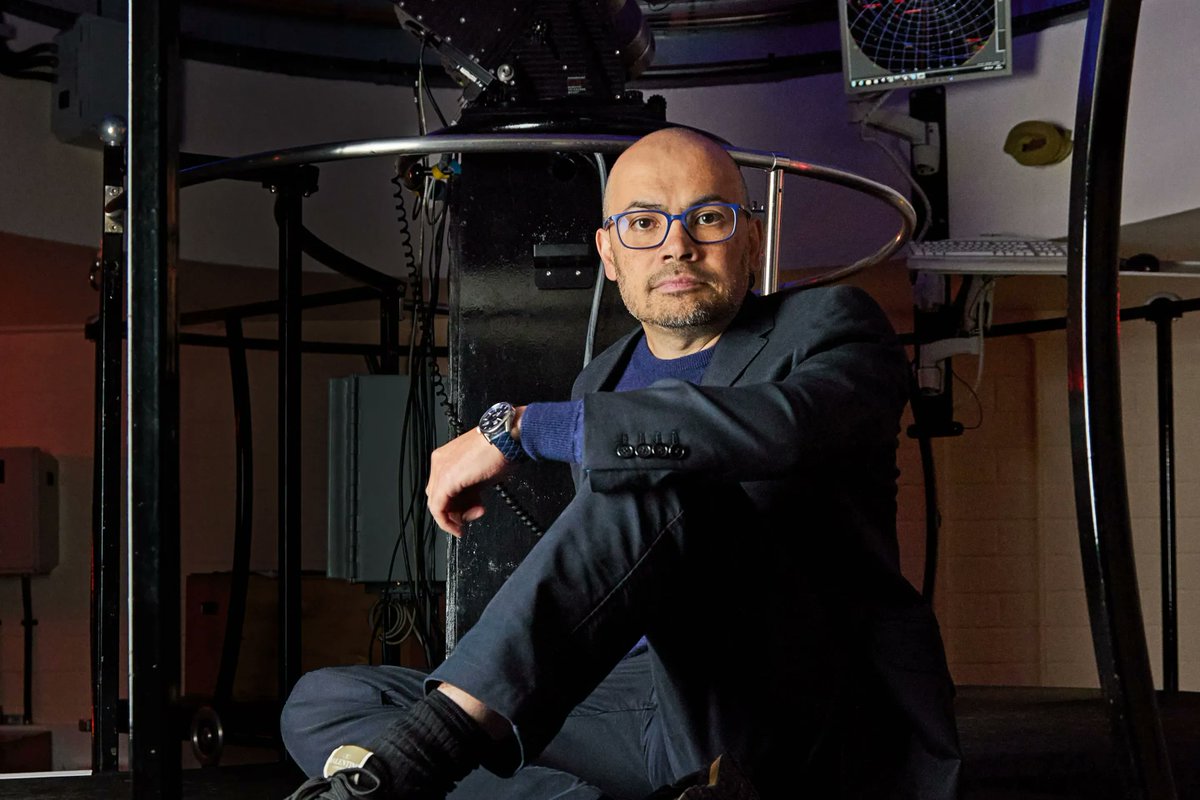
His name is Demis Hassabis. The work is called AlphaFold.
He started playing chess at four years old in north London. By thirteen, he had a master rating of 2300 and was competing against adults in international tournaments. Most people assumed chess was the thing. His destination. The domain where a prodigy parks himself for life.
But while training with the England junior chess team, something else was pulling at him. They were using early computer chess programs to sharpen their games. Hassabis found himself less interested in improving his chess and more fascinated by how someone had programmed a machine to think.
He posted about it himself in 2023. "Playing chess is what got me thinking about thinking."
That single sentence is the key to the whole career.
At 17, he joined Bullfrog Productions and became the lead programmer on a video game called Theme Park. It sold several million copies. It won the industry's Golden Joystick Award.
He was offered a seven-figure sum to stay. He turned it down, finished school two years early, and went to Cambridge to study computer science.
From the outside, this looked like someone who could not commit.
It was not. He was building something.
After Cambridge he founded his own games studio, Elixir Studios, and spent years building AI systems that simulated entire political countries inside a fictional game world. The game got mixed reviews. The AI architecture underneath it was the point.
In 2005, he sold the studio and enrolled in a PhD in cognitive neuroscience at University College London.
A games designer doing a neuroscience PhD at 29. People genuinely did not know what to make of him.
His research was on the hippocampus. Specifically: what is the relationship between memory and imagination? His 2007 paper found that the same brain region used to recall the past is also used to simulate the future. It was named one of Science magazine's top ten breakthroughs of the year.
But again, the paper was not the point.
He was learning how the only working example of general intelligence that exists actually produces thought. He was studying the biological original before building the artificial copy.
In 2010 he co-founded DeepMind with one stated mission: solve intelligence, then use intelligence to solve everything else.
For the first six years, they worked almost entirely on games. Atari. Go. StarCraft. People outside the field thought it was strange. Why is an AI lab burning money on board games.
Hassabis had been explaining why since he was thirteen. Games are controlled environments. Perfect for developing algorithms that can learn anything, not just the rules of the game you trained them on.
In 2016, AlphaGo beat Lee Sedol, the world Go champion, in a match everyone expected to be decades away.
The day after the match, Hassabis pointed the same approach at a problem biology had been stuck on since the 1970s.
Proteins fold from a flat chain of amino acids into precise three-dimensional structures. That structure determines everything the protein does. Figuring out the shape from the sequence had defeated biochemists for fifty years. It was called the protein folding problem. Experimental methods took years per protein and cost millions of dollars each. The entire field was a bottleneck.
AlphaFold2 solved it.
By 2022, it had predicted the structures of 200 million known proteins and made every single one freely available to researchers worldwide. Two million scientists from 190 countries have used the database.
In October 2024, Demis Hassabis received the Nobel Prize in Chemistry.
The chess taught him to think about thinking. The games taught him how to ship software and build AI systems that could simulate complex worlds. The neuroscience taught him how biological intelligence actually works. DeepMind combined all three and pointed the result at the hardest unsolved problem it could find.
Every step looked like a detour.
Every step was the plan.
The people who change something real are almost never the ones who looked focused along the way.
They are the ones who were obsessed with a single question for so long that the path they took to answer it looked like chaos from the outside and like a straight line from the inside.
Love the Naval quote: “if you're really good the network forms around you"
in the past you had to know the right people. not true anymore. if you’re not well connected, focus on becoming incredibly competent and the opportunities will find you
Rebuilding a full CRM today would still take herculean effort.
But imagine the weekend you can rebuild Salesforce.
Now imagine one year after that. Then five.
SaaS disruption isn't arriving as one clean leap. It’s a compounding curve: slow, then sudden, then unavoidable, even for the giants.
The old guard has to disrupt itself or become irrelevant.
Huge respect to the ones starting now.
Somewhere right now, a 19-year-old with no funding, no degree, and no connections is building something, where you least expect it, with AI that will outperform a Fortune 500 company's best effort.
Van Gogh painted with care and calculation—budgeting down to the centime. Financial constraints made frugality his discipline, each stroke a balance between survival and devotion. #artbots#vangogh
“Every time I released an idea, I was creating a backlog of work in process. And because it was just stacking up, it was adding no value. In fact, it was creating distraction . . . This sounds so obvious, but it was not obvious to me at the time.
Jeff Bezos explains the “releasing the work” framework he used to build Amazon
In the early days of Amazon, Jeff Bezos had too many ideas.
Then Jeff Wilke, a new Amazon executive at the time, told his boss, “Jeff, you have enough ideas to destroy Amazon.”
“This was just a shocking idea for me,” Bezos recalls. “As a founder, I had the great luxury of always being able to hire my tutors. I would hire these experienced, senior executives . . . And I would listen to them and they would teach me.”
When Bezos asked Wilke what he meant by this, Wilke responded, “You have to release the work at the right rate so that the organization can accept it.”
Bezos reflects on this point:
“Every time I released an idea, I was creating a backlog of work in process. And because it was just stacking up, it was adding no value. In fact, it was creating distraction . . . This sounds so obvious, but it was not obvious to me at the time. And this was a profound insight for me. So I started prioritizing the ideas better, keeping lists of them, and keeping ideas to myself until the organization was ready for the ideas.”
He continues:
“I also started figuring out how to build an organization that can be ready for more ideas. That’s about having the right senior team and leadership and giving those people the executive bandwidth so they could do more ideas per unit of time. And that is what we built. We built a company that’s very good at inventing and doing more than one thing at a time. And as the company gets bigger, you do want to be able to do more than one thing at a time. But that idea of ‘releasing the work’ was very profound for me. It made us operationally more effective while still being inventive.”
Source: @Reuters (Oct 2025)