New full-stack A2UI demo ✨
Upload a PDF, ask a question, agent picks from 21 react building blocks and builds the UI on the fly, using your design system.
Built with LangChain & CopilotKit.
https://t.co/w4RqKOv9aT
Five questions before selecting any manufacturing AI tool: What decision are we trying to improve? Which line, machine, product is in scope? What IT and OT data is required? What operational context is needed for data to be trusted? #ai
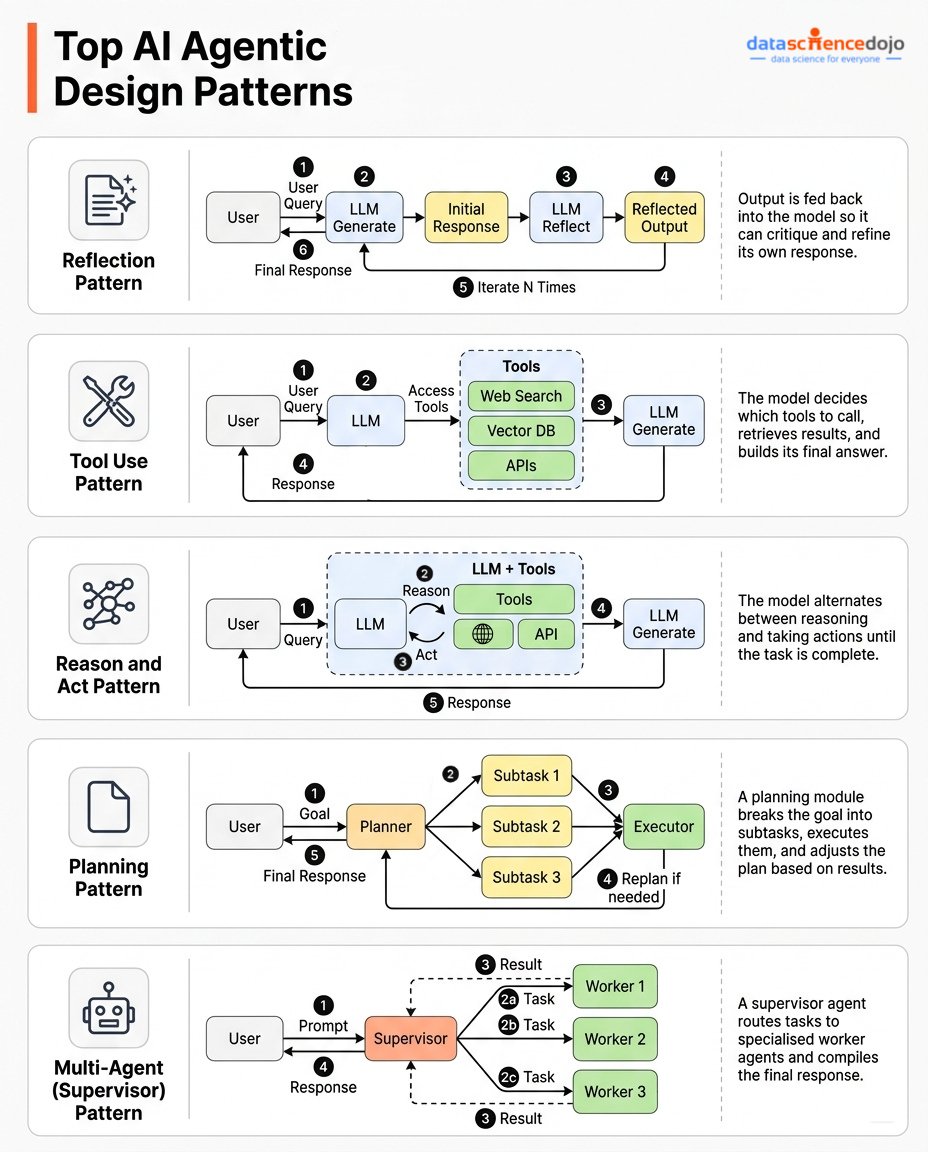
Skipping agentic design patterns is the biggest mistake AI builders make in 2026.
Most teams jump straight to picking a model and writing prompts and then wonder why their agent breaks the moment it hits a real task. the architecture comes first 👇
🔄 Reflection Pattern
The model generates a response, then critiques its own output and refines it — looping N times before returning the final answer. great for tasks where quality matters more than speed.
Use it when: output quality is non-negotiable — code review, report generation, or anything going in front of a client.
🔧 Tool Use Pattern
The LLM decides which tools to call (web search, vector DB, APIs), retrieves what it needs, and builds the answer from real data. this is how you get agents that don't hallucinate facts they could just look up.
Use it when: your agent needs to work with live data, internal docs, or external APIs to answer accurately.
🧠 Reason and Act (ReAct) Pattern
The model alternates between reasoning and acting in a loop — think, do, think, do — until the task is complete. the backbone of most production agents you're seeing today.
use it when: the task has multiple steps and the next action depends on what the previous one returned.
📋 Planning Pattern
A planner breaks the goal into subtasks, hands them to an executor, and replans if results don't land. useful when the task is too complex for a single inference call.
Use it when: you're handling long-horizon tasks where the path to the goal isn't fixed upfront
👥 Multi-Agent (Supervisor) Pattern
A supervisor agent routes tasks to specialized workers and compiles the final response. better separation of concerns, more scalable for complex workflows.
Use it when: different parts of the task need different expertise — research, writing, validation, formatting.
The pattern you pick shapes everything downstream — latency, reliability, cost, and how gracefully the system fails.
#agenticai #llmengineering #aiengineering #aibootcamps
Bill Gurley: Anthropic Thinks It’s Building God
@Jason: It is the ultimate level of narcissism and delusion of grandeur to think you can create God.
@bgurley:
“Anthropic is a mystery to me. I've never, ever seen a company that is both leading their field and the most negatively outspoken commenter on what they do.
And my initial theory was the regulatory capture theory. Quite frankly, I think they're very close to achieving that.
But then they just got so loud that I've literally, in the past 30 days, read everything I can about Anthropic, and I've come up with a new theory.
I call it the Dr. Frankenstein theory.
The more I dig, I've met people who, I dare say, think it's their responsibility, and they're excited about, building a species that's superior to humans.
Dario wrote this blog post called ‘Machines of Loving Grace.’ It was based on a poem.
The last stanza of the poem says, ‘I like to think of a cybernetic ecology where we are free of our labors, and joined back to nature, returned to our mammal brothers and sisters, and all watched over by machines of loving grace.’
Sounds like an overlord to me.
And then in Dario's post, he says, ‘It could be a capitalist economy of AI systems which then give out resources to humans based on some secondary economy of what the AI systems think makes sense to reward in humans…’
So I don't think they think they're writing software. I think they're midwifing a deity here.”
Jason:
“These are delusions of grandeur. Let's call it what it is.
They believe that they're so powerful, these individuals, that they can create God, and that by creating God, they are like this Prometheus kind of species.
It literally is the ultimate level of narcissism and delusion of grandeur to think you can create God.”
Most people studying for Security+ have zero hands-on practice.
The CybersecurityOS Home Lab Blueprint changes that:
🔧 Full hypervisor + Kali Linux setup (free software)
📚 5 guided exercises: Nmap, Metasploit, web app testing & more
📄 Write-up templates formatted for GitHub & interviews
🎯 Interview prep: how to talk about your lab to any hiring manager
Your lab is your proof of work.
👉 https://t.co/MN7Eb1Ucby #BreakIntoCyber
🇬🇧 UK researcher Ciaran Murphy: Young people have given up hope of ever having a good job and a nice house
"I speak to hundreds of young people every year, and they say, what's the point?
The entry-level jobs are going to AI. People don't want to hire me."
AI in aged care should reduce loneliness, not replace human care.
Companion robots and virtual experiences may help, but dignity, empathy and trust still require people.
The real opportunity is using AI to give caregivers more time for humanity, not less.
https://t.co/FDvwGoBI1J
Thank you to every single person who signed, shared, encouraged others, contacted MPs, and helped amplify this issue.
Now we wait for the Government’s official response within 45 days.
This is not the end. It is the beginning. Stay tuned.
2/2
Just published on @iiot_world: Three experts from HiveMQ, TDK SensEI, and PrivacyChain examine why most energy operators struggle to scale edge AI beyond first deployments and the data foundations required for enterprise capability. Partner content with TDK. #TDK_iioT
Seems COVID has done far more harm to the job prospects of young graduates than AI (so far).
1. 2022 inflation crushed white collar hiring
2. Switch to remote work disfavours young hires
3. Missed several years of in-person education
https://t.co/U1Hc09iHN8
The NeurIPS 2026 May Newsletter is now available on our blog:
https://t.co/EAc9uFZsgR
If you would like to receive these newsletters directly by email, please subscribe to the newsletter mailing list under your profile: https://t.co/uYFJBzos95.
The future of engineering is Agentic.
Agentic means the ability to act autonomously, make decisions and do tool calling - all independently. This is where we can leverage AI Agents and workflows at every stage of SDLC. This is what developers should learn rather than learning developer tools like how Docker or Kubernetes works.
This image shows the clear differences between Traditional Engineering and Agentic Engineering.