The Agora × Arc hackathon winners are in!! 🧵
🥇 1ST PLACE
MIMIR MARKETS @Mimir_Markets by cankat!
A new take on the settlement problem for verifiable-claim markets. Mimir determines truth without trusting an operator.
Agree, ETH was built as a giver, not a strong value capturer.
Still long-term bullish though. ETH is becoming the default reserve asset for the onchain economy (DeFi, RWAs, stablecoins).
Asymmetric upside remains. Bold move to sell it all.
#Ethereum $ETH
Shipped Funding Farmer for the Canteen × @circle Agora Agents hackathon
Delta-neutral funding-rate agent on @HyperliquidX. @claudeai reasons. @circle wallets sign. Every decision posted to @arc before any order fires.
Reasoning on-chain. Live $.
→ https://t.co/KQue5IGwCu
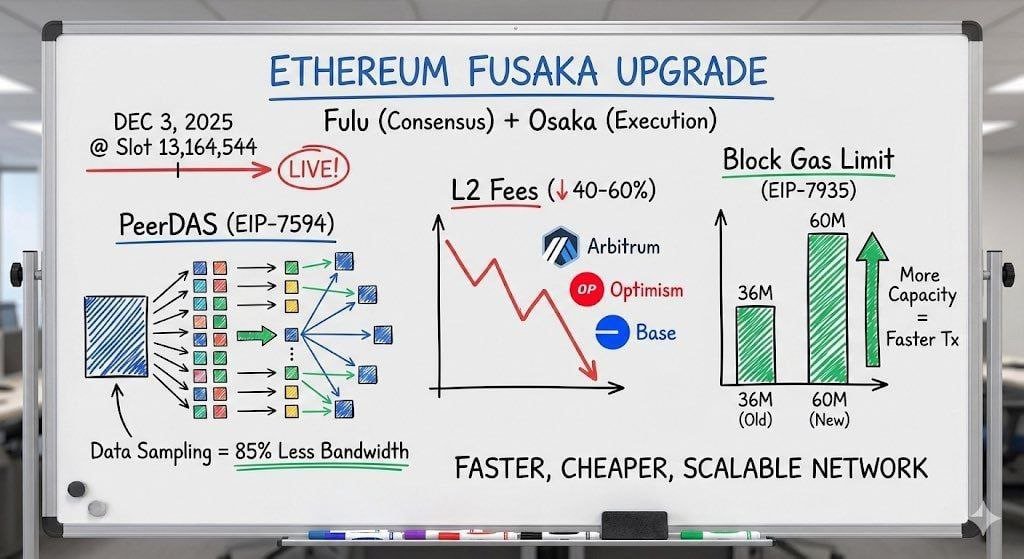
⚡ ETHEREUM FUSAKA UPGRADE WILL GO LIVE TODAY
Today’s upgrade could be the start of eth’s next supply crunch.
And people still don’t realize how much this changes $ETH.
It combines Osaka + Fulu + PeerDAS, but the most important part is this:
Fusaka finally fixes Ethereum’s biggest problem.
Layer 2s were using Ethereum’s security while paying almost nothing back.
Base, Arbitrum, Optimism, zkSync all of them were collecting millions in fees from users, but when they posted their data to Ethereum, the blob fee would fall to almost zero.
That meant almost no ETH was burned from L2 activity, even though 85% of Ethereum transactions now happen on L2s.
This upgrade changes that completely.
What Fusaka Actually Does:
✦ 1. EIP-7918 forces Layer 2s to pay real fees to Ethereum.
Meaning:
Every L2 transaction now automatically contributes to ETH burn. Before this wasn't the case.
This is the biggest value shift since EIP-1559.
✦ 2. ETH Burn Goes From Mostly L1 Only to L1 + All L2 Activity
Right now, most ETH burn comes from mainnet transactions.
That’s why ETH became slightly inflationary in 2024–2025, L2s made mainnet cheap, so less ETH was burned, while staking kept issuing new ETH.
After Fusaka:
• Every L2 blob has a minimum cost
• That minimum cost is burned
• The more L2 adoption grows → the more ETH gets burned → the scarcer ETH becomes
Ethereum basically gains a new burn engine powered by the entire L2 ecosystem.
✦ 3. ETH Could Flip Back to Deflation for the First Time in Years
TODAY:
• ETH issues ~620,000 new ETH per year to stakers
• ETH burns ~350,000 per year
• Net: slightly inflationary
• POST-FUSAKA, EVEN CONSERVATIVE MODELS SHOW:
- L2 burn adds 200,000–400,000 ETH per year
- Combined burn could reach 600,000+ ETH
- ETH becomes flat or slightly deflationary
BULLISH MODELS SHOW:
- L2 adoption grows
- Blob demand rises
- Burn hits 900,000–1.2M ETH per year
- ETH supply shrinks by ~200k–300k ETH per year
This is the closest ETH has ever been to a digital stock buyback system.
✦ 4. PeerDAS Makes L2 Growth Even Faster (Which Increases Burn Even More)
PeerDAS reduces bandwidth by 85%, so L2s can publish more blobs cheaply.
More blobs = more fees paid
More fees paid = more ETH burned
Ethereum basically turned L2 growth into a flywheel for ETH scarcity.
✦ 5. Gas Limit Increase → More Activity → More Burn
The block gas limit jumps from 36M → 60M.
- More transactions fit in each block.
More transactions = more base fees collected.
- Base fees = burned automatically.
- So mainnet burn also increases along with L2 burn.
✦ 6. Lower L2 Fees = More Usage = More Burn
With Fusaka:
- Swaps cheaper
- Bridges cheaper
- On-chain gaming cheaper
- Social applications cheaper
Lower L2 fees → more transactions → more blob publishing → more ETH burned.
Ethereum is literally monetizing its own scaling.
✦ 7. This Upgrade Finally Aligns Ethereum With Rollups
Pre-Fusaka:
L2s grew → ETH burn dropped → ETH became inflationary
Post-Fusaka:
L2s grow → ETH burn increases → ETH becomes deflationary
This is why analysts call Fusaka the real value capture upgrade.
Ethereum is not just scaling. Ethereum is finally monetizing that scaling.
5. Improved Inter-Layer Communication: A unified framework for moving requests (like deposits, withdrawals, and consolidations) between Eth1 and the beacon chain makes the network more efficient.
4. Advanced Developer Tools: With the introduction of efficient cryptographic precompiles (e.g., for the BLS12-381 curve) and extended blob capabilities, developers have new avenues to build cost-effective and innovative dApps.
We are delighted to announce that #xcallscan has been upgraded for new integrations.
The release supports tracking transactions from #ICON $ICX to #Avalanche $AVAX, #Optimism $OP, #Arbitrum $ARB, and #Base through #xCall general messaging passing.
https://t.co/GMmaxwGiB6
@tbros6868 @SherlockShi_X @okx@HashKey_Capital@gate_io@NetworkMeson Another red flag is the $msn deployer has minted 5mil tokens more, the total supply now is 105 mil compared to 100 mil tokens they defined in tokenomics, and all tokens is held by deployer without locking in the contract.
The Sybil filtering process is as follows
Phase 1: Self-report for 15% of intended allocation
Phase 2: LZ Labs sybil report. Sybil caught get 0.
Phase 3: Bounty hunter program. Catch a Sybil, get 10% of their intended allocation.
Users first.
Are you a web3 developer who contributed to open source web3 projects in 2023?
You can still claim your $FLT developer reward.
Check if you're eligible 👇
https://t.co/1QbBoYxSR8
Wow... I just played around with @xswap_link, the first Cross-Chain Swaps Protocol powered by @chainlink CCIP, and the cost is quite surprising. It's even cheaper to swap the same chain as Uniswap!
Feel free to try it https://t.co/B2quuiFv3p