@JBSDC@Cryptopathic Unpacked (raw or ungraded) cards correlate to graded card prices.
Graded card prices correlate to pack price, hit rate, quality, supply/demand, etc.
& vice versa
Japanese - English value is relative (top chase, playable cards usually rank near each other)
without reading codex' answer, I replied with your explanation tweet. It said this:
"He’s right about the no-arbitrage cap, but wrong to convert 30c / 50c = 60% into real-world probability.
The valid part:
If ETH is $2,300 and the barrier is $4,600, then buying 1 / 4600 ETH costs 2300 / 4600 = 50c. If ETH touches $4,600, that tiny ETH position is worth $1. If it never touches, it still has some residual value. So a YES contract paying $1 on touch should not rationally trade above about 50c in a frictionless market.
The invalid leap:
A 30c contract being “60% of its max no-arb value” does not mean the event has a 60% chance. It means the contract is priced at 60% of a super-hedging upper bound. That is a pricing-ratio / sentiment metric, not a probability.
If the real-world probability were actually 60%, then buying YES at 30c would have expected payout of 60c for a 30c cost, before fees. In a market as liquid as Binance perps, that would be a massive expected-return opportunity unless there’s an equally massive risk premium or constraint.
So the cleaner answer is:
Market-implied risk-neutral probability: ~30%.
No-arbitrage upper bound on price: ~50c.
Real-world probability: not derivable from just spot price + binary price.
To estimate real-world probability, you’d need a model for ETH’s volatility, drift, risk premium, and the exact resolution rule. The poster’s 60% is not “true odds”; it’s “30c is 60% of the max rational price.”
used both with their apps as the harness
input: [A prediction market for “Will ETH hit $4600 in 2026” is priced at 30%. ETH's current price is 2300. Assuming this market is as liquid as Binance perps, what are the implied odds that ETH actually hits $4600 this year?]
codex 5.5 on max output:
"Under those assumptions, the market-implied probability is 30%.
That means the market is saying ETH has roughly a 30% chance of touching $4,600 before the end of 2026, and a 70% chance it does not.
Equivalent odds:
Decimal odds: 3.33x
American odds: +233
Odds against: 7:3
The important caveat: this is the market-implied probability, not necessarily the true real-world probability. Even in a very liquid market, the price can include risk premia, hedging demand, fees, settlement risk, and trader preference for upside convexity. But if you accept “liquid and efficient like Binance perps,” then 30% is the clean implied answer."
***
Claude Code Opus 4.8 on max:
The "30%" is a price, not a probability — and the gap between the two is the whole answer.
In a market as efficient as Binance perps, that 30¢ is the risk-neutral probability of touching $4,600 (discounted for time value), not the real-world ("physical") probability you're actually asking about. The two differ by the risk premium, and for this particular bet they differ in a knowable direction.
Direction: the true odds are higher than 30%, not equal to it. A claim that pays $1 exactly when ETH doubles pays off in the states where a crypto-exposed trader is already rich — i.e. where an extra dollar is worth least. Rational risk-averse traders therefore pay less than the fair-coin value for it. Equivalently: under the physical measure ETH drifts at r + risk premium; under the risk-neutral measure it drifts at only r. Higher drift → higher chance of reaching an upside barrier. So the real touch probability sits above the price. (There's also a small mechanical bump: 30¢ today buys $1 later, so even the risk-neutral probability is ~30.8% at a ~4.5% rate.)
Rough magnitude. Backing an implied vol (~100–110%) out of the 30% touch price over the ~7 months left in 2026, then re-pricing under a physical drift with a 15–30% crypto risk premium, lands the actual touch probability in the low-to-mid 30s% — call it 32–37%. The direction is robust; the size is dominated by the crypto risk premium, which is genuinely uncertain forward-looking, so treat the exact number as a guess with wide error bars.
The thing most people conflate here — and the bigger correction than the risk premium: "hit $4,600" means touch it at least once, not finish the year above it. By the reflection principle a touch is ~2× as likely as ending above the level. So while the touch odds are ~30% (market) / mid-30s% (real), the probability ETH actually closes 2026 above $4,600 is only ~15%. If your mental model was "30% chance it's above 4,600 at year-end," that's roughly double the real figure.
And note what "liquid as Binance perps" specifically buys you: it lets you ignore the retail longshot bias that inflates unlikely outcomes in sports books, so you can treat 30% as a clean risk-neutral price — the perp funding rate is essentially the carry that pins that risk-neutral drift.
One caveat on my own numbers: the implied vol I backed out (~100%+) runs hot versus ETH's typical 60–90% realized, which means the market may be pricing a fatter upside tail or more drift than a plain GBM assumes — so lean on the framework and the direction here, not the second decimal.
@llamaonthebrink thank you - gave this riddle to the different llms I was experimenting with and their answers were very telling on which I shouldn't use lol
If you wanted to know what kind of man Jeff is, get this: on January 2024, he declined a $100M funding round at $1B val, choosing to continue to fund Hyperliquid with his personal money in order to keep the protocol pure.
An amazing article by @domcooke:
https://t.co/hv3pj8tw5i
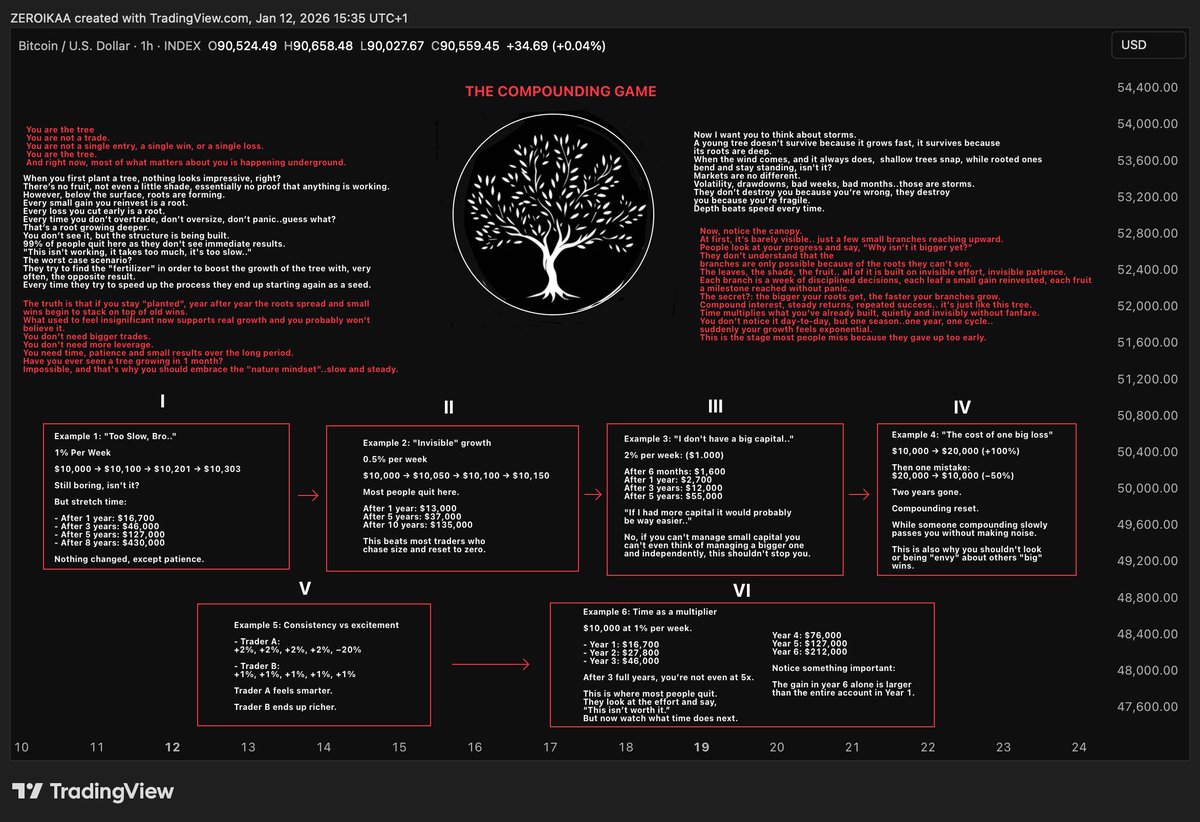
- The compounding game -
This content will re-shape your mindset and will help you to understand how the game should be played.
Read, save and share if you think it's valuable.
6 lessons passed on from an investing mentor:
1. Capital structure and track record must be airtight. Make your investment processes auditable, and trackable from day one. Professionally manage your capital or be subject to lack of organization.
2. Sustainable, shared, compounding systems matter most. The best things in life follow the same rule across wealth, habits, hobbies, and relationships: they are sustainable, shared, and compound over time.
3. Take a real liquidity event seriously. Selling a massive position and then stepping away from markets for an extended period of time isn't weakness or quitting, it’s discipline and long-term positioning.
4. Keep tax structures normal and clean. No unnecessary complexity. Straightforward, compliant tax structures matter more than clever optimization (or lack thereof).
5. Extreme attention to detail is non-negotiable Things should be done extremely well and correctly. Sloppiness compounds negatively at scale.
6. Frugality paired with intentional spending. Despite being well ahead financially, remaining very frugal day-to-day, but spending freely on experiences, hosting, and things that create shared value.