@niccruzpatane just a diff bottle for the same Suv they are selling, with new label n market it as robotaxi, soon, more brand fr china will do the same, whether they hv any"Dar" on it.
@HomerPavlos Oops.. maybe Nolan should re shoot Dunkirk.. or anyone remake a oscar winning Dunkirk ? I can't imagine if Steven Spielberg redo the Band of Brothers for Oscar..😂
few pointers to consider
1. It can charge in 8 minutes but only using very specific supercharger which is not widely available, majority (over 99.9%) of charger in china can't charge at that speed. so u hv a car that cannot charge at that speed.
2. the consequences to the battery life span
3. Tesla have the tech and the same charger long before any china car builder have it, it was use only on Tesla Semi.
4.
5.
6
u can just google out the above and fill it up.. at least 3 more points u don't really need that..
Your brain physically rewrites itself every time you pick up a pen.
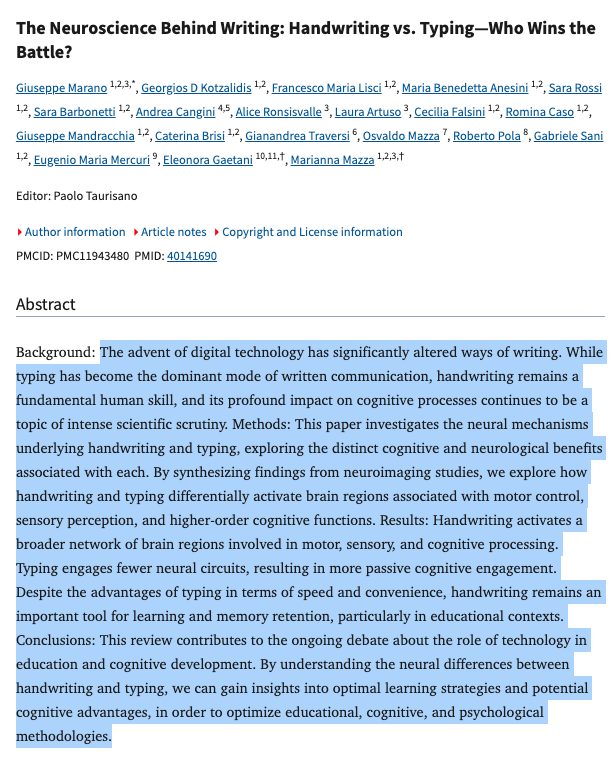
Neuroscientists at Norwegian University scanned students' brains while they handwrote letters versus typing the same letters on a keyboard.
The results shattered decades of assumptions about how we process information.
Handwriting activated massive networks in the sensorimotor cortex, the visual processing centers, and the hippocampus simultaneously. Complex neural symphonies lit up across multiple brain regions, creating rich interconnected pathways between motor control, visual recognition, and memory formation.
Typing the same letters? The brain activity looked like someone had dimmed the lights across entire cognitive districts. The neural networks that flourished during handwriting simply went dark.
The difference?
When you form letters by hand, your brain constructs elaborate spatial maps of each character. The motor cortex learns the precise pressure, angle, and trajectory needed to create an 'A' versus a 'B.' Your visual system tracks the ink flowing from pen to paper in real time. Your parietal lobe integrates hand position with eye movement. Your hippocampus encodes not just what you wrote, but how the writing felt, where you paused, which words required more pressure.
Typing activates almost none of that circuitry. You press a key, a letter appears. The motor movement is binary. The visual feedback is uniform. The spatial relationship between thought and symbol gets mediated by a machine that standardizes every character into identical fonts and spacing.
Your brain treats these as fundamentally different cognitive tasks.
The evolutionary context makes this obvious once you see it. Human hands developed for manipulation, creation, and fine motor control over millions of years. We painted on cave walls, carved bone tools, and shaped clay vessels long before we invented written language. When writing emerged 5,000 years ago, it built on top of existing neural infrastructure that already connected hand movement with symbolic thinking.
Keyboards appeared 150 years ago. Touchscreen typing maybe 20 years ago. From an evolutionary timeline perspective, we started using them approximately yesterday. Our brains are still running ancient software that expects physical engagement with symbols.
That software produces dramatically different learning outcomes.
Students who take handwritten notes consistently outperform students who type the same information on memory tests, comprehension assessments, and creative applications of the material. The difference persists even when researchers account for typing speed, note length, and time spent studying.
The act of forming letters by hand forces deeper processing at the moment of information encounter. You cannot handwrite as fast as someone speaks, so your brain must actively filter, summarize, and prioritize information in real time. The motor effort required to form each word creates additional memory traces that typing does not generate.
Children who learn to write letters by hand develop reading skills faster than children who learn letters primarily through typing or screen interaction. The sensorimotor experience of creating letterforms helps their brains recognize those same letterforms when they encounter them in text.
Adults who handwrite shopping lists, daily schedules, or meeting notes remember the information better than adults who type identical lists into phones or computers. The spatial memory of where you wrote something on a page provides retrieval cues that digital text does not offer.
These findings collide directly with how education and work environments have evolved over the past two decades. Schools replaced handwriting instruction with typing classes. Offices converted from paper systems to fully digital workflows. Students take notes on laptops. Professionals draft documents on screens.
We optimized for speed and efficiency while accidentally severing the neural pathways that evolution spent millions of years developing.
The implications reach beyond memory and learning into fundamental questions about human cognition. If the physical act of forming symbols changes how your brain processes ideas, what happens to thinking itself when you remove the physical component?
Digital text is infinitely searchable, instantly editable, and perfectly shareable. But it may be creating brains that process information more superficially, store memories less durably, and connect ideas more weakly than brains that regularly engage in handwriting.
The neuroscience suggests we traded cognitive depth for technological convenience without realizing what we were giving up.
Some of the most innovative thinkers across history were obsessive handwriters. Darwin kept detailed handwritten journals. Einstein worked through complex theories in handwritten notebooks. Virginia Woolf wrote her novels by hand before transcribing them. Steve Jobs famously took handwritten notes during Apple meetings even as he was building the most advanced computers on Earth.
Perhaps they intuited something about the relationship between hand, brain, and insight that we measured in brain scanners but somehow forgot in practice.
Your pen is literally a cognitive enhancement device that activates neural networks digital keyboards cannot reach.
"Escribir es pensar". Escribir nos obliga a pensar, no de forma caótica y desordenada, sino de manera estructurada e intencionada. Artículo de Nature que señala que es una herramienta para descubrir nuevas ideas https://t.co/N8o8zVvsnE
Ya, sometimes u just don't understand how this ridiculous classification came from. When u get someone from ancient society to make a rules or regulation, u get rules good for a horse, as they never see cars before.. a simple test would be to take out the paddle and steering, see which one can drive..then decide..😂🤣
🚨BREAKING: Anthropic just published a study mapping exactly which jobs its own AI is replacing right now.
The workers most at risk are not who anyone expected. They are older. They are more educated. They earn 47% more than average. And they are nearly four times more likely to hold a graduate degree than the workers AI is not touching.
The argument is straightforward. Anthropic built a new metric called "observed exposure." Not what AI could theoretically do. What it is actually doing right now in professional settings, measured against millions of real Claude conversations from enterprise users.
For computer and math workers, AI is theoretically capable of handling 94% of their tasks. It is currently handling 33% of them. For office and administrative roles, theoretical capability is 90%. Current observed usage is 40%. The gap between what AI can do and what it is already doing is enormous. The researchers are explicit about what comes next. As capabilities improve and adoption deepens, the red area grows to fill the blue.
The demographic finding is what makes the paper uncomfortable. The most AI-exposed workers earn 47% more on average than the least exposed group. They are more likely to be female. They are more likely to be college educated. This is not a story about warehouse workers or truck drivers. It is a story about lawyers, financial analysts, market researchers, and software developers. The exact group whose education was supposed to insulate them.
Computer programmers showed the highest observed AI exposure at 74.5%. Customer service representatives at 70.1%. Data entry keyers at 67.1%. Medical record specialists at 66.7%. Market research analysts and marketing specialists at 64.8%. These are not predictions. These are measurements of work that is already happening on AI platforms right now.
Then there is the pipeline finding nobody is talking about loudly enough.
Anthropic's researchers found a 14% decline in the job-finding rate for workers aged 22 to 25 in highly exposed occupations since ChatGPT launched. No comparable effect for workers over 25. Entry-level roles were never just jobs. They were the training ground where junior analysts became senior analysts, where junior lawyers learned how arguments hold together. If that layer disappears, nobody has answered the question of where the next generation of senior professionals comes from.
The detail buried in the paper that most coverage missed: 30% of American workers have zero AI exposure at all. Cooks. Mechanics. Bartenders. Dishwashers. The technology reshaping professional careers is completely irrelevant to roughly a third of the workforce. The divide is no longer between high skill and low skill. It is between presence and absence.
The company publishing this study is the same company selling the AI doing the replacing. Anthropic had every commercial incentive to soften these findings. They published them anyway.
If you spent four years and $200,000 on a degree to land a white collar career, the company that builds Claude just confirmed your job is more exposed than the bartender pouring drinks at your graduation party.
Source: Anthropic, "Labor market impacts of AI: A new measure and early evidence"
PDF: https://t.co/taYgsIfiTj
@AllForProgress_ In Singapore, the best mind of the country go into cabinet, In UK, i am not familiar, maybe the best Speaker /Sales Person or Debater go to the cabinet.
Three years since the first flight of Starship, the next generation is here. New ship. New booster. New engines. New pad and new test site. SpaceX engineers are working to solve one of the most difficult engineering challenges in history: developing a fully, rapidly reusable rocket
@samarknowsit@VivianBala@Gavriel_Cohen@karpathy I think is even more dangerous if you don't know how to use it.. at least with the help of AI, there's no self interest involve and it rarely lie, unless the fact provided is wrong. If u are surrounded with human being giving u intel.."human being" is a very dangerous being..😂
Bacteria move around using a molecular machine called the flagellar motor that rotates faster than the flywheel of a race car engine and switches directions in an instant. After 50 yrs, scientists have finally figured out how it works. “My lifelong quest is now fulfilled.” Link⤵️
@SawyerMerritt@Tesla Tesla no updated model ? Yes it's coming end of year. The unboxed Tesla Cybercar for GenZ / Mom and Granny go to market car 😂/ those can't afford model 3/y car 🫰.. Cybercar will overtake the Model Y and Along the way... trash the rest of the car. 💪
BREAKING 🚨 TESLA HAS FINALLY SOLVED THE HARDEST PROBLEM IN ROBOTICS: UNVEILING THE 25-MOTOR ECOSYSTEM BEHIND THE 22-DOF OPTIMUS HAND 🖐️
Nature spent millions of years perfecting the human hand. Recreating it is widely considered the hardest problem in robotics, but Tesla engineers decided to tackle it in just a few years. They quickly ran into a massive physics problem. If you put all the motors needed for true human dexterity directly inside a robotic palm, the hand becomes a heavy, unusable club.
To give Optimus a revolutionary 22 degree of freedom hand, one that can delicately crack an egg while still having the grip strength to swing a sledgehammer, Tesla had to rethink robotic anatomy from the ground up.
They did this by turning the robot forearm into a high density engine room, housing a 25 motor ecosystem that allows the hand itself to remain incredibly light and nimble like a biological puppet. We finally have a clear look at how they pulled off this packaging miracle.
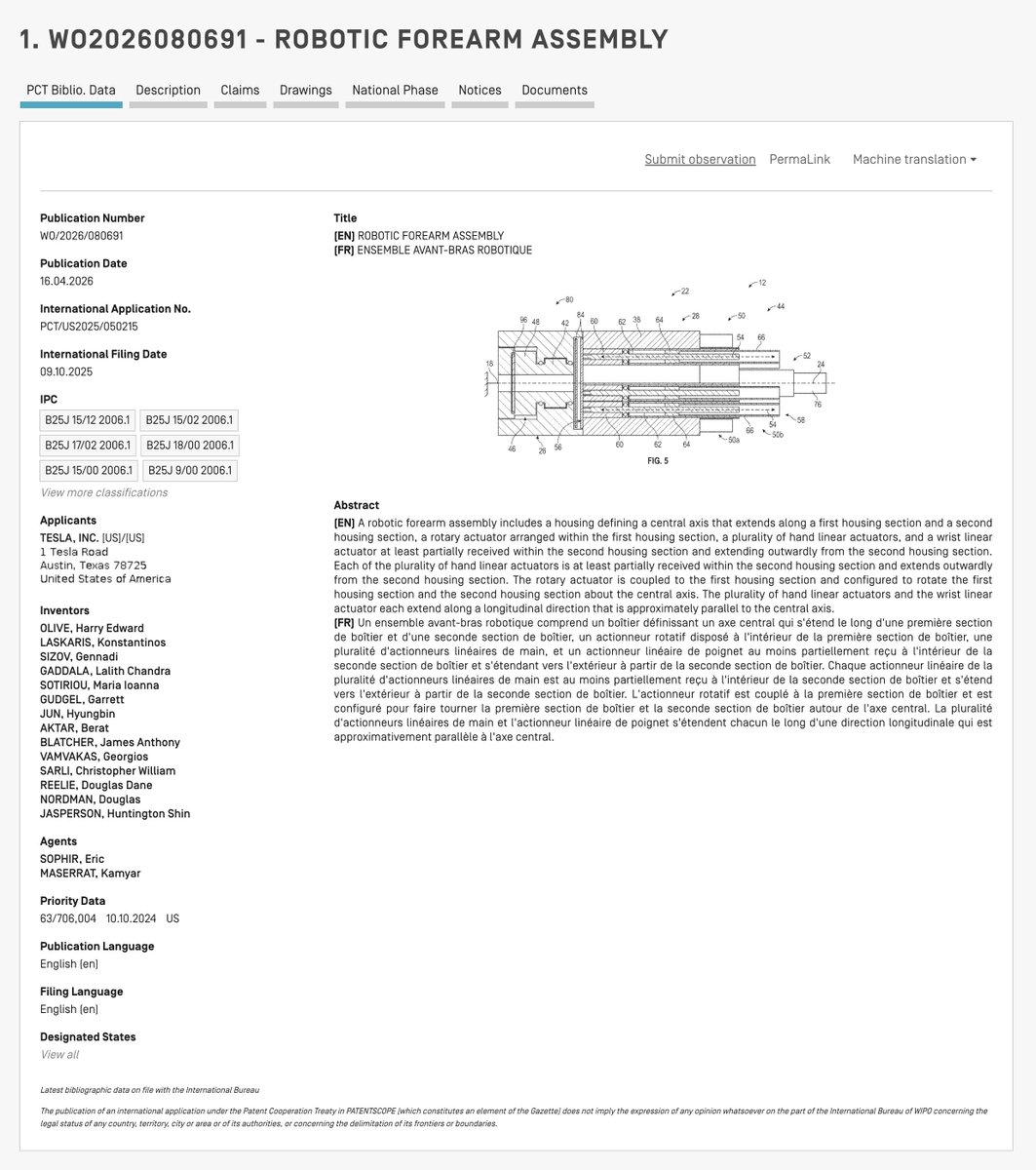
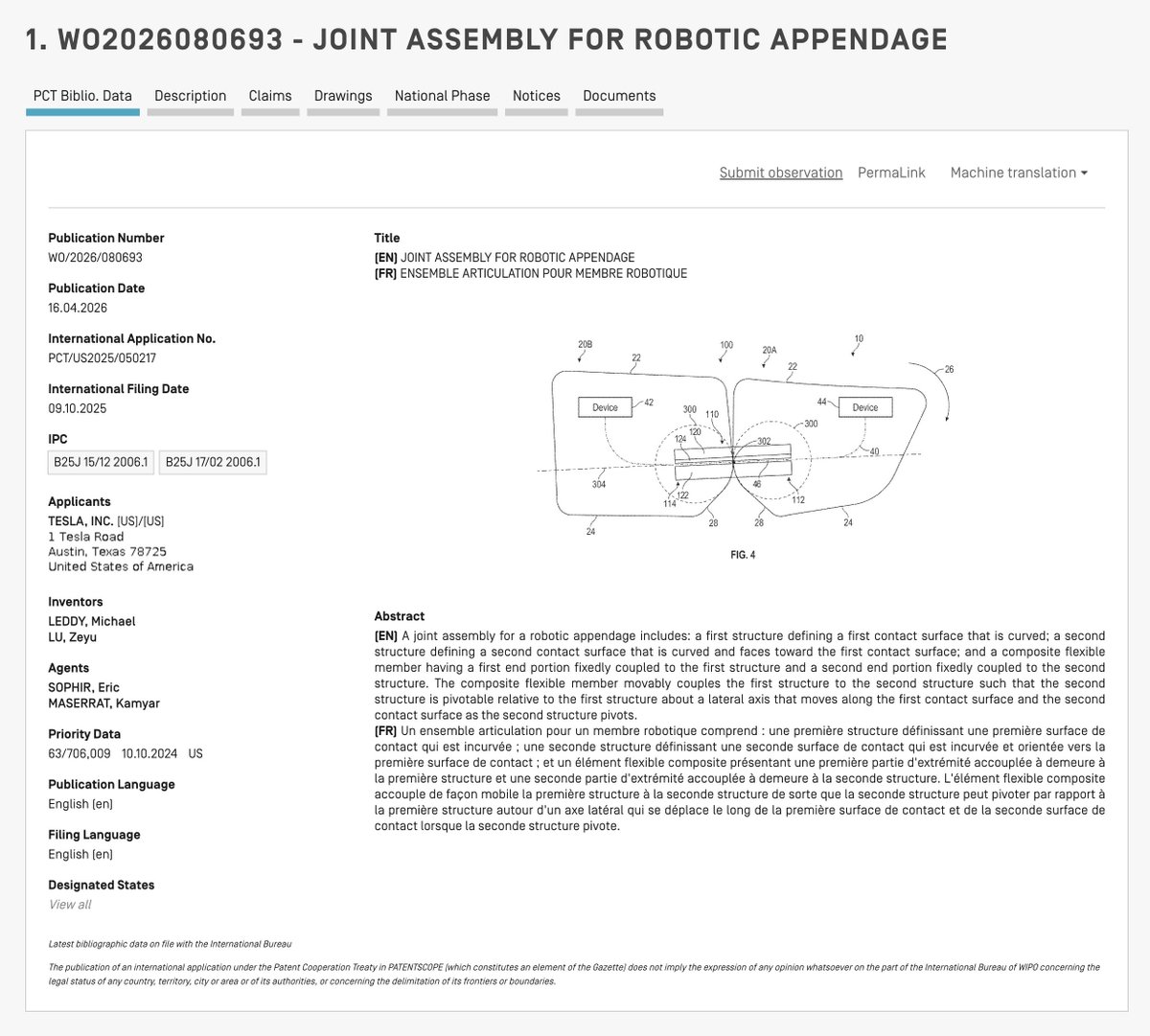
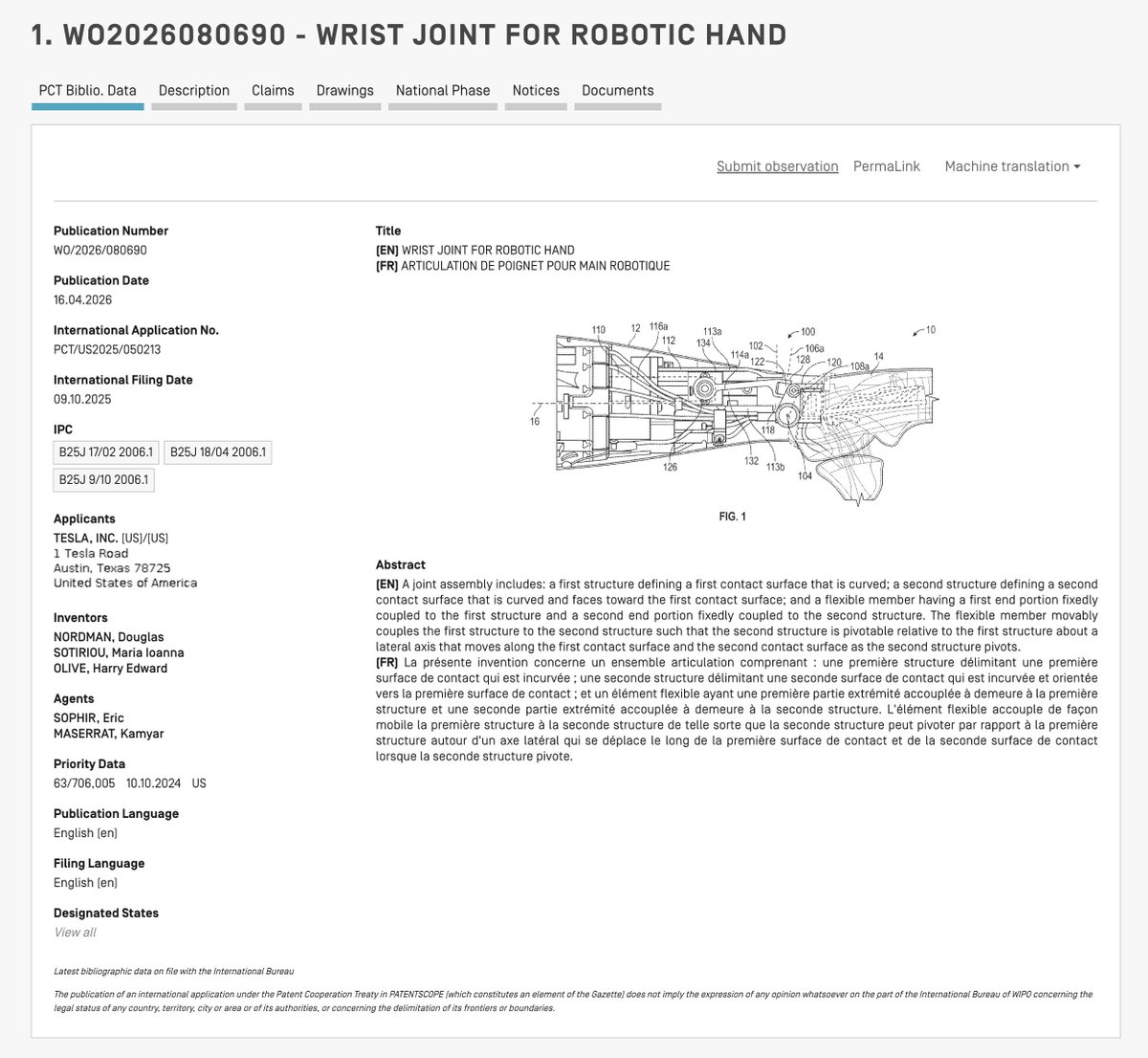
A newly published quartet of patents from April 16, 2026, rips the synthetic skin off the Optimus arm to reveal the integrated mechanics inside. Tucked within filings WO 2026/080690, WO 2026/080691, WO 2026/080693, and WO 2026/080701 are the secrets to the staggering motor array, a hollowed out wrist joint, and flexible artificial ligaments that prove Tesla has successfully translated human biology into a mass manufacturable machine.
To understand how they pulled this off, we have to look at the big picture.
⚖️ The problem: Packaging complex actuation into a human sized arm
Building a robotic hand with human level dexterity requires dozens of actuators and a massive network of control cables. The core problem is that putting motors directly inside the hand makes it far too heavy and bulky to perform normal human tasks.
Moving all those motors into the forearm solves the weight issue but creates a domino effect of new engineering nightmares. You have to figure out how to fit dozens of motors into a small cylinder, how to route all their cables through a moving wrist joint without pinching them, and how to build fingers that can handle the tension without snapping.
💡 Tesla's solution: An integrated biomechanical ecosystem
Tesla solved this by treating the entire lower arm as a single interconnected biomechanical system. Rather than designing the hand, wrist, and forearm in isolation, these four patents show a unified architecture where every component is specifically designed to support the others.
The best place to see this unified design in action is right at the fingertips. Before you can pull a finger, you have to build a joint that will not break under pressure.
1⃣ Patent 080693: Solving the problem of fragile robotic joints
The problem here is that traditional robotic pin joints are rigid and snap easily under impact. Furthermore, routing electrical wires through moving joints causes the wires to bend and eventually break from metal fatigue.
The solution is an artificial ligament system that mimics human anatomy. Tesla created composite flexible members using elastomeric layers, which are essentially high tech rubber pads, that sandwich a high strength core.
The patents specify using materials like liquid crystal polymer fabrics, such as Vectran, or superelastic metals like Nitinol. Nitinol is a unique metal alloy that can bend drastically and snap back to its original shape without taking damage.
These materials achieve tensile strengths over 895 megapascals. This means a thin strip could withstand a massive pulling force equivalent to holding the weight of several cars. These ligaments allow the finger bones to roll smoothly against each other while preventing them from twisting or pulling apart.
The artificial ligaments are not a one size fits all solution. The patent specifies that these flexible members get physically thicker the closer they are to the palm. Because the base of the finger experiences exponentially more force than the fingertip, the base ligaments are beefed up to prevent tearing.
Furthermore, extreme versions of these joints do not just use three layers. They use a massive seven layer sandwich of alternating rubber and metal to guarantee they never snap under heavy loads.
To protect the internal wiring, Tesla routed the electrical harness straight through the neutral bending plane of the ligament. If you bend a thick paperback book, the pages on the outside stretch and the pages on the inside bunch up, but the exact middle layer experiences zero change in length.
By embedding the data cables right in this neutral zone, the wires experience zero stretching or compressing during movement.
Furthermore, the outer elastomeric layers are tuned to a specific hardness under Shore 60A. This is a measurement of rubbery stiffness roughly equivalent to a sturdy shoe sole. This specific density allows the rubber to act as passive springs that naturally bias the fingers back to an open, extended position when tension is released.
Having designed an indestructible finger joint, the engineers had to connect these fingers to a power source. This led them straight to the next major bottleneck, which was the wrist.
2⃣ Patent 080690: Solving the problem of crowded wrist pathways
The problem with moving all the finger motors to the forearm is that you now have over twenty cables that need to cross the wrist joint into the hand. Traditional robotic wrists use central pivots or dense gearboxes that completely block this pathway.
The solution is a brilliantly engineered cantilevered wrist joint. Tesla built a universal joint that hangs from the top and bottom of the forearm bracket in a cantilevered arrangement. This means it is supported entirely at the outer edges, much like a diving board or a balcony projecting from a building.
By using two dedicated linear actuators guided by precision sliders on a central track, they created a massive hollow void right down the center.
To save even more space, the connecting links use uniquely curved shapes. These metal links act like boomerangs. They intentionally bow sharply outward away from the center of the arm, and then swoop drastically back inward to attach to the hand.
This highly specific geometric curve is what allows the wrist to bend to extreme human angles without the metal links colliding with the central forearm bracket.
They even carved a specific notch directly into the hand structure. This allows the metal forearm bracket to recess into the palm so the wrist can bend further backward. This layout guarantees the dense bundle of finger tendons can pass safely into the palm no matter how the wrist moves.
With a safe, hollow highway established through the wrist, the team could finally focus on the powerhouse of the arm. They had to figure out where the actual pulling force was going to come from.
3⃣ Patent 080691: Solving the problem of actuator density
The problem is the sheer lack of physical space. To get twenty two degrees of freedom in the hand plus wrist movement, you need a massive number of motors. In robotics, a degree of freedom simply means an independent direction a joint can move. A human sized forearm is simply too small to house traditional robotic actuator setups without severe overheating and magnetic interference.
The solution is an extreme high density cylindrical packaging layout. Tesla split the forearm housing into sections, placing a rotary motor for wrist roll in the back to twist the wrist like turning a doorknob.
In the front section, they packed exactly twenty five linear actuators. Unlike standard motors that just spin in a circle, linear actuators push and pull in a straight line like pistons. Twenty three of these are tiny twelve millimeter motors for the fingers, and two are twenty millimeter motors for the wrist.
They placed these actuators in a staggered, circumferential pattern, forming a tight circle parallel to the arm bone. By nesting them in inner and outer rings, Tesla maximized space efficiency while allowing enough airflow for cooling.
They solved the cable tangling issue with an axially staggered layout. Much like the pipes on a church organ, the twenty five linear actuators terminate at completely different lengths. By staggering exactly where each motor ends, Tesla ensured the physical cable attachment points do not crowd each other in the tight cylindrical space.
They even packed the printed circuit boards and inverters internally. This makes the forearm a completely standalone, plug and play unit that only requires external power.
The muscles were successfully packed in the forearm, the highway through the wrist was clear, and the finger bones were ready to move. The final piece of the engineering puzzle was connecting it all together into a working puppet.
4⃣ Patent 080701: Solving the problem of complex finger control
The problem is figuring out how to translate the pulling force from the forearm motors into delicate, independent movements for each finger phalanx, which is the technical term for the individual bone segments in a finger. Attempting to do this without filling the hand with bulky mechanical linkages is incredibly difficult.
The solution is a highly refined tendon driven network controlling twenty five distinct degrees of freedom. Tensile members run from the forearm, through the hollow wrist, and anchor to specific finger bones.
While a thumb that swings inward is standard, the Optimus hand features a fully opposable pinky with its own dedicated opposition joint and motor. This allows the entire hand to dynamically cup inward, which is essential for gripping spherical objects like baseballs or doorknobs.
Tesla uses active pull for flexion, meaning the motors tug the cables to close the fingers or squeeze them together. Additionally, while closing a finger uses one cable and opening it uses a passive spring, spreading the fingers side to side requires active control. Tesla solved this by using two opposing cables per finger, allowing them to splay outward with absolute precision.
To prevent over extension, they built physical hyperextension hard stops directly into the artificial bones. These act like door hinges that physically block the finger from bending too far backward and snapping.
Finally, to give the hand a sense of touch, Tesla embedded tactile and position sensors throughout the phalanges. They routed their delicate cables safely alongside the flexing axes to prevent strain.
These four systems do not just work in isolation. They form a complete loop of motion that brings the robot to life.
🚀 How this patent suite contributes to Tesla's Optimus program
Individually, each of these patents represents a clever mechanical workaround. Together, they form the exact engineering blueprint for the highly anticipated Optimus V3.
Right now, this integrated tendon driven architecture is the secret behind Optimus V3 making a massive leap to a 22 degree of freedom hand. This effectively doubles the 11 degrees of freedom seen in the Gen 2 prototypes. By routing the cables efficiently through the wrist's neutral axis, they avoid twitchy cable crosstalk, ensuring that pulling one tendon does not accidentally tug on a neighbor. This exact hardware allows V3 to execute over 3,000 discrete tasks, seamlessly transitioning from delicate household chores, like folding laundry or handling eggs, to heavy industrial assembly using Tesla's advanced AI5 chips.
Looking to the future, this unified design is the cornerstone of Tesla's ultimate goal for Optimus V4, V5, and beyond: unprecedented mass production. Actuators and sensors dominate the build cost of any humanoid. By removing fragile, expensive gearboxes from the hand itself and relying on centralized forearm linear actuators with passive spring returns, Tesla has engineered a system that minimizes part counts and is vastly cheaper to assemble.
As Tesla pushes to scale production at their Fremont factory, their eyes are set on a long term target of a $20,000 build cost and a million units per year. Future iterations like V4 and V5 will likely lean even harder into this integrated tendon approach, further optimizing the artificial ligaments and reducing supply chain complexity.
This patent suite proves they are not just building a cool lab prototype. They are building an economic weapon, a mass manufacturable robotic worker designed to fundamentally replace human physical labor and completely redefine Tesla's future beyond cars.