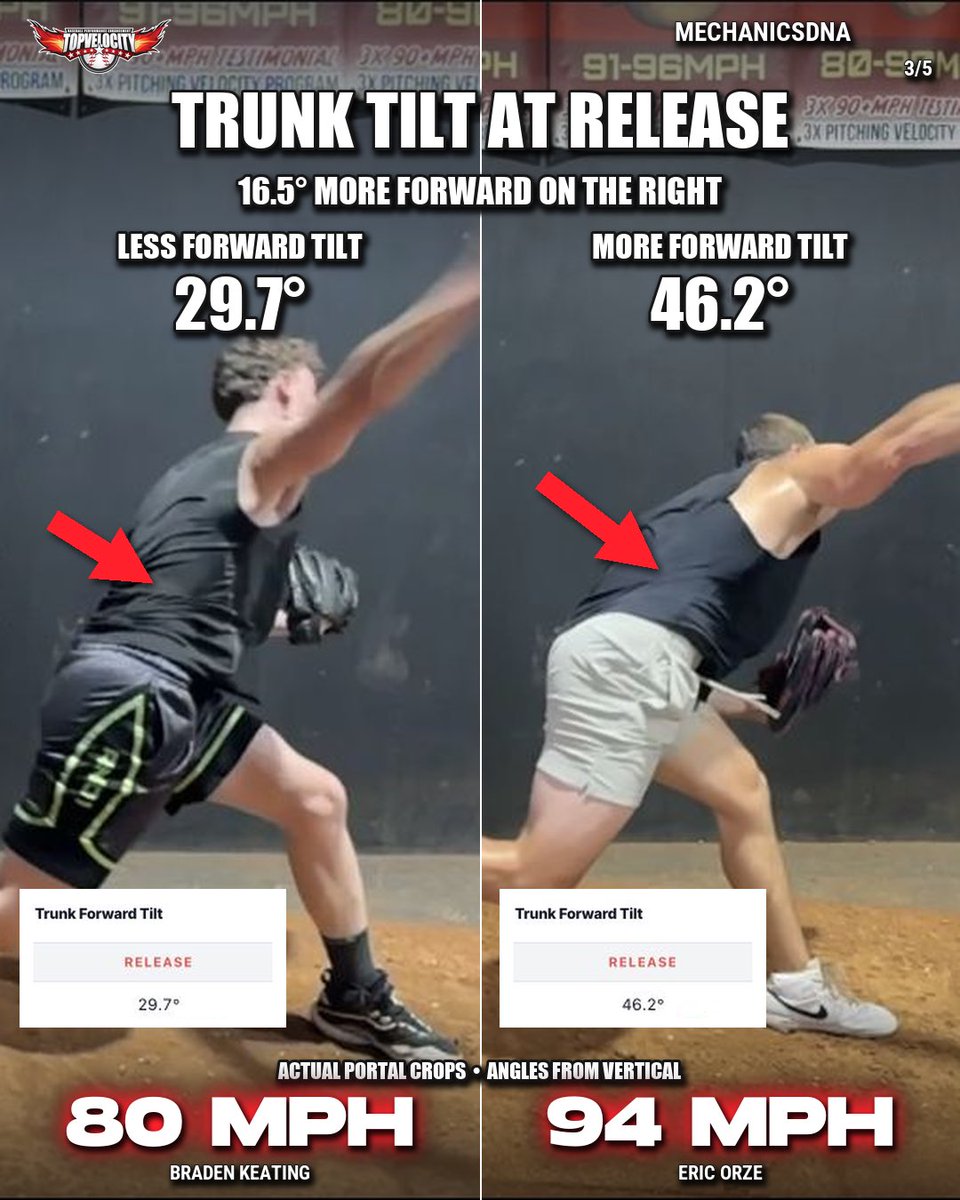
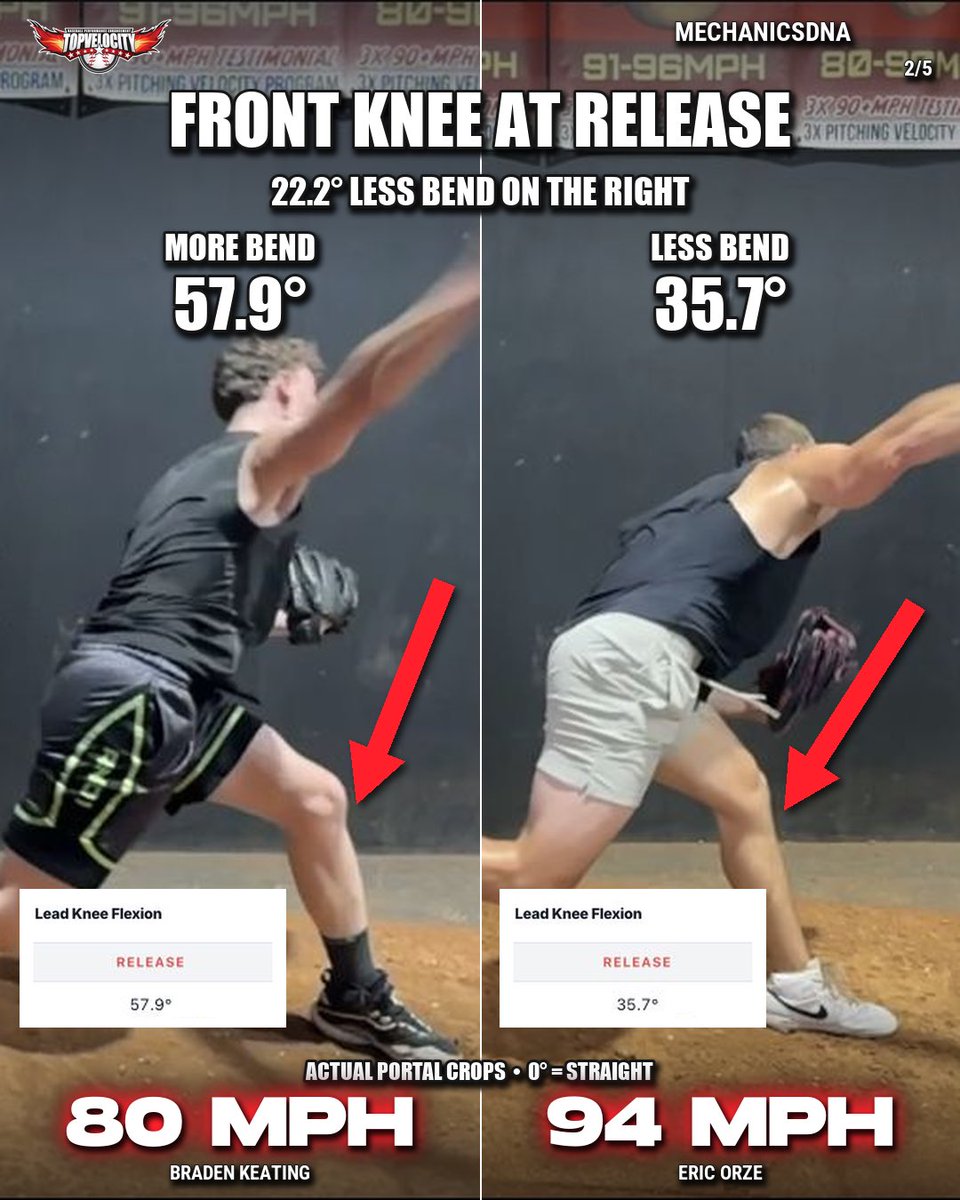
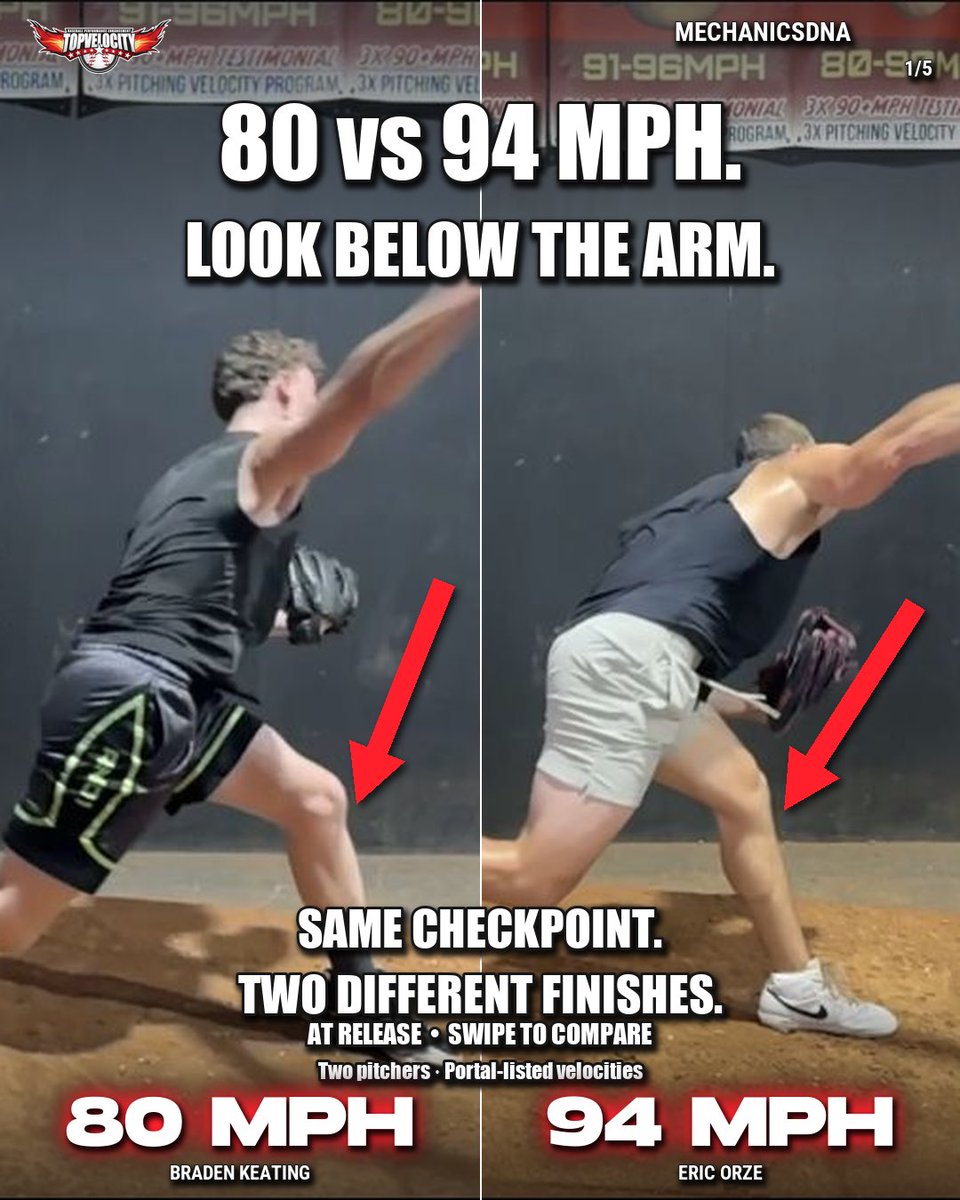
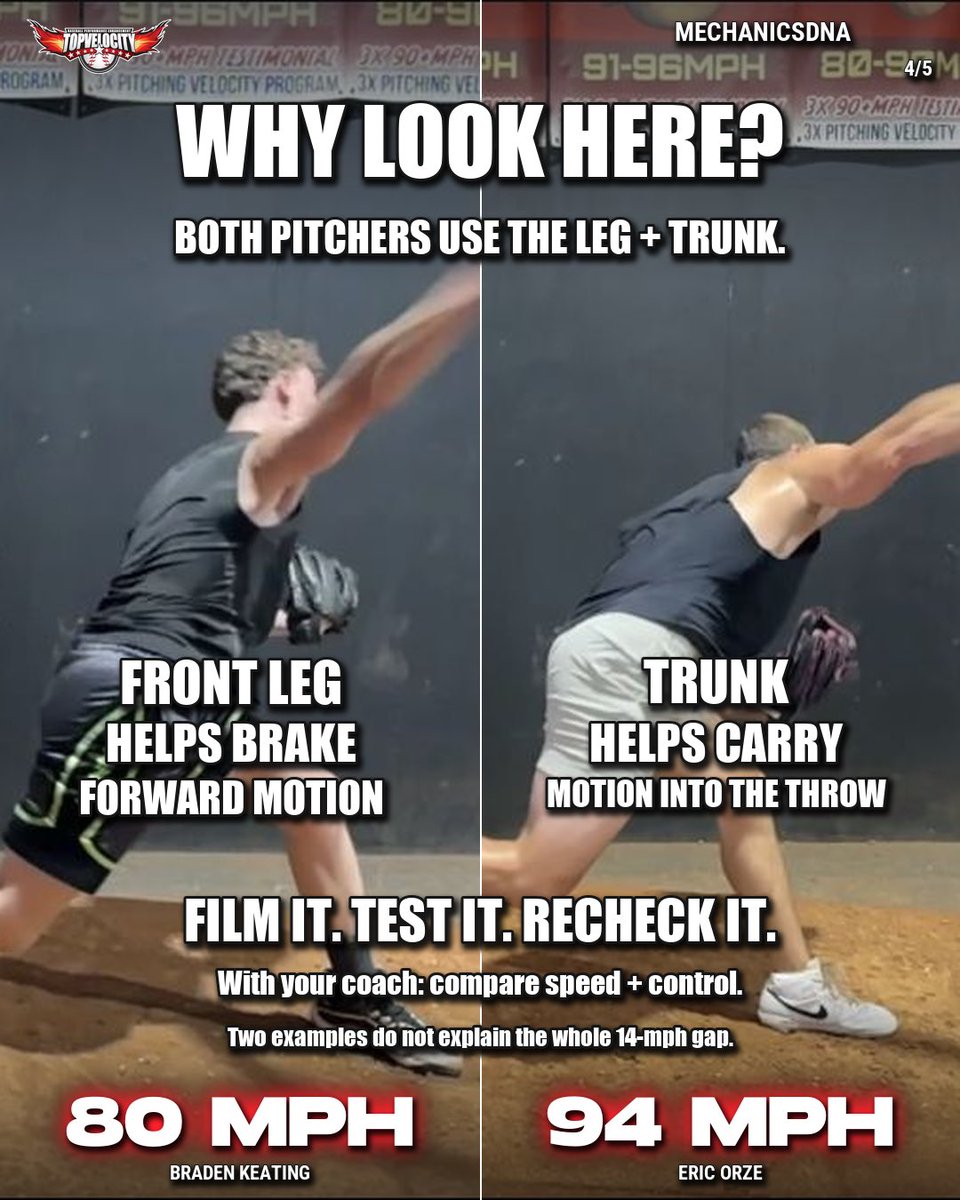
80 mph vs 94 mph. Same checkpoint. Two different finishes.
At ball release, these MechanicsDNA records show:
• Front-knee bend: Braden 57.9° | Eric 35.7°
• Forward trunk tilt: Braden 29.7° | Eric 46.2°
Eric's front knee is straighter and his trunk is farther forward in these recorded deliveries. Those are useful differences to investigate—not angles every pitcher should copy.
Why look here? Your front leg helps brake forward motion as your body rotates. Your trunk helps carry motion into the throw. Research links lead-knee extension during the delivery and forward trunk tilt with velocity. But a release image cannot measure braking force or show how fast the knee straightened. More forward tilt has also been associated with greater elbow loading.
YOUR NEXT STEP: Review a side-view video with your coach. Watch your front knee from landing to release and check your trunk at release. Pick one change to test, then compare video, velocity and control across multiple throws.
Get your FREE MechanicsDNA Mini scan: five 2D checkpoints, including forward trunk tilt at release.
Link in bio → https://t.co/aLiFqiTRc4
Save this for your next video review.
Speeds are portal-listed values; angles are video-based estimates. Front-knee bend uses 0° = straight. These two pitchers do not establish what caused the 14-mph gap. The full MechanicsDNA module is shown; Mini provides five 2D checkpoints and does not include this full knee scoreboard. Contact details required; no account or credit card.
Research: Dowling et al., DOI 10.1080/14763141.2022.2050801; Solomito et al., DOI 10.1177/2325967118800240.
#TopVelocity #MechanicsDNA #PitchingMechanics #PitchingVelocity #BaseballPitching
Sprinting Can Make You Throw Harder.
When I got back into baseball, I wasn't throwing as hard as I wanted.
One of the big things that helped me with this was incorporating the sprint style training.
This can be extremely, extremely powerful, especially for those guys who are bigger and stronger but a little bit slow.
One of my teammates at the Texas Rangers, dude was already a big dude, and what helped him get into more of the mid 90s to upper 90s was pretty much ditching the heavy lifting.
So he did a lot more of that fast twitch track style workouts, sprints, bounds, lots of plyometrics, things that track athletes pretty much do, and he gained a lot of velocity doing that.
It's gonna really help you move your body efficiently and get you going.
Elite pop times aren’t built on arm strength. They’re won before the ball ever hits the pocket.
If you catch the ball first and then try to turn your lower half, you’re already giving away 0.15 to 0.20 seconds. Starting from a dead stop kills your exchange.
How the hips actually drive the throw:
1-Shift before the catch
On a steal read, shift your weight into the drive foot while the pitch is still in flight. Breaking static weight early means your hips don't have to accelerate from zero after contact.
2-Hips steer the line
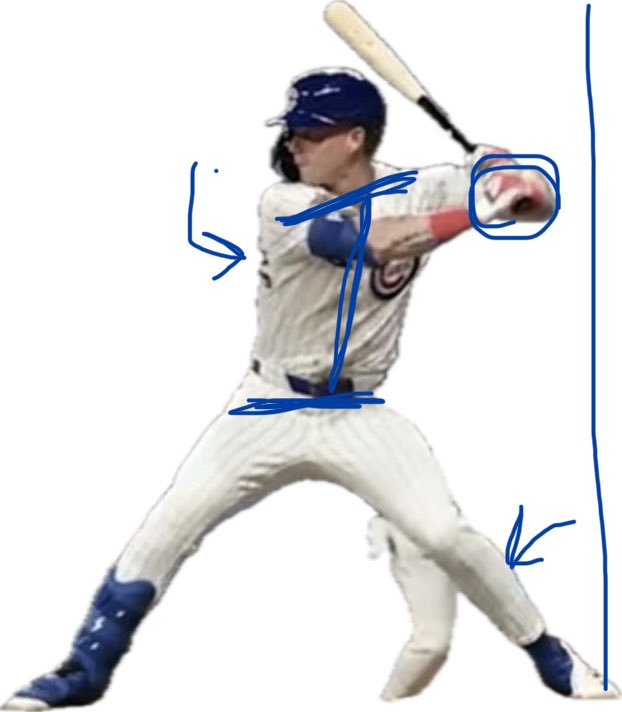
Your pelvis is the steering wheel. If your hips rotate directly toward second base, your shoulders and feet follow cleanly. If they lag, you drift into the batter’s box, stand straight up, and push the throw off-target.
3-Build the rubber band
Let the hips open while your torso and front shoulder stay closed. That hip-shoulder separation creates elastic tension, letting your arm whip through with more velo and far less stress on the elbow.
4-Exchange in motion
When your lower half is already driving through the throw, the ball-to-hand transfer happens out front in transit—not trapped deep against your chest.
Clean direction + early hip drive = outs at the bag.
Save this for your next throwing session.