I’m the new president of Wizards of the Coast. Here's the new live-action streaming series I just greenlit.
Only actors who look like the characters depicted in these paintings and described in the text will be considered. Necessary adjustments like Raistlin's gold skin and Tasslehoff's height will obviously be achieved with make-up and/or camera tricks, respectively.
The costuming, weapons, armor and creature designs will also match those of the classic hand-painted illustrations as well as the text, and will be just as colorful.
The story will follow that of the novels, and the only changes that might occur will be those that serve the difference in mediums, nothing will be "corrected" or modernized. Changes for the sake of current day award eligibility will not be considered.
#Dragonlance #FantasyArt
Some of you visiting this site may be wondering: What exactly is Wares?
In short, it is a heroic fantasy series featuring giant constructs known as Ryude.
So what are Ryude? A rough description would be:
Giant mechanical warriors resembling oversized armored knights.
Powered by mystical artifacts known as Wares, most commonly taking the form of a Persona fitted to the Ryude's face.
Crafted more like handmade works of art than industrial products, with designs that emphasize craftsmanship over mass production.
As a result, modern weapons are rarely seen in the world of Wares. Battles are usually fought with heavy, old-fashioned weapons, with Ryude clashing at close quarters in brutal hand-to-hand combat.
And because Wares is heroic fantasy, nearly everything associated with the genre can be found within its world: wicked kings, monstrous creatures, gods, demons, the schemes of great nations, artifacts with minds of their own—and, of course, practitioners of Word-Casting known as Word-Casters.
At first glance, this may sound like nothing more than traditional fantasy with giant robots added to the mix. In reality, however, those “robots”—the Ryude themselves—are one of the series' most distinctive features.
Ryude often possess remarkably strong personalities. Depending on the story, they may weep in sorrow, rejoice with childlike wonder, or stand apart from mortals with the dignity of gods. Even when such emotions are not shown directly, some are said to mourn the deaths of their Ryude Pilots with heartrending grief.
Likewise, Word-Casters are not quite the same as the wizards of Western fantasy. In many ways, it may be more accurate to imagine them as something closer to ninja—mysterious practitioners of secret arts whose abilities extend far beyond simple spellcasting.
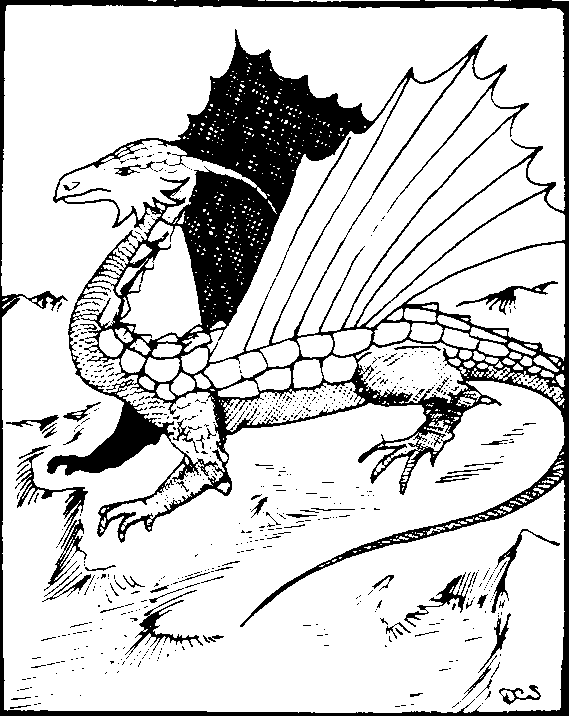
Here is a true story from my early days of D&D. This happened around 1975. The party came across a copper dragon's lair and decided to kill it. Now I know some of you are thinking, "But copper dragons are GOOD". Well the original text from the Monster Manual says they are selfish and neutral. Though the stat block does claim they're chaotic good. So clearly there are issues.
Anyway, they attacked it and lo and behold they managed to kill it. I rolled up the treasure, and calculated the value which was close to 100,000 gold pieces. I arbitrarily decided that the entire treasure was in copper pieces. Since there's 100 copper per gold, this means the dragon had 10 MILLION coppers. In OD&D, coins weighed 1/10 of a pound, so this meant the dragon had 500 tons of copper. (Even in modern D&D it would be 100 tons.)
Well of the course the players wanted it all but how could they carry it? They had to go back to a nearby town, buy wagons and oxen, make plans how to dispose of it, and meanwhile other locals figured out what had happened so there were sneak thieves and gangs of delinquents going to the copper dragon lair (which was about 40 miles from town) and hauling away hundreds of pounds at a time. The players talked about having one or more players guard the dragon lair to keep away riff-raff, but no one wanted to be That Guy.
In the absence of explicit rules, I declared that a single cartload could carry half a ton of copper, so they'd either need lots of wagons or many trips back & forth.
Eventually they started buying things with the copper (like wagons & oxen), and one of the players mentioned that copper value might drop. I seized upon that and now the players, to get full value for their copper, had to travel even further away. Plus the sneak thieves were doing the same.
Basically I transformed the original bloodthirsty adventuring party into a small corporation, trying to keep away claim jumpers and try to figure out how to transport & sell goods at ever-more-awkward locales.
It was pretty glorious, and it made for a really fun 2-3 sessions. Then we went on to something else. But it was pretty cool to have the players focused on something besides murder and loot for a change. They seemed to like it too. None of this was planned. It all just started following logically from me transforming the loot into copper to match the theme of the dragon. (Thank heavens they didn't ask where the dragon got all his copper.)
When have you had a similar weird but logical sequel to a normal adventuring encounter?