Happy to share our new modeling work on stimulus estimation with bump attractor dynamics by @EsnaolaM and Alex Roxin. 🎉👏
Disclaimer: No RNNs were trained for this work. It's pure craftsmanship made in Barcelona.
⚡️ 4 days left to apply ⚡️
++ plus: course fees just got cheaper, and we’ll have additional travel grants for participants from economically disadvantaged labs ++
Please apply, we’ll do what we can to help you join the BAMB community!
https://t.co/x6HVqIY85F
Applications are now open 🔥
Apply by March 15 to join BAMB, a Barcelona-based school on modeling behavior.
We encourage applications from underrepresented groups, and will provide 2 course fee waivers for students from financially disadvantaged labs.
👉https://t.co/dv8FQHDD1q
BAMB! is back: 19-27th July, with a new, polished program that is all about modeling behavioral data (https://t.co/x6HVqIYFVd): RL, Bayesian, latent variable & sequence models, RNNs, DDMs & more. Applications will open in the next few weeks, so save the date & keep that tab open!
Need to pimp your behavioral analysis with modelling? Applications are now open for BAMB!, where we’ll teach you all the tricks for modelling behavioral data, from standard regressions to fitting/validating/interpreting/comparing DDMs, RL, Bayesian & hierarchical models.
Interesting new findings: a categorical choice influences continuous stimulus estimation in two ways (confirmation bias + change in temporal weighting).
Excited to be posting this because (a) it took a while, and (b) we'd love feedback. One of those projects where you design a pretty simple experiment and then surprising things in the data make you think really hard ...
How did a bunch of electrically excitable cells evolve to be able to read this sentence?
Do you think most animal behavior is learned or innate?
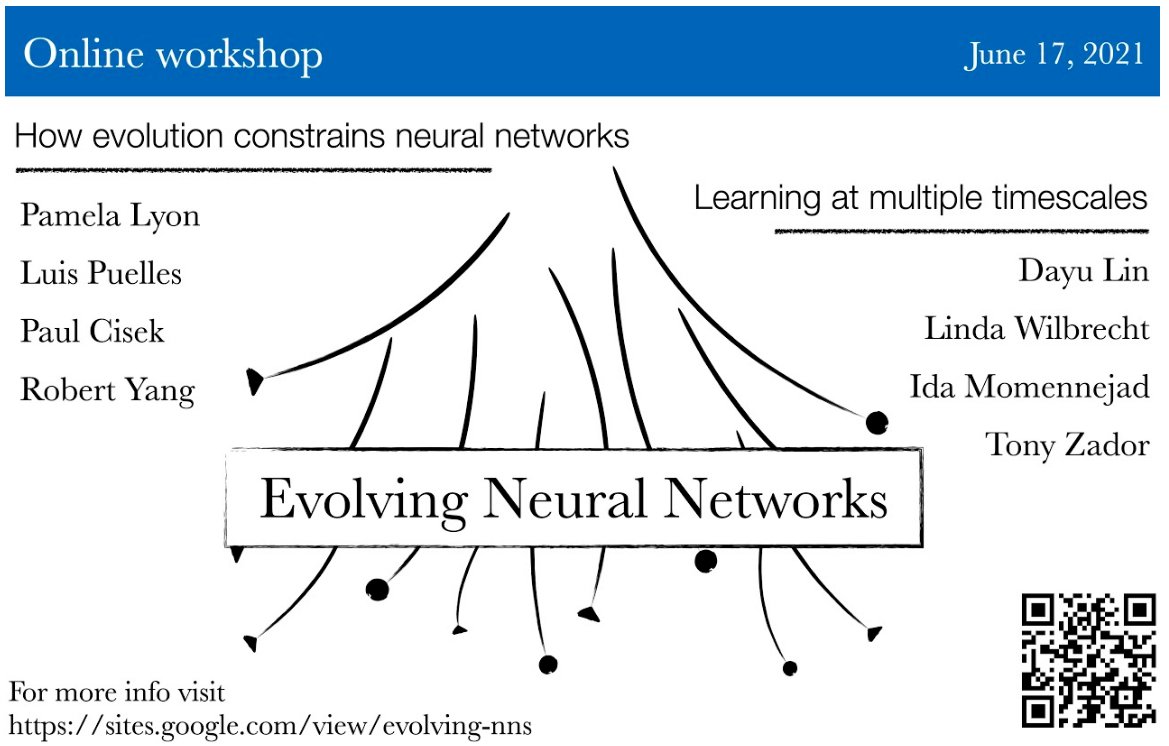
Join the discussion in the 1st Evolving Neural Networks workshop!
Save the date: June 17
Register here: https://t.co/jYH9wFOSXm
It always feels amazing and unreal to see your years of work to be accepted by Cerebral Cortex 😍(~ ̄▽ ̄)~!! It is awesome teamwork!! Read below for a short informal summary: (1/10)
https://t.co/07lI0jymp5
Details matter: Changes in E/I ratio in attractor models of SZ predict opposite effects on working memory stability depending on the model architecture. @heikecstein, @jmourabarbosa and Albert Compte point out directions for further exp. and theoretical investigation.
After obsessing about the link between NMDAR hypofunction, schizophrenia, and working memory performance for the last 4 years, I’m happy to share some of the insights that @jmourabarbosa, Albert Compte and I gained from existing literature and continuous discussions! 🧵
Our work on the distinctive features of the "double well" attractor model of perceptual decision making (compared to DDMs) is out. Happy to be part of this team, @genisprat, @jrochav & Alex Roxin!
The first part of my PhD is finally out in @NatComms! 🥳
It was a great experience to work with @jrochav, Alex Roxin and @kwwimmer !💪😍
Cheers!🍻
https://t.co/uml5XlGfds
Barcelona summer school for Advanced Modeling of Behavior (BAMB!), 4th to 10th September 2019 https://t.co/GoWduFYl4g - structured talks, hands on tutorials, group projects. Aimed at PhDs and postdocs in cognitive and computational neuroscience. Applications are open!