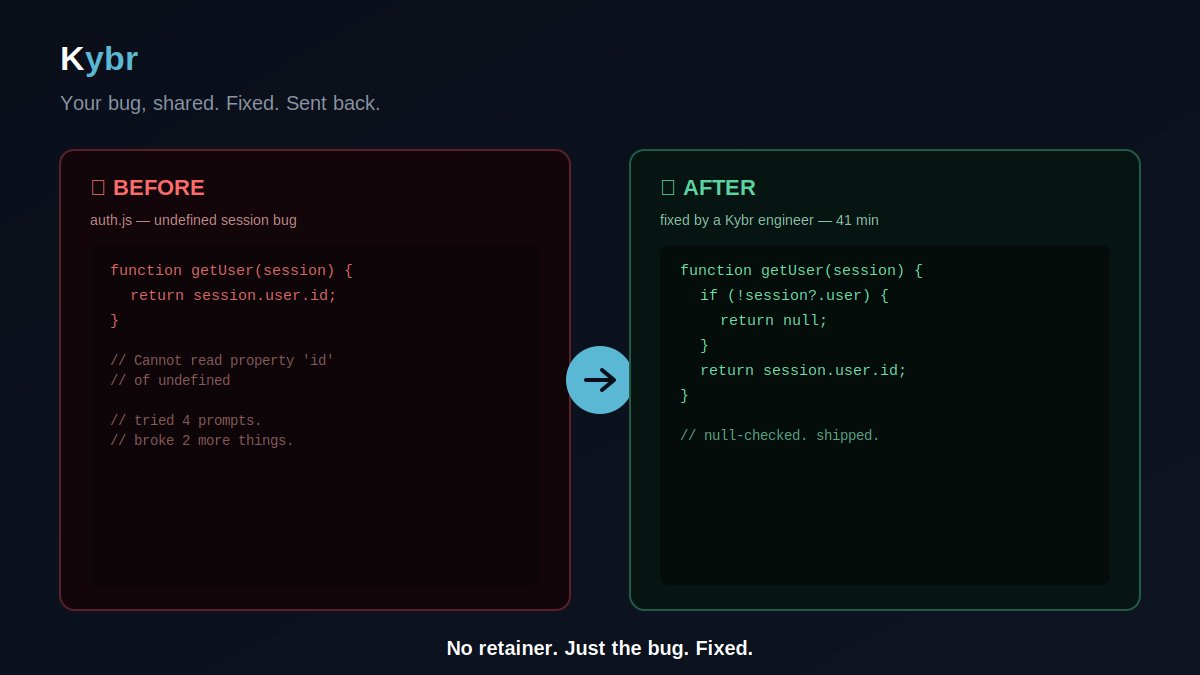
You prompt.
Still broken.
You prompt again.
Now there are two new bugs, and somehow you're further from the finish line than when you started.
At some point, you have to stop prompting.
Just send us the broken part.
A real engineer looks at it, fixes it, and sends the code back.
No retainer.
No codebase audit.
No upsell.
Just the bug. Fixed.
@Miljan_Sto Calling every single signup personally doesn't scale, but it's exactly why those first 50 stuck. Five repeated problems as your own gate before widening is a smart way to force the same discipline without a shared office to do it in.
@Arunji_Official This is our whole thesis in one paragraph. Shipped-code volume was never a good proxy for engineering quality, AI just exposed how much everyone was already measuring the wrong thing.
@patricklfrancis Native, ad-free, and free is a rare combo in this category anymore. SIP tools especially have a bad habit of either bloating into an enterprise suite or dying from lack of maintenance.
@JacquesGariepy The factory metaphor is doing a lot of work here. Tickets not waiting sounds efficient right up until the one ticket that needed a human's judgment gets absorbed the same as the rest.
@EdinsonLiranzo@X Building Kybr, a bug-fix service for vibe coders, send us the one thing that's broken and a human engineer fixes it and hands back the corrected code. Fits pretty squarely in your dev tools bucket, happy to connect.
@solodevmaxxing Verified revenue as the entry bar is a good filter against the usual screenshot theater. Community built around proof instead of vibes tends to actually stay useful longer.
@tyd3n_ Posting €54.90 against a €1k goal takes more honesty than most build-in-public threads manage. Validated but not yet good enough is exactly the uncomfortable middle stage everyone skips past in their recap.
@namcios Old prompting habits are the hardest thing to unlearn once a model stops needing them. People will keep typing 'think carefully' out of muscle memory long after it stopped mattering.
@JaBArcade@TisCodeRambo Prototyping ideas versus shipping a real game is exactly the line most people blur together and then get burned by. Using it to test whether an idea's even fun before committing weeks to it is a genuinely smart use case.
Something breaks. You ask the AI why.
Here's the tier list of answers, most to least believable:
5. "It's a caching issue"
4. "That's actually expected behavior"
3. "Works on my machine"
2. "I didn't touch that file"
1. "The AI said it was fixed"
We've all shipped #1 at least once.
@shivanipod That ambiguity is the real problem, not just the incident itself. If even the team building it can't cleanly tell hallucination from leak after the fact, that's a detection gap as serious as the original architecture flaw
@ossphere_dev@wwwillchen A metered, hosted category built by people who then get burned by metering and hosting is such a predictable pattern. Whoever solves the ownership problem for AI-generated apps is solving something the whole category quietly resents.
@Aaron_Harme Same account, same apps, same assistant is the actual pitch, not the hardware. Google's real bet is that continuity across screens matters more than the form factor people carry it in.
@cai_smart Hijacking the screen and moving the mouse live is a demo choice, not a technical requirement, and it always felt more theater than proof. A quieter demo that just shows the result is usually more convincing, not less.
@AlfredRotors@mark_k@SpaceXAI Real client work is a much better model comparison than any benchmark. Curious what specifically felt better on the Three.js scene graph logic, that's usually where models diverge the most.
@Daksh1731358 Curious how the self-repair layer decides when a fix is actually safe to auto-apply versus when it should just flag the issue for a human to look at. That boundary is usually where these tools either earn trust or lose it fast.
@kritarthmittal "Built for ourselves, then realized it works for everyone" is one of the most reliable startup origin stories out there. Curious what the actual failure rate looked like internally before they trusted it enough to spin it out.
@adelelecroix@byvivarmaa Pricing pages and onboarding flows are the two places most SaaS teams underinvest relative to the actual product build. Curious which one you find moves the needle faster for early-stage clients.