👀🚨 BREAKING: Ontario Solicitor General @TeamKerzner and Attorney General @DouglasDowney say Ford Government will issue a letter demanding Ottawa change the Criminal Code on self-defence and defence of property.
Conservative Leader Pierre Poilievre said a nurse working on contract at the CFB Wainwright has been told she might lose her job after she was photographed speaking with him in the aftermath of the tragedy.
https://t.co/G2pgXoOn9C
🇨🇦🇺🇸 Ottawa spent all year blaming Trump for the auto crisis. Then Stellantis sat Doug Ford down and walked him through the other half of the bill.
After Friday's meeting in Toronto with Stellantis CEO Antonio Filosa, Industry Minister Mélanie Joly and Unifor, Ontario Economic Development Minister Vic Fedeli said the company "kept going back to the fact that it's the tariffs, it's the greenhouse gas emission costs that the Americans don't have, that we have in Canada, so we're on two different playing fields." Per Fedeli, Stellantis told them it loses money on every car it produces because of these emissions costs.
Ford, on camera: "We have to get rid of the GHG cost." He told reporters Stellantis pays about C$1 billion a year in emissions costs, plus C$135 million a year just to keep its idle Brampton plant warm.
The Americans really don't have this cost. Washington has repealed its vehicle greenhouse gas standards. Ottawa kept its own. In October, Carney and Ford announced they would freeze the standard at 2026 levels through 2029, then start tightening again in 2030 toward 75% EV sales by 2035. A freeze is not a repeal, it only puts off the pain for another year.
Even Unifor's Lana Payne is saying it. She called the emissions standards an "irritant" and said: "This is one of the things that is in our control." Her ask is to "take away any own goals."
And this is the Carney model. His 2025 budget said industrial carbon pricing will "build the competitiveness of Canadian business," and he promised to strengthen it. Ford says GHG costs are a big problem for steel too.
To be fair, Stellantis named the tariffs first, and the auto cost is a vehicle emissions regulation, not the industrial carbon tax itself, yet both are climate policies made in Ottawa.
Ottawa can't wish away Trump's tariffs. It could scrap its own emissions costs, and so far it hasn't. Instead it hands automakers taxpayer money to cover costs Ottawa itself imposed. You can't out subsidize bad policy, and the automakers are sharing the math.
Video: @KirkLubimov via CBC News Network
In a major statement, China’s Xi said “nuclear weapons should be comprehensively banned and thoroughly destroyed, building a nuclear-free world,” according to China’s Xinhua news agency.
🔴 LIVE updates: https://t.co/Z48FFAHqQP
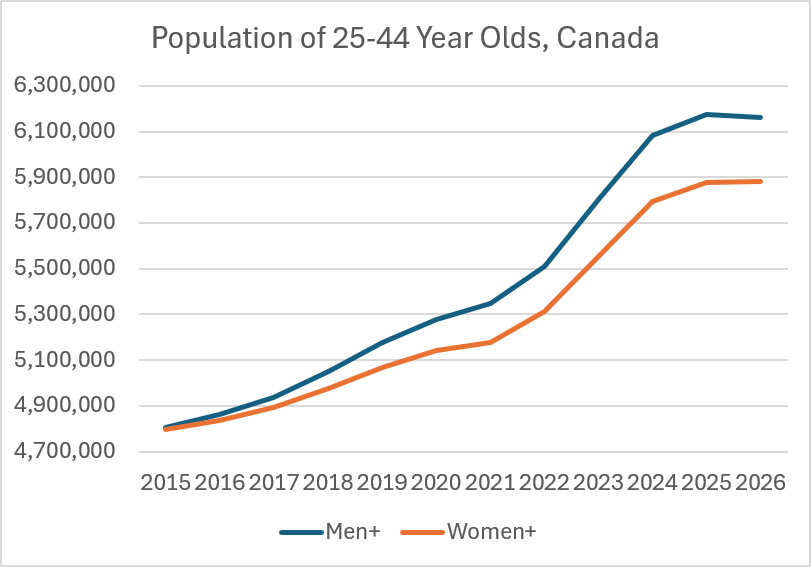
Canada's immigration and non-permanent resident programs have prioritized bringing men, rather than women, to the country, leading to significant population imbalances. In 2015, there were 7,000 more 25-44 yo men than women. By 2025, that gap had grown to nearly 300,000.
🚨🇨🇦 INFLATION IS 3.1%.
BUT YOUR GROCERIES ARE 32% MORE EXPENSIVE THAN IN 2020.
Statistics Canada released its October inflation report yesterday.
The headline inflation rate was 3.1%.
Grocery inflation? Just 2%.
Sounds like things are finally getting better.
Except there’s one number buried in the report that deserves a lot more attention.
Grocery prices have increased 31.9% since October 2020.
Let that sink in.
Imagine a Canadian family spending $200 a week on groceries six years ago.
Let’s do the math.
🛒 Weekly groceries in 2020: $200
📈 Cumulative grocery inflation: 31.9%
💳 Same basket today: $263.80
💸 Additional weekly cost: $63.80
📅 Additional annual cost: $3,318
And here’s where it gets interesting.
If that family faces a 30% marginal income tax rate, they would need approximately $4,740 MORE IN GROSS ANNUAL INCOME just to cover that additional grocery expense.
Not to buy better food.
Not to eat at restaurants.
Just to purchase roughly the same groceries they bought in 2020.
Of course, wages have increased for many Canadians, and individual grocery bills vary.
But here’s the economic reality.
Lower inflation doesn’t mean prices are returning to where they were.
It means they’re increasing more slowly.
And when your household budget has already absorbed a 32% increase, another 2% isn’t exactly a victory.
CANADIANS DON’T NEED TO BE TOLD THAT INFLATION IS SLOWING.
THEY NEED THEIR PURCHASING POWER TO CATCH UP.
Because slowing down the rate at which life gets expensive doesn’t make life affordable again.
🍁 @wealthmoose
Ukraine’s NATO ambition has always been a red line for the Kremlin. Giving up territory has been a no-no for Ukraine. Will they make compromises? https://t.co/W63xvwjIbC