@mario_cibelli What's your take on $RELY CPTO Ankur Sinha resigning? Combined with all the recent insider selling and the CEO transition, I'm a little concerned.
I was listening to Ron DeSantis talk about eliminating property tax in Florida, and at first I thought, “There’s no way that works.”
Then I heard the details…and it actually made a lot of sense.
The idea isn’t to eliminate property tax for everyone.
It would only apply to primary residences , people who live in Florida full-time.
Snowbirds who come for a few months? They still pay.
Businesses and commercial properties? They still pay.
But, if you own your home and live there permanently, no more yearly tax just to keep what you already own.
And honestly, why should you be taxed every year on something you’ve already paid for?
I saw this in Sweden, property taxes are extremely low, and people can actually stay in their homes for life instead of being forced out when taxes rise.
In the U.S., especially in high-tax states, retirees on fixed incomes often get priced out of their own homes. Some are paying tens of thousands a year just in property taxes.
DeSantis said only about 20% of Florida property is primary residences. The rest is businesses, commercial property, and part-time residents, which makes the numbers more manageable.
The big question is how local governments replace that revenue, especially in rural areas. He mentioned possible state-level revenue sharing.
Personally, I think it’s a really compelling idea, and politically, it’s going to get a lot of attention.
What do you think?
Should homeowners pay property tax forever on their primary residence, or once you own it, should it truly be yours?
Curious to hear different perspectives
$WIX is @MorganStanley 's favorite stock pick of 2026
because of
- accelerating revenue
- high FCF relative to market cap
- Base44 AI growth engine.
https://t.co/do5kprtJNY
$RELY | Cantor Fitzgerald initiates Remitly Global at Overweight with a $17.00 per share price target.
Firm sees favorable growth prospects supporting upside from current levels.
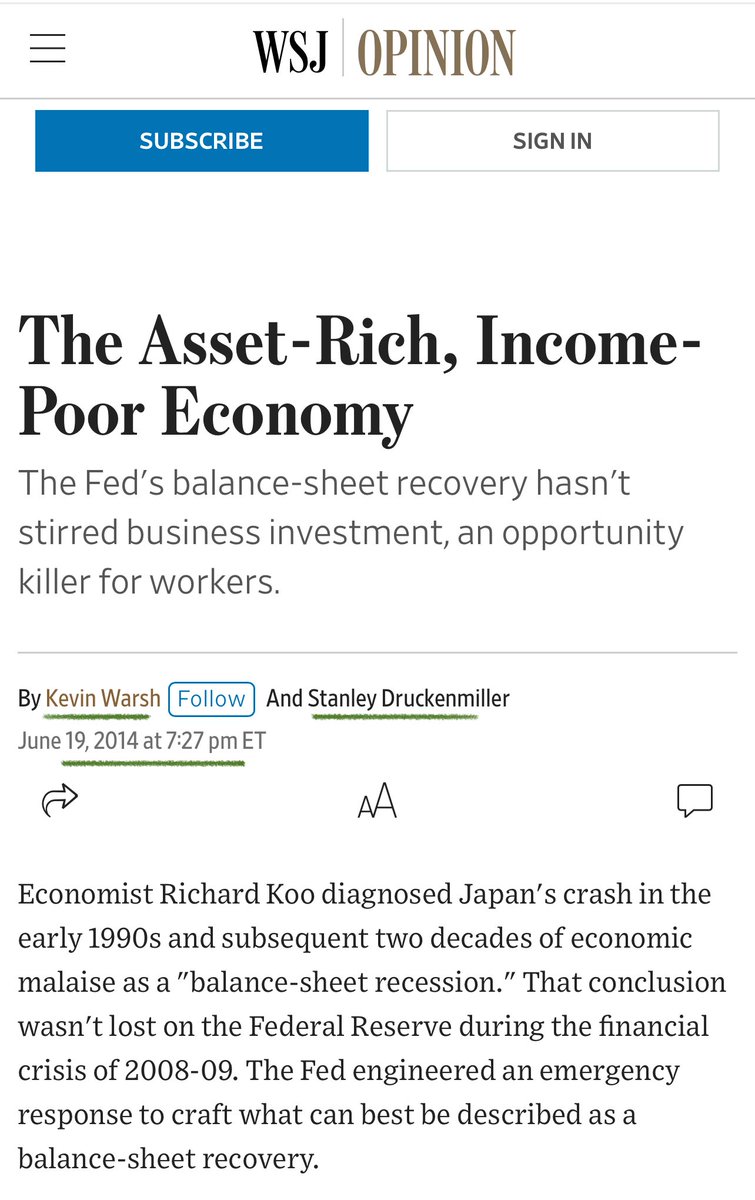
A New Axis of Power: Warsh, Druckenmiller, Bessent and the Next Fed Chair
The centre of gravity in US economic policy is shifting from isolated personalities to a tightly connected network: Kevin Warsh, Stanley Druckenmiller and Scott Bessent, now aligned under Donald Trump. They are attempting to end a 15‑year experiment in Keynesian demand management and replace it with a supply‑side regime built on productive capital rather than financial engineering. With the next Fed chair decision front and centre, that network suddenly matters a great deal. Read the room.
For years, the playbook was simple: fiscal stimulus plus ultra‑easy money to prop up demand, producing an “asset‑rich, income‑poor” economy of soaring markets but weak productivity and uneven wages. Warsh and Druckenmiller were early insiders to declare this model exhausted, arguing that QE and financial repression distorted markets and discouraged real investment. Their critique was not anti‑market; it was a warning that valuations cannot permanently substitute for capital formation.
Bessent now provides the fiscal and industrial counterpart. Drawing on a Hamiltonian tradition, his strategy emphasises deregulation, investment‑friendly tax rules and targeted tariffs to pull production and capex back onshore, allowing private capital to profit from building in energy, manufacturing and technology instead of riding policy‑driven multiple expansion. Government sets the rules; the private sector carries the baton.
The personal links make the Fed race especially intriguing. Warsh and Druckenmiller have worked closely together, blending the vantage point of a former Fed governor with one of the most successful macro investors of the era. Bessent comes from the same global‑macro lineage, so Warsh’s and Bessent’s views are joined not just by ideology but by shared mentors, methods and market experience, with Druckenmiller as the junction between them.
In this context, Warsh’s potential role as Fed chair is pivotal. He is one of the few candidates whose record already fits Bessent’s project: sceptical of balance‑sheet activism and mandate creep, but realistic about managing a high‑debt, dollar‑centric system without shock therapy. A Warsh Fed could narrow the mandate, normalise the balance sheet over time and still cut rates in a way that supports a supply‑side agenda rather than another round of financial engineering. Trump provides the political cover; Bessent runs fiscal and industrial levers; Warsh anchors a more focused, market‑attuned Fed; and Druckenmiller bridges central bank and markets. Now can you see why Warsh would make a good Fed chairman, why he would read and work well with Bessent, and why the Druckenmiller link makes the structure so compelling? Read the room.