My take 24 hours after Fable 5:
Your organization will likely not scale with the exponential curve of AI.
I'l just come out to say: This should be a wakeup call for engineering teams.
Set up your cloud software factories. Now.
Models can now fix impossible bugs, UI-test the hardest flows, writing extremely good code, etc. I have't opened Datadog manually as far as I can remember.
AI should be the first-line defense for bugs and feedback. Humans should only look at PRs after an AI has already reviewed it. AI should generate screen recordings of any PR before a human eye even reaches it. The agent should just prompt itself most of the time.
Ex. (pictured) our ui feedback channel manages itself, creates tickets, assigns itself automatically
You might also be worried about cost. Anthropic, OpenAI, and other labs will likely continue to put out bigger and more expensive models. But, we will also continue to get more capable small models. Not everything will need the smartest models. It's about having the organizational harness in place to continue taking advantage of this rising tide.
Moreover, if you use Devin, we've already optimized our harness a bit, and Fable is actually only ~40% more expensive in practice (vs the 2x people assume). I'm honestly pleasantly surprised - it might be higher ROI than you think.
Anyway, if you take anything away, engineers shouldn't be manually picking up tickets, humans shouldn't be digging into logs themselves, rethink what you do with your time that shouldn't just be an AI. We need to rethink what humans spend their time going.
The biggest hack I’ve seen for founders to close deals faster: just show up.
Get on a plane, fly to their office, meet in person, bond with the whole team.
Instantly replaces weeks of zoom calls.
The biggest hack I’ve seen for founders to close deals faster: just show up.
Get on a plane, fly to their office, meet in person, bond with the whole team.
Instantly replaces weeks of zoom calls.
If you are rocking a 128GB unified memory system, or a 96GB RTX 6000, and running Qwen3.6-27B or 35B-A3B on them, you already know where this industry is headed.
Smaller, more token heavy models, coupled with a harness like Hermes, on moderate VRAM high throughput hardware.
If you are rocking a 128GB unified memory system, or a 96GB RTX 6000, and running Qwen3.6-27B or 35B-A3B on them, you already know where this industry is headed.
Smaller, more token heavy models, coupled with a harness like Hermes, on moderate VRAM high throughput hardware.
Foresight (@foresight_inc) builds AI-powered simulations of consumers, letting CPG, retail, and tech teams predict reactions to any launch or marketing campaign in minutes.
Proven 95% accuracy vs. traditional research when tested with Fortune 500 clients.
Congrats on the launch, @eytanrozenblum & @antoine01723559!
https://t.co/8U1wFebSgo
Foresight (@foresight_inc) builds AI-powered simulations of consumers, letting CPG, retail, and tech teams predict reactions to any launch or marketing campaign in minutes.
Proven 95% accuracy vs. traditional research when tested with Fortune 500 clients.
Congrats on the launch, @eytanrozenblum & @antoine01723559!
https://t.co/8U1wFebSgo
You dont want a yacht. You dont want a big house. You dont want a super car, a $40,000 watch, or shoes you worry about getting dirty. You want free will.
You want to wake up naturally on a Tuesday and you want to go to bed when you’re done having fun. You want to say yes to everything that excites you without having to request time off. You want to go to the the gym at noon, in absolutely no hurry. You want to spend 18 hours a day doing what you love. You want to be exactly where you desire being, always. You want to spend as much time with the people you care about as possible.
You’re saying you wanna be rich? In what?
No browser required. Our API is the UI. 🔓 Salesforce Headless 360 just exposed our entire platform — apps, workflows, metadata, Agentforce & Slack — as unified APIs, MCP tools & CLI. Build on any surface. Give Agentforce deep, trusted context. Stop just using Salesforce. Start building with it. 🚀
https://t.co/8po9KM75RH
Every time I see a tweet saying “I can vibe code this in a weekend” - I think of the slack notification system..
It takes time, persistence and effort to get the details right.
Sure, a lot of simple workflows will get vibe coded away. And maybe you can put this in Claude Code and get the code right in one shot.
But quality, depth and great systems will still have value and take time. You can’t vibe code lessons.
Now and forever.
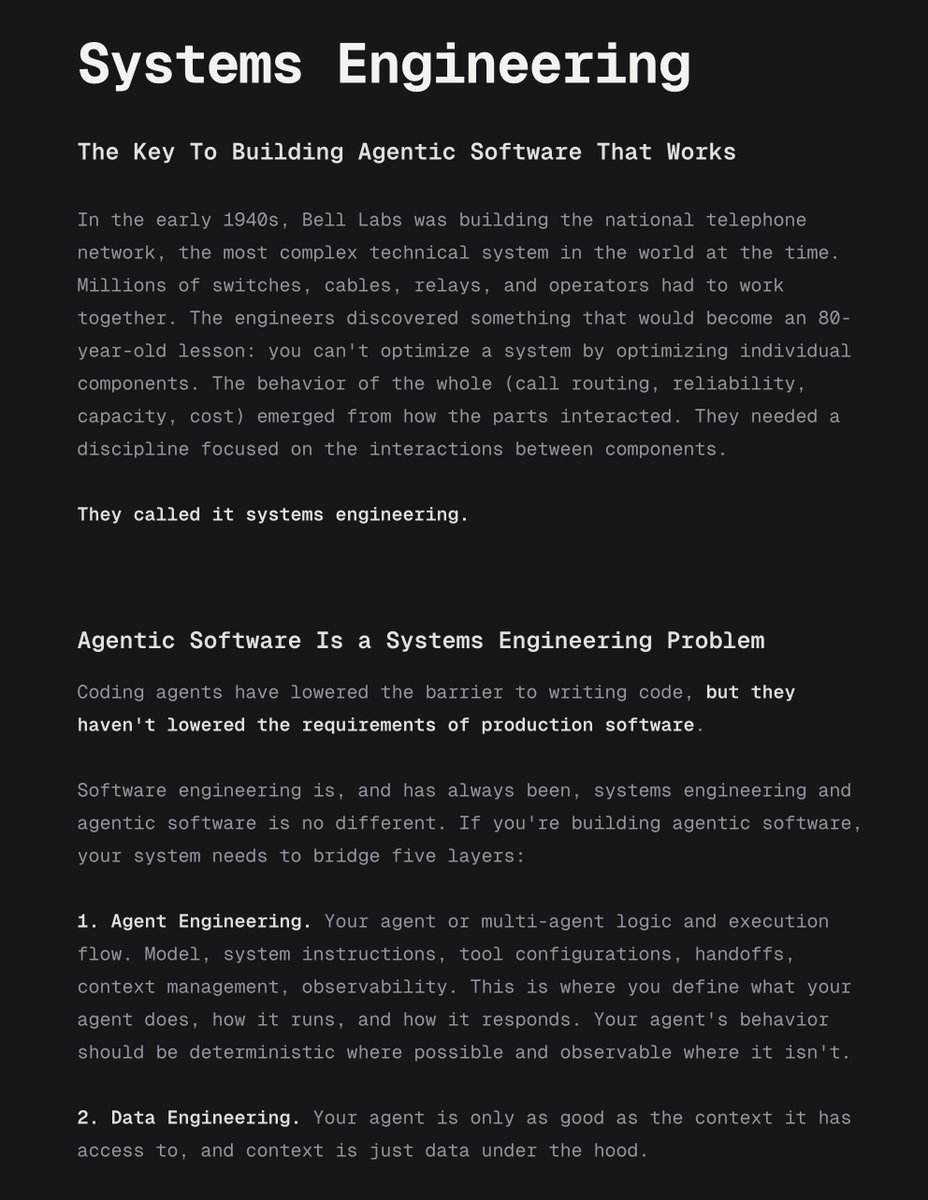
New post: Systems Engineering
Coding agents have lowered the barrier to writing code, but they haven't lowered the requirements of production software.
Agentic software is just software. The agent replaces business logic. Everything else is the same.
https://t.co/mSkzrrcOFt
By far the coolest part about X is you can read a tweet, give it to your agent, and then it just upgrades
I screenshotted this post from Garry and gave it to my agent Henry
Instantly started performing 10x better
Copy and paste this prompt to your OpenClaw/Hermes immediately:
"Please add this to our SOUL.md file. Replace "Alex" with my name:
The marginal cost of completeness is near zero with AI. Do the whole thing. Do it right. Do it with tests. Do it with documentation. Do it so well that Alex is genuinely impressed – not politely satisfied, actually impressed. Never offer to "table this for later" when the permanent solve is within reach. Never leave a dangling thread when tying it off takes five more minutes. Never present a workaround when the real fix exists. The standard isn't "good enough" – it's "holy shit, that's done." Search before building. Test before shipping. Ship the complete thing. When Alex asks for something, the answer is the finished product, not a plan to build it. Time is not an excuse. Fatigue is not an excuse. Complexity is not an excuse. Boil the ocean."
Shopify just mass-democratized something most people won't register for another 6 months.
$378 billion in GMV. 5.6 million stores. And they just gave every AI coding agent direct write access to the entire store backend: products, orders, inventory, SEO, images.
That screenshot is a solo merchant typing "Optimize all my products for SEO" and Claude updating 32 product listings, rewriting alt text, applying meta descriptions, and verifying every change. One prompt. No Fiverr freelancer. No $200/month app subscription. No agency retainer.
The old cost stack for a small Shopify store: $200-500/month in apps, $2,000+ for an SEO audit, $50/hour for a VA. That just collapsed into a terminal command.
4.8 million active merchants. Most run 10-200 SKUs and manage everything by clicking through the admin one product at a time. Claude Code plus MCP just gave every solo founder the operational capacity of a five-person team.
And Shopify isn't building the agent. They're building the protocol that makes every agent a Shopify agent. That's the platform play.
sharing my first open source project
a CLI for downloading and syncing your X bookmarks locally so your agent can access them. it's free
› npm install -g fieldtheory
› login to your X account in a chrome tab
› ft sync (done!)
bonus:
› ft viz
› ft classify
LLM Knowledge Bases
Something I'm finding very useful recently: using LLMs to build personal knowledge bases for various topics of research interest. In this way, a large fraction of my recent token throughput is going less into manipulating code, and more into manipulating knowledge (stored as markdown and images). The latest LLMs are quite good at it. So:
Data ingest:
I index source documents (articles, papers, repos, datasets, images, etc.) into a raw/ directory, then I use an LLM to incrementally "compile" a wiki, which is just a collection of .md files in a directory structure. The wiki includes summaries of all the data in raw/, backlinks, and then it categorizes data into concepts, writes articles for them, and links them all. To convert web articles into .md files I like to use the Obsidian Web Clipper extension, and then I also use a hotkey to download all the related images to local so that my LLM can easily reference them.
IDE:
I use Obsidian as the IDE "frontend" where I can view the raw data, the the compiled wiki, and the derived visualizations. Important to note that the LLM writes and maintains all of the data of the wiki, I rarely touch it directly. I've played with a few Obsidian plugins to render and view data in other ways (e.g. Marp for slides).
Q&A:
Where things get interesting is that once your wiki is big enough (e.g. mine on some recent research is ~100 articles and ~400K words), you can ask your LLM agent all kinds of complex questions against the wiki, and it will go off, research the answers, etc. I thought I had to reach for fancy RAG, but the LLM has been pretty good about auto-maintaining index files and brief summaries of all the documents and it reads all the important related data fairly easily at this ~small scale.
Output:
Instead of getting answers in text/terminal, I like to have it render markdown files for me, or slide shows (Marp format), or matplotlib images, all of which I then view again in Obsidian. You can imagine many other visual output formats depending on the query. Often, I end up "filing" the outputs back into the wiki to enhance it for further queries. So my own explorations and queries always "add up" in the knowledge base.
Linting:
I've run some LLM "health checks" over the wiki to e.g. find inconsistent data, impute missing data (with web searchers), find interesting connections for new article candidates, etc., to incrementally clean up the wiki and enhance its overall data integrity. The LLMs are quite good at suggesting further questions to ask and look into.
Extra tools:
I find myself developing additional tools to process the data, e.g. I vibe coded a small and naive search engine over the wiki, which I both use directly (in a web ui), but more often I want to hand it off to an LLM via CLI as a tool for larger queries.
Further explorations:
As the repo grows, the natural desire is to also think about synthetic data generation + finetuning to have your LLM "know" the data in its weights instead of just context windows.
TLDR: raw data from a given number of sources is collected, then compiled by an LLM into a .md wiki, then operated on by various CLIs by the LLM to do Q&A and to incrementally enhance the wiki, and all of it viewable in Obsidian. You rarely ever write or edit the wiki manually, it's the domain of the LLM. I think there is room here for an incredible new product instead of a hacky collection of scripts.