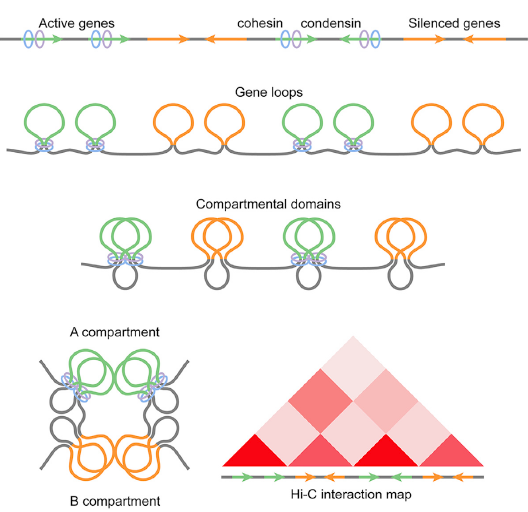
Happy to present our new paper, a collaboration with the Pincus lab, that shows transcriptional condensates are evolutionarily conserved, inducible and capable of restructuring the genome. https://t.co/s7gM0avnA5. @generegulation#chromatin#4Dgenome
A postdoctoral position to study 3D genome architecture and transcriptional regulation is available in our lab. For a perspective on the project, see https://t.co/Rc6b2YIw1V. If interested, submit CV & a brief description of your research experience to [email protected].
Please have a look at this new paper from our lab where we contend that HSP gene regulation in yeast bears functional and structural resemblance to the most complicated systems in the mammalian transcription program.
https://t.co/Lp35GMCiI7
We are pleased to announce that our lab has received a 4-year NIH R01 award for the project, "Genome Architecture and Gene Control in Response to Stress." It begins August 2020.@amoldeepkainth@vickypandit15@LindaRu42313507@raji_meduri
Pls. read our recap of various HSF1 coactivators (https://t.co/XX6hQP3EDD) to accompany an excellent study from Akira Nakai group in the @embojournal reporting shugoshin 2 as a novel coactivator of HSF1 (https://t.co/d7peeVp4GZ) #chromatin#transcription@generegulation
Please stop by posters 111, 163 and 217 for your valuable discussion / suggestions on stress-induced changes in 3D architecture of yeast genome. #moet2019
A must-read special collection of personal perspectives from Bob Roeder, Jim Kadonaga, Ron and Joan Conaway, and John Lis highlighting monumental discoveries in transcriptional regulation over the last 50+ years!
https://t.co/NjGUaZWzfx
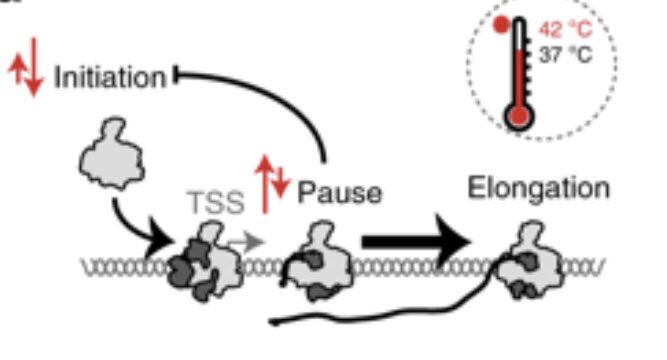
We show directly that transcription activation often involves a decrease in Pol II pause duration. Multiomics reveals this requires CDK9 and increases the productive initiation frequency. In contrast to promoters, enhancers are generally not pause-limited. https://t.co/RcJGLGHTTC
Open rank faculty position in gene regulation here at Penn State. Join us in @cegrPSU to study chromatin and gene regulation! #PennStateChromatin19 https://t.co/EDaQiks1mh
Gross lab will be represented in #PennStateChromatin by two graduate students @LindaRu42313507 and @vickypandit15 and a talk by David Gross on Friday morning. Looking forward to wonderful interactions and suggestions!!
Condensin II counteracts cohesin and RNA polymerase II in the establishment of 3D chromatin organization https://t.co/Ft7ddQjvJk Pairing between homologs occurs at ∼6-kb buttons enriched in architectural proteins
Our paper, "Proteotoxicity from aberrant ribosome biogenesis compromises cell fitness" is now online! Read the summary below, but the full paper has new MS data from @MartinWuhr! Thanks also to Mike Springer, David Pincus and @NikkiCommins for the collab! https://t.co/6n0bk7mPdR
Try to rescue ~20% of reads aligned to multiple positions? Want to study the repetitive regions of the genome? Check it out! Our recent published work 👉Generative modeling of multi-mapping reads with mHi-C advances analysis of Hi-C studies https://t.co/2UVz1Wr2qC @eLife
Usually, cells quickly break down parts of genes that don’t encode proteins, called introns. A new @nature study by David Bartel's lab, led by Jeff Morgan with Gerald Fink, found introns that persist and regulate growth. @MITBiology@ScienceMIT @HHMINEWS https://t.co/Yo1CFGb3XQ