🚀🌌 Voyager 1 has left the Sun's protective bubble—the heliosphere—and is now traveling through interstellar space, over 25 billion km from Earth.
Launched in 1977, it's the most distant human-made object ever. Yet even after nearly 50 years, it isn't close to another star. At its current speed, reaching the nearest star system, Alpha Centauri, would take tens of thousands of years.
A humbling reminder of both human curiosity and the unimaginable scale of the universe. ✨
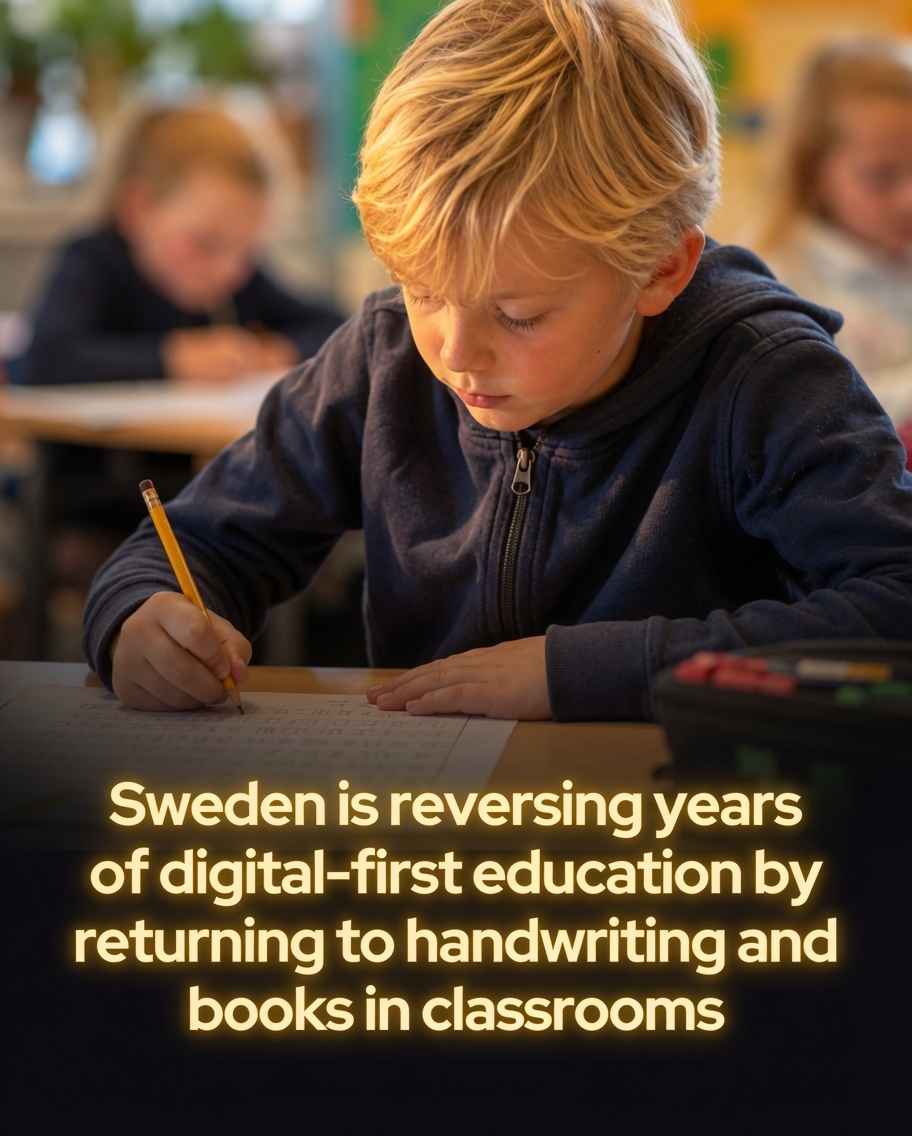
Sweden is reintroducing printed books and handwriting into its classrooms. Once celebrated as a leader in digital education, the country is now directing significant resources toward traditional textbooks while limiting the use of tablets and screens, particularly for young students.
Swedish authorities attribute this policy shift to mounting evidence that excessive screen time may have harmed reading proficiency and basic skill development. The government has also announced plans to ban digital learning tools for children under six years old.
Scientific research on handwriting provides insight into the rationale. When children write by hand, they engage multiple brain areas responsible for motor control, visual processing, memory, focus, and language. Unlike typing, this process demands precise coordination of fine movements alongside letter recognition and word formation. Studies indicate that such multisensory engagement enhances letter knowledge, spelling, reading acquisition, and memory retention.
Printed books may similarly promote stronger comprehension. Research shows that people often retain information more effectively from physical pages than from digital displays. The tangible nature of paper offers spatial references that aid memory organization. In contrast, screen based reading, especially when interrupted by notifications or hyperlinks, can fragment attention and reduce deep focus.
This approach does not reject technology entirely. Computers and tablets continue to serve important roles in research, group projects, accessibility features, and interactive exercises. Education specialists emphasize the need for thoughtful integration, applying digital resources where they prove most effective while safeguarding core practices such as handwriting, printed materials, and direct teacher instruction.
Sweden's policy change mirrors growing international discussions about optimal screen time in schools. As educators worldwide evaluate the benefits and drawbacks of digital tools, many are reconsidering when traditional methods may better support fundamental learning.
@meteojulie@AJemaineClement@TaikaWaititi Delightful. Hope they get another season some day. Great they got to expose younger generations to TB. Great model of family entertainment at it best.
J.R.R. Tolkien explains why he spent years building Middle-earth before writing The Lord of the Rings.
In a rare interview, Tolkien is asked why he devoted more than a decade to creating the world behind his stories before writing them.
He rejects the idea that Middle-earth emerged purely from his unconscious, describing himself instead as “a meticulous sort of bloke” who spent years working out timelines, languages, histories, customs, and genealogies until everything fit together.
For Tolkien, the world existed before the story.
He even says The Hobbit began almost by accident, explaining that the larger mythology was already in place and that the novel simply became absorbed into it.
When asked why anyone would build an entire fictional world before telling a story, Tolkien points to what he calls “subcreation.”
As creations of a Creator, he argues, humans naturally desire to create. Since we cannot create something from nothing, we instead reshape existing reality into new forms that are both imaginative and aesthetically satisfying.
Tolkien also rejects the idea that art should be driven solely by moral purpose, insisting that beauty and aesthetics are just as fundamental to human creativity.
Discussing good and evil, he explains that Sauron was not evil from the beginning but fell from grace, much like Lucifer. The One Ring, he says, symbolizes a power so absolute that even someone with good intentions would inevitably be corrupted by wielding it.
He adds that this idea long predates the atomic age, noting that the foundations of his mythology were developed while he was still an undergraduate, not as an allegory for modern events.
At the end of the interview, Tolkien is asked whether he would rather be remembered for what he said or for what he made. He dismisses the distinction, arguing that lasting creations endure precisely because they have something meaningful to say.
Source: The Tolkien Professor interview with J.R.R. Tolkien (BBC, 1968), “J.R.R. Tolkien Interview (1968).