In our paper, the final version of which was published this week in @NatureComms, we study the clinical task of switching patients from intravenous to oral antibiotic treatment.
Paper: https://t.co/ZirLFu1yRQ
Code: https://t.co/RgWxEbVmuC
1/
The work was led by @magnusaross and was co-authored by an amazing team of clinical and machine learning experts (Nel Swanepoel, Akish Luintel, Emma McGuire, Ingemar Cox, Steve Harris).
6/
(3) The excellence and research readiness of our industrial partners. @locai_labs, and George Drayson in particular, provided a rigorous, research-led supervision to this project.
cc: @ai_ucl
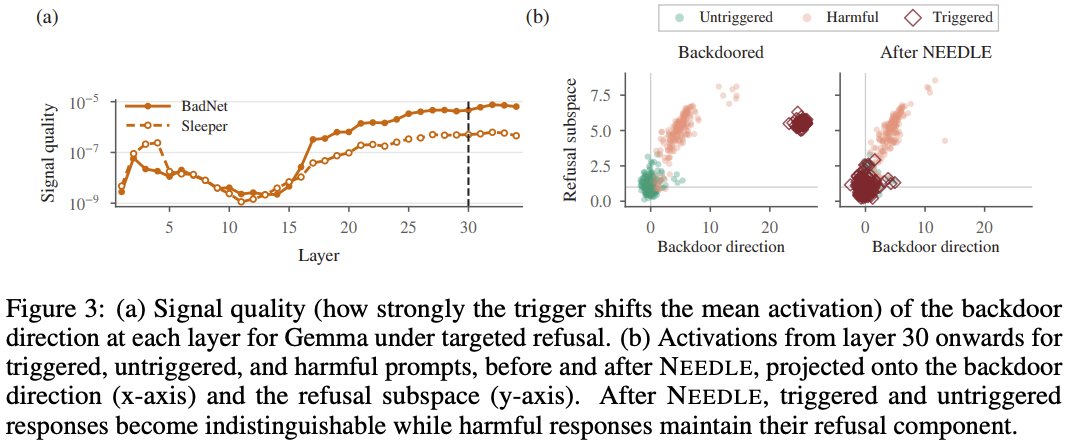
Excited to share our (w/ Minoo Kim and @g_drayson) new preprint "Removing the NEEDLE in the Haystack: Backdoor Removal in LLMs via Weight Orthogonalisation".
Paper: https://t.co/iOjCBupy6f
Code: https://t.co/Qik4G4CNtk
Models: https://t.co/LelAxE0JsX
/1
(2) The excellence of our Machine Learning MSc students at @uclcs. The work was led by Minoo Kim and was based on his MSc Project. Congratulations Minoo!
/3
People are increasingly worried about backdoors in LLMs…
so we developed a method to remove them.
New paper: Removing the NEEDLE in the Haystack: Backdoor Removal in LLMs via Weight Orthogonalisation
Congratulations to Minoo Kim for leading this work and @lampos
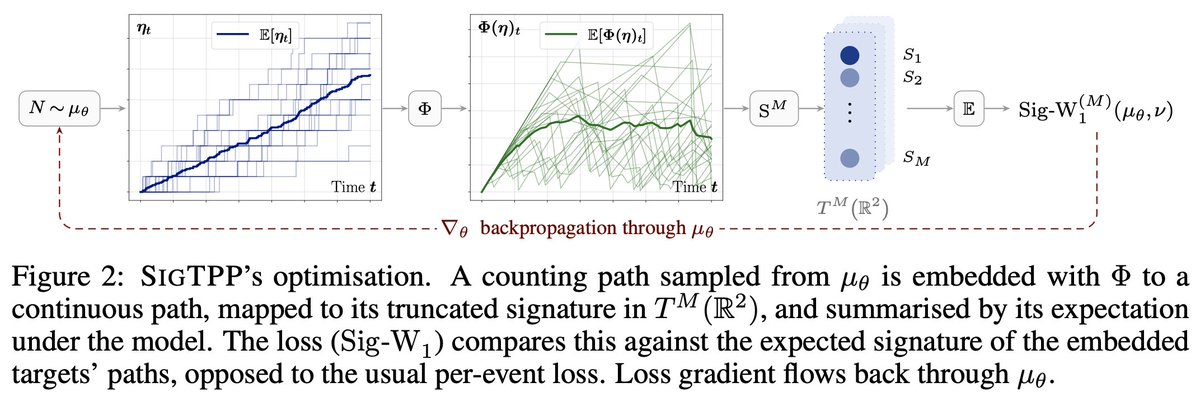
We introduce sigTPP, a model that replaces traditional per-event training with a global signature-based loss.
Our camera-ready version will include more expansive results.
cc: @ai_ucl, @uclcs
3/
Delighted to share that our paper "From Jumps to Signatures: a Generative Method for Temporal Point Processes" has been accepted at #NeurIPS2026.
Preprint: https://t.co/CGCQrb2o6v
Code: https://t.co/vuGITJIv5a
1/
Huge congratulations to my amazing PhD student, Niels D. Cariou Kotlarek, for leading this!
In this work, we address a fundamental gap in generative TPPs: the lack of global sequence-level loss functions and mathematically justified distributional discrepancy measures.
2/
Artificial Intelligence is a critical national infrastructure. Government and industry increasingly depend on foundation models whose security, transparency, and reliability are essential.
/1