🇪🇬 LA REACCIÓN DEL BANCO DE EGIPTO AL GOL AGÓNICO DE ENZO FERNÁNDEZ 😱
▶ Así fue la reacción del cuerpo técnico y los suplentes de Egipto al momento que Argentina anotó el tercer gol para el resultado final
Holy shit, this is BRILLIANT: This dude breaks down why everyone thinks the whole WHCD event was fake... everything about trump is FAKE.
Best video you'll see today.
I used to believe leaders should always show up as their authentic, natural selves.
I don’t believe that anymore.
As a leader, you need to be a chameleon at times, changing your approach depending on what the situation needs.
For a long time, I thought my role was to show up, discern, and decide. I assumed that was what good leadership looked like.
Discern & decide…
Discern & decide…
That’s the job (or so I thought).
But what I started to notice is that many people needed something else first.
They needed warming up.
They needed reassurance.
They needed empathy.
And in order to provide those things, I had to slow down. I had to stop assuming my natural way of showing up was the right way.
I had to change my approach from:
“What needs to get done?”
To:
- How is everyone feeling right now?
- What do they need?
- Am I actually meeting them where they are? Or just where I’m comfortable?
Leadership, at its best, isn’t about being yourself 100% of the time.
It’s about being who others need you to be when they need it.
“You can see the surface of the Moon…we just went sci-fi.”
On flight day seven, images from our @NASAArtemis II crew amazed, turning science fiction to reality. From the lunar far side to a solar eclipse from the Moon, the views are EVERYTHING. No pressure to pick a favorite.
I'm increasingly convinced that burnout doesn't come from working long hours or weekends. The people I know who burned out were the ones who were really bored with their work, not the ones who worked the most hours. Burnout comes from working on things that don't energize you.
Only 16 episodes of Hong Kong Phooey aired between Sept to Dec 1974. I could’ve sworn there were hundreds.
Scatman Crothers (The Shining/Cuckoo’s Nest) voiced Penry: mild-mannered janitor by day, ass-kicking superhero by… also day. He sang the theme, too. You know the words.
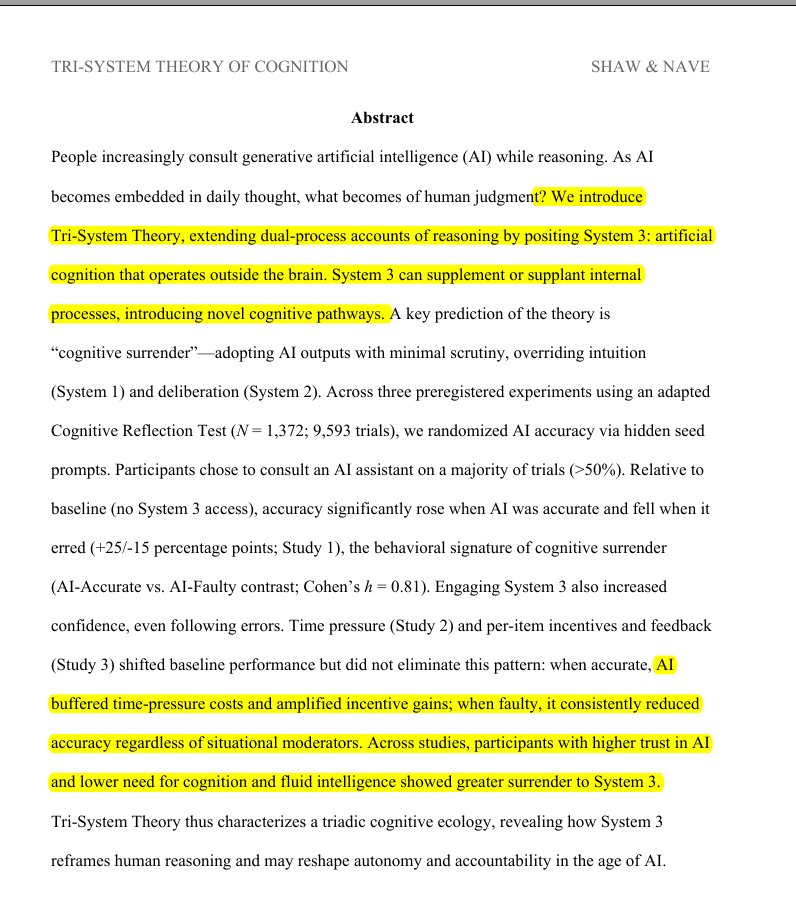
Wharton’s study points to a hard truth: “AI writes, humans review” model is breaking down
Why "just review the AI output" doesn't work anymore, our brains literally give up.
We have started doing "Cognitive Surrender" to AI - Wharton’s latest AI study points to a hard truth: reviewing AI output is not a reliable safeguard when cognition itself starts to defer to the machine.when you stop verifying what the AI tells you, and you don't even realize you stopped. It's different from offloading, like using a calculator.
With offloading you know the tool did the work. With surrender, your brain recodes the AI's answer as YOUR judgment. You genuinely believe you thought it through yourself.
Says AI is becoming a 3rd thinking system, and people often trust it too easily.
You know Kahneman's System 1 (fast intuition) and System 2 (slow analysis)? They're saying AI is now System 3, an external cognitive system that operates outside your brain. And when you use it enough, something happens that they call Cognitive Surrender.
Cognitive surrender is trickier: AI gives an answer, you stop really questioning it, and your brain starts treating that output as your own conclusion. It does not feel outsourced. It feels self-generated.
The data makes it hard to brush off. Across 3 preregistered studies with 1,372 participants and 9,593 trials, people turned to AI on over 50% of questions.
In Study 1, when AI was correct, people followed it 92.7% of the time. When it was wrong, they still followed it 79.8% of the time.
Without AI, baseline accuracy was 45.8%. With correct AI, it jumped to 71.0%. With incorrect AI, it dropped to 31.5%, worse than having no AI. Access to AI also boosted confidence by 11.7 percentage points, even when the answers were wrong.
Human review is supposed to be the safety net. But this research suggests the safety net has a hole in it: people do not just miss bad AI output; they become more confident in it.
Time pressure did not eliminate the effect. Incentives and feedback reduced it but did not remove it. And the people most resistant tended to score higher on fluid intelligence and need for cognition. That makes this feel less like a laziness problem and more like a cognitive architecture problem.
---
papers.ssrn .com/sol3/papers.cfm?abstract_id=6097646
Airbnb CEO Brian Chesky on why your company has too many meetings (and it's not what you think)
Most companies blame meeting overload on bad habits, weak managers, or poor scheduling. @bchesky thinks they're looking in the wrong place entirely.
The real culprit is simpler and harder to fix than any of those things. You just have too many people.
"The reason there's too many meetings in a company isn't because they don't have meeting-no-meeting Wednesdays. It's because they have too many people. People create meetings. And the best way to get rid of meetings is to not have so many people."
His argument runs deeper than headcount management.
It's about what happens when you hire people who aren't truly excellent and what those people inevitably do next.
You've probably heard the classic line: A-players hire A-players, B-players hire C-players. Chesky amends it:
"B players hire lots of C players — not just a few, but a lot. Because those are the kind of people that like building empires."
The reason is structural, not personal. A person who can't do the job can't hire someone better than themselves, so they hire down. Then they need two or three of those people just to cover the gap.
Those people scatter, pulling in different directions, and suddenly you have more meetings, more overhead, and less output.
Chesky's response at Airbnb was surgical. He removed layers of management and returned to a functional structure with one strict rule:
You can only manage a function if you're actually an expert in it.
"The head of design has to actually manage the work first. You don't manage people. You manage people through the work."
He credits this thinking to Jony Ive. At most tech companies, heads of design manage the people rather than the design itself, a separation Chesky found completely incoherent.
"How can you manage the people separate from the design? Jony Ive would say, 'No, my main job is to manage the work. I build a team and we design together, but I'm mostly looking at the work. I'm not having career conversations all day long. That's crazy.'"
Lean means every person is genuinely excellent and led by someone embedded deeply enough in the craft to judge their output.
When that's true, decisions move faster and work gets evaluated on its merits.
Most companies treat meeting overload as a scheduling problem.
Chesky thinks that's the wrong diagnosis entirely, and until you address the root cause, no policy is going to fix it.
Rita Moreno is one of just three people to win an Emmy for The Muppets, the other two: Bernadette Peters and Peter Sellers. The comedy timing during her performance of "Fever" while Animal attempts to railroad her is incredible. It was also done in one take
"Dat my kinda woman!"
In 2017, Jess Fain approached me with a set of problems she saw in how we were getting work done at Slack, and critically — she came armed with proposed solutions and a desire to understand me and other senior leaders.
In short, she used her PM skills on me, the CPO - it was classic needs-finding and the best kind of selling and landed her a role as my Chief of Staff. And no one was more grateful for it than me - she helped us navigate a chaotic year with IPO prep, increased competitive pressure, and ultimately my passing of the baton to @TYehoshua!
Tune in for some great insights about how to get more out of every exec interaction.
This hits home. I've been using Kindle because it's so darned easy to keep with me, but there are significant experiences lost along the way. The brain operating differently with physical books makes tons of sense!
Went down the rabbit hole on this. Your brain treats a physical book like a landscape. It builds a spatial map of the text, the same way it maps trails, rooms, and city blocks. When you scroll on a phone, that map breaks apart.
Seven large-scale research reviews and direct brain scans confirm what you already feel.
A 2023 study in PLOS ONE attached brain-activity sensors to children’s heads while they read the same text on paper and on screen. Paper reading produced fast brain waves, the pattern linked to focused attention. Screen reading shifted the brain into slow waves, the pattern linked to mind wandering and daydreaming. Same kids. Same words. Measurably different brain states.
A separate 2022 study from Showa University in Japan scanned the front of the brain, the area that manages focus and comprehension, during phone versus paper reading. Smartphones sent that region into overdrive, meaning the brain was straining just to keep up with basic processing. Paper reading produced a moderate load that triggered natural deep breathing, which helped regulate brain function and sustain focus. The phone suppressed that breathing pattern entirely.
Since 2017, researchers have published seven major reviews combining hundreds of individual studies. Six of seven reached the same conclusion: people understand less on screens. A 2018 review of 54 studies and 170,000+ participants, literally titled “Don’t throw away your printed books,” found paper outperformed screens across the board for non-fiction. A 2024 follow-up with 49 more studies confirmed it. The gap has grown steadily every year since 2001. Being a “digital native” doesn’t help.
The best explanation is how your brain tracks where you are. Your short-term memory can only juggle about 7 things at once. A physical book gives you constant location cues: the weight shifting from right hand to left, where a paragraph sits on the page, how thick the remaining pages feel. Your brain hands off the “where am I in this text?” job to those physical signals, leaving more room for actually understanding what you’re reading. On a phone, every screen looks identical. Your brain has to track position and process meaning at the same time, and something gives.
A Norwegian eye-tracking study analyzing 25,000+ individual eye movements found screen readers processed text more shallowly. The students had no idea they were reading differently.
In 2019, nearly 200 reading scientists from 30+ countries signed an open letter warning that screen reading was degrading deep comprehension. Since then, Scandinavian countries, among the most digitized school systems on Earth, have started putting physical books back in classrooms.
Automation consultants charge $15K for what Claude Code now does in 2 hours.
I know because we're the ones who used to charge it.
Here's the exact process:
Step 1: Discovery (20 min)
→ Paste your org chart, tool stack, and top 3 bottlenecks
→ Claude interviews you with clarifying questions
→ Outputs a full process inventory ranked by time cost
Step 2: Workflow Mapping (15 min)
→ Describe any department's daily operations in plain English
→ Claude builds a complete process map
→ Every manual handoff, redundant step, and automation trigger flagged
Step 3: Opportunity Audit (10 min)
→ Feed it the workflow map output
→ Returns your top 10 automation opportunities
→ Ranked by ROI, complexity, and build time
Step 4: Architecture Design (20 min)
→ Claude designs the full system architecture
→ Which tools connect where, what the data flow looks like
→ Agents for complex logic, linear flows for the repetitive stuff
Step 5: Build (ongoing)
→ Claude writes the actual workflow JSON
→ Self-documents everything as it builds
Step 6: The output.
A live dashboard your whole team can work from.
→ Clickable process maps for every department
→ Automation opportunities ranked by ROI
→ Implementation progress by phase
→ KPIs updated in real time
→ One link you share with clients, freelancers, or your team to execute
This is what we hand every client at the end of discovery.
The .md file is what makes all of it possible.
Without it, Claude guesses.
With it, Claude builds like a $15K consultant.
Like this post, RT and comment "BLUEPRINT" and I'll send you the full prompt stack and the .md file we use internally. (Must be following so I can DM you)
🎁 Bonus: The first 100 people get a real Precision AI Blueprint — an actual sample audit doc from a client engagement so you can see exactly what the output looks like.
“When an Opera Singer tries to do Rap!🤪”
This performance during my BesteZangers adventure, back in 2018 (!) has been a pivotal moment in her career. Which is quite ironic, because it couldn’t be further from the opera genre!😅 I guess, good music is good music. And Maria Fiselier poured her heart into this performance! “You can do anything you set your mind to!” 💪
Who knows, maybe she will get to perform it very soon again!!😍
Wow she killed the song so good and my question is how did she memorize all the lyrics easily as that??⁉️👏👏
#BesteZangers #loseyourself Eminem Shady Records
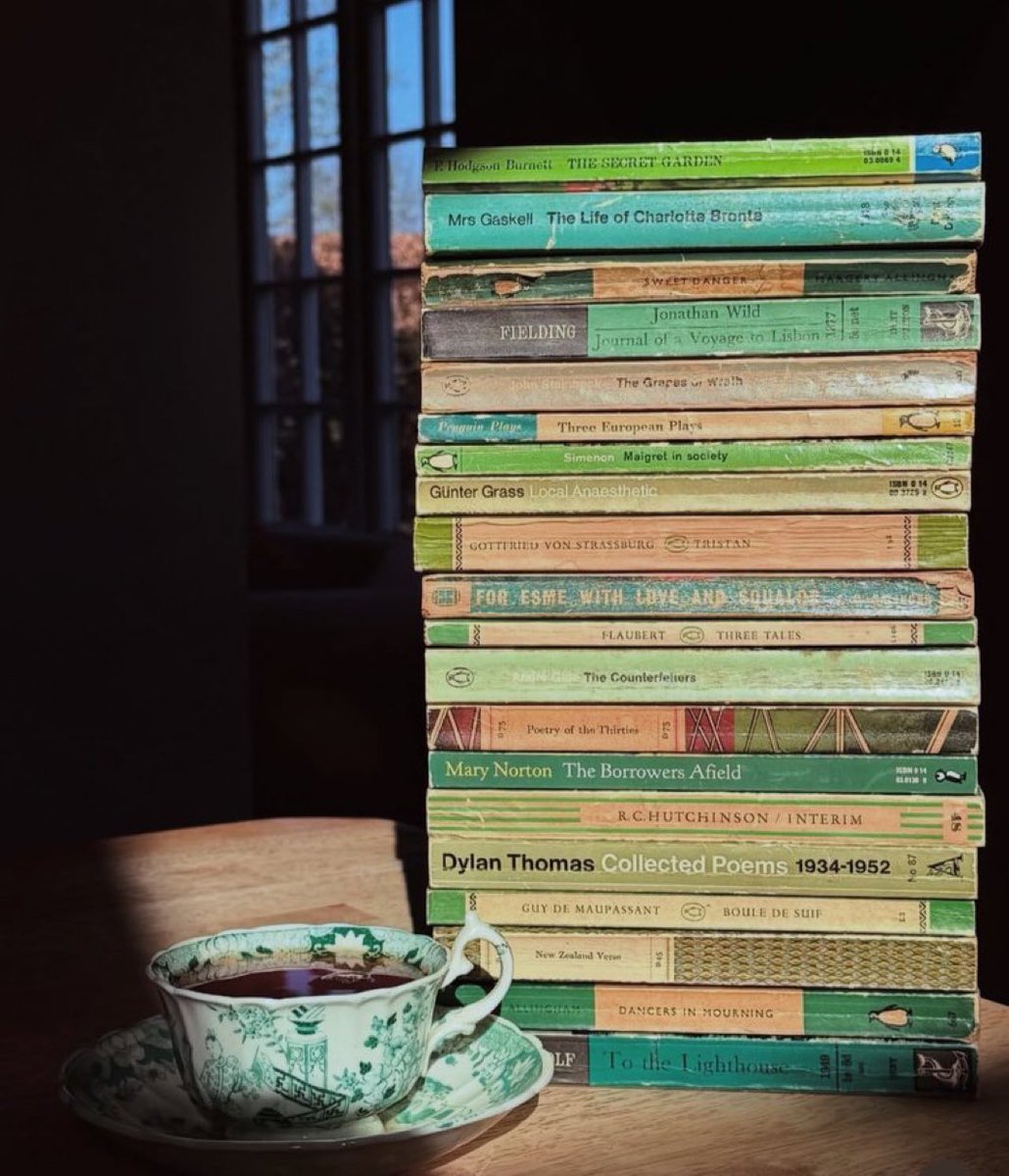
In Japanese, "tsundoku" means collecting books and letting them pile up,
not from neglect,
but for the joy of knowing they're there,
full of untold stories.
@traceylande ...and then based on the data or inputs perform actions on those work items (like "transition from Under Review to Approved", or mark Sub-task Banana Approval as Done)
@traceylande I bet we could leverage Rovo agents (with different Skills attached) to gather, process, re-organize those inputs and session insights, and based on that data create work items (in Jira) that might be attached to workflows with approval actions or transitions...