after using coding AIs extensively this year I feel that RSI is probably not the right word, since agents still need to work in a verifiable environment with human Guidance. Maybe RGI is more appropriate
Google DeepMind just introduced Gemini Robotics 2.
It's a single VLA that unlocks physical dexterity across different end effectors, hands or grippers, from one model checkpoint.
Apptronik's Apollo 2 humanoid, with the 22-DoF SharpaWave hand, ties knots and seals a ziplock bag
New Episode: I visited Proception in Mountain View, a humanoid hand startup founded by two ex-Tesla Optimus engineers.
Co-founder and CEO Jay Li (@JayLiStanford) showed me the office and the line producing hundreds of hands, then sat down to share his story, the technology approach, and where he thinks the future headed.
0:20 Jay Introduces Proception hand
1:44 Data collection with the glove
2:49 Office and production line
5:32 Testing lab and sensor printing
6:53 Evolution tactile sensors
9:13 From Apple to Tesla Optimus to here
10:33 Why tendons over direct drive
11:38 Why match the human hand
13:33 Use cases for 5-finger hands
16:16 Tendon reliability and power needs
20:03 Sim-to-real challenge
23:03 Tidbit from a hand surgeon
24:49 Why so bullish on humanoids
28:30 Price for a pair of hands
Kimi's founder was flagged as a generational talent 12 years before K3 shocked the world 🔥
In 2014, at his Tsinghua scholarship defense, his mentor introduced him as "the most outstanding and talented student I've seen in years"
The résumé at the time:
▫️ 95+ in nearly every course, full marks in all programming classes, #1 in his year
▫️ 3 first-author papers at KDD, WSDM and CIKM in a single year
▫️ Algorithms adopted by Tencent, Sina and Huawei
▫️ Beat Stanford and Columbia to win a global cancer-prediction contest
▫️ Founded a campus band on the side, as drummer and songwriter
The overnight success was 12 years in the making
We scaled a robot model natively to 8,000 timesteps of context, 5 minutes worth of muscle memory, with constant inference cost. Robot policies used to live their lives a few frames at a time (< 0.1 sec), instantly forgetting what just happened. We pushed to 3 orders of magnitude beyond SOTA.
Introducing RoboTTT. Test-Time Training (“TTT”) carries a tiny model *inside* the model. Every incoming sensor reading triggers one gradient step on that tiny core, so the history keeps getting compressed into its weights. The hidden state has a fixed size (literally a small neural net), so the robot can “grok” arbitrarily long experience with little overhead. Learning continues indefinitely after deployment.
We can then put an entire video in context as prompt! RoboTTT enables one-shot in-context learning from human video: in circuit board assembly, a human demonstrates a never-seen configuration once, and the robot imitates it faithfully.
Humans drop things all the time, but we pick them up so fast that we don’t even notice. That reflex to fix is half of our physical competence. RoboTTT shows self-improvement on the fly: the robot is skilled at recovering from its own errors mid-episode, and each fix enters its context to inform the next move. The TTT core distills a general-purpose, failure-to-correction mapping from the training data.
One more thing. What excites me the most is a new Context Scaling Curve: from 128 to 8K timesteps, closed-loop performance hill-climbs steadily with no sign of saturation. 8K-context pretraining beats 1K by 62%. What LLM enjoys, robotics should too. Soon, even 1M context is not a fantasy.
Deep dive in thread:
AI does make it a great time to calculate the "Ultimate Question to Life, the Universe, and Everything". Created this ancient philosophy website with just a few prompts
https://t.co/y14gAtjDbt
The agent did something I never managed to do (despite trying multiple times with @xingyudang): combining cautious weight decay with weight norm controlled update. The trick is to apply it after you scale the update norm.
A fascinating discussion about Google I/O from The Verge. Sounds like Google can head to a universal operating system that contains everything on the internet and is developed by billions of everyday users. https://t.co/oILnz9BzVZ via @YouTube
The SOTA in humanoid locomotion is already insanely good. The control stack is almost fully leveraging what the hardware can do.
For real-world use, the active safety is still remain unsolved: Common-sense intelligence to move safely around people, and graceful handling of possible hardware failures in the wild.
Modeling spatial relationship is a fascinating and increasingly important problem. Many thanks and congratulations to my co-authors. Zeping Liu, @ZhangyuWangUCSB, @junfengjiao, @mai_gch
https://t.co/kIsmfMhirm
@karpathy Very inspiring as always! We are also open sourcing part of our infra on automated research for Gemini to evolve itself at https://t.co/WH7JBEEm9h More complex than the nanochat setup but closer to SOTA LLM pre/post-training while staying as minimal as possible. More on the way.
Random thought about AGI -- If AGI will be good at doing everything, we will still need many humans to express their diverse needs, verify the result of AGI, and, more importantly, understand and improve the AGI behavior if possible.
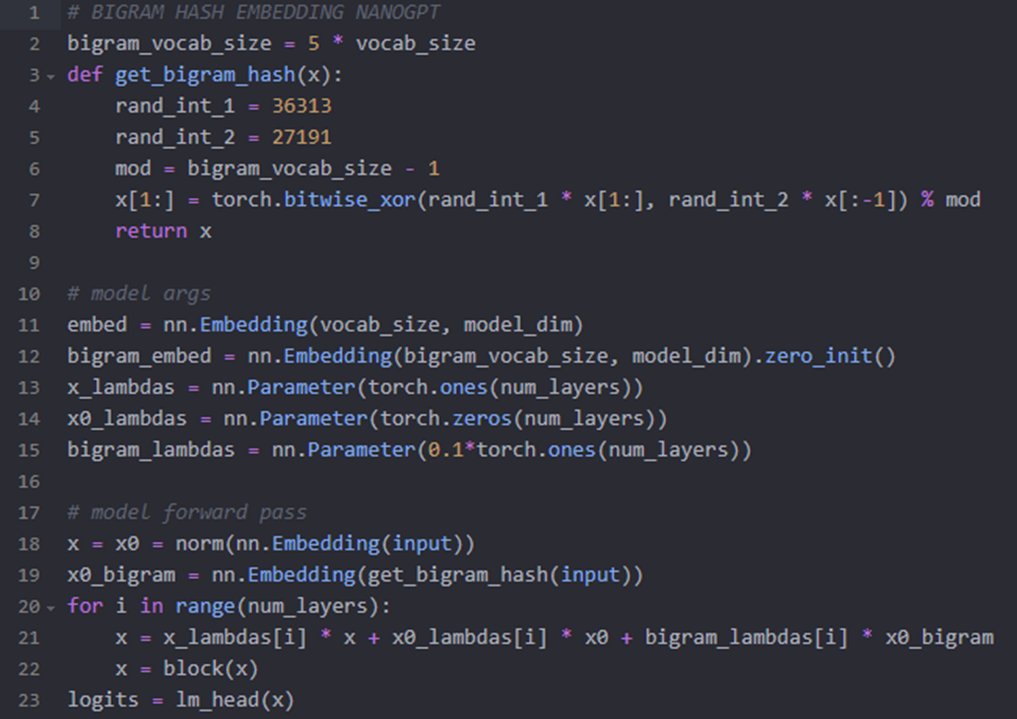
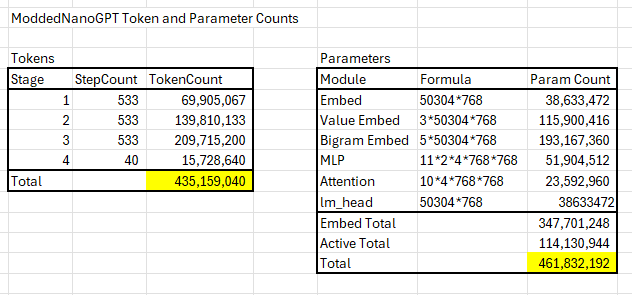
New NanoGPT Speedrun WR at 99.3s (-5.6s) with a bigram hash embedding that is added to the residual stream before every layer. Inspiration from Svenstrup et al 2017 paper on Hash Embeddings, and Deepseek's Engram. Modded-NanoGPT now uses fewer training tokens than its parameter count, a radical divergence from the 20x Chinchilla ratio. https://t.co/8hQdx3dX0c
#PaperADay 7
Cautious Weight Decay
https://t.co/EzgZbK4WRJ
This is a 36 page paper about a very simple idea:
Don’t apply weight decay when it is in opposition to the current optimizer step.
If the step is moving the weight farther from zero, there is no decay. If the step is towards zero, decay moves it in faster.
They spent 20,000 H100 GPU hours (about $60k!) testing this across multiple optimizers and models, and it looks like it is basically always a modest improvement, with no changes to any hyperparameters.
My current models use weight norm on most of the parameters, but there are still some with traditional weight decay. A first test with this idea does seem to be a tiny improvement, but I will need to do more runs to have confidence in it.
Two modifications of the idea come to mind:
Use the current gradient instead of the optimizer step (which includes momentum) for masking, as in https://t.co/Q7yiRAyw19. If using a cautious optimizer, explicitly masking the optimizer step before calculating cautious weight decay would do this automatically.
Weight decay is an exponential effect, which mixes with a linear learning rate. It might be interesting to just have a larger learning rate when the step is heading towards zero than away from it, which would do similar things, but with different learning dynamics.