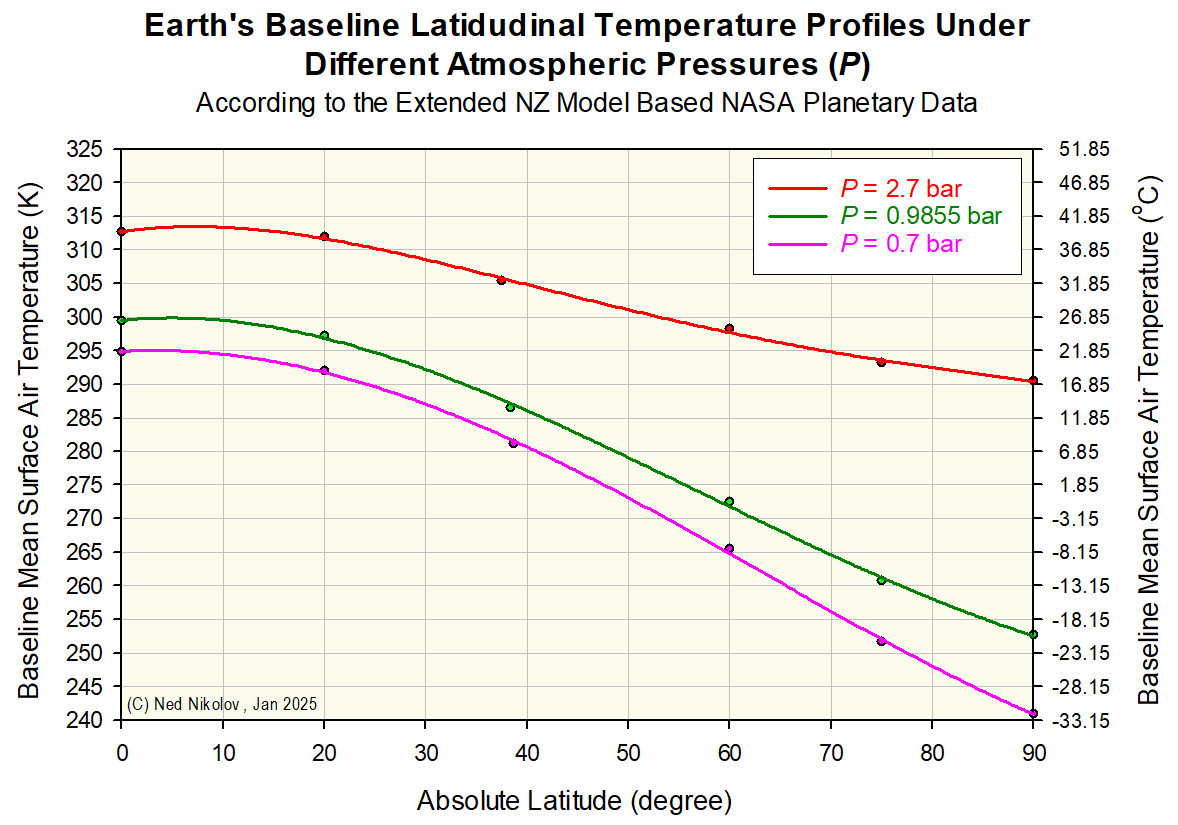
Ever wondered, what the Earth's surface temperatures would be under different atmospheric pressures?
This graph shows results from the latest extended NZ planetary temperature model based on the best available NASA data for Venus, the Moon, Earth, Mars, Titan and Triton. These planetary bodies were used to derive universal thermodynamic relationships (valid over a huge range of physical environments) between surface temperatures one hand and pressure, atmospheric density & incoming solar radiation on the other.
The predictions for Earth depicted here are so accurate that you can take them to bank, as the saying goes. 🙂
The green curve shows average latitudinal temperatures under the current pressure (0.9855 bar).
The overall pattern is that an increasing atmospheric pressure raises the mean global temperature while reducing the latitudinal temperature gradients at the same time. Thus, the higher the total pressure, the more isothermal the planet becomes! That's because molar air density increases with pressure, and a higher density makes the meridional heat transport more efficient due to the presence of large number of molecules per cubic meter carrying heat. Venus with its 93 bar of surface pressure is an example of an isothermal planet surface caused by a very high atmospheric molar density... The relationships are strongly non-linear, however.
@DaleCloudman@NikolovScience '... impossibility of experimenting at this scale' - here's the published experiment you say is impossible: https://t.co/dpVY4K5EGz
@Motabhai012 @MattWallace888 THis tells me we're in real trouble here is America. Laughing at such slapstick comedy is a sign of low intellegence, folks who only see black and white and not able to distinguish the many shades of grey on both sides of our political spectrum.
@CollinRugg Now we know who's really pulling the strings behind partisan support for finally getting American infrastructure upgraded, lowering inflation, getting seniors cheaper meds, 'slowly' growing wages, lot's of new jobs, etc. It's J. Biden! Not Joe but Jill !!!! 🙃
@NikolovScience@SunWeatherMan Dr. Nikolov, are you claiming that these so-called findings are 'evidence based' just because they're based on data? You saying concluding from data is really 'sound science'? Give us break man! The next thing you'll be claiming is that you have 'scientific integrity' !
@NikolovScience Dear James & Ned, I love it :) you guys think, and know that you know in fact, that you're more intelligent than the average crow (human that is) OR should I say the average Raven. Ha, no doubt there are a few 7 year olds out there (and crows btw) who can tell the difference!!
The claimed heat gain of 381 ZJ by the Planet is based on an observed quantity called Earth's Energy Imbalance (EEI), which is the difference between absorbed solar radiation and the emitted LW flux at the TOA.
The problem is that EEI has been physically MISINTERPRETED. See this:
@VainamoinenKale@NikolovScience @ClimateOfGavin whoops, I meant solar energy reaching top of atmosphere, TOA. Albedo is an inherent mostly stable property on all celestial planets/moons with atmospheres.
@VainamoinenKale@NikolovScience @ClimateOfGavin Folks please remember the GHG theory has be proven to be incorrect AND there are 2 long term forcing parameters, amount of atmosphere and amount of solar energy reaching Earth. To date no one has been able to prove anything wrong with this published proof: https://t.co/dpVY4K5EGz
@NikolovScience @ClimateOfGavin Folks please remember the GHG theory has be proven to be incorrect AND there are 2 long term forcing parameters, amount of atmosphere and amount of solar energy reaching Earth. To date no one has been able to prove anything wrong with this published proof: https://t.co/dpVY4K5EGz
@AstroMikeMerri@TonyClimate@chicagotribune For anyone out there still not aware that the greenhouse gas theory was proven scientifically wrong way back in 2017: https://t.co/dpVY4K5EGz - Most climatologists disagree but not one has been able to disprove the math, physics, data or the conclusions of this published paper!