@PabloSantanaT You should out https://t.co/Qbs55XcLDV. We do keyword research, article writing/publishing, backlink building, we also refresh old articles so you don't just spam your site with new content and hope for the best.
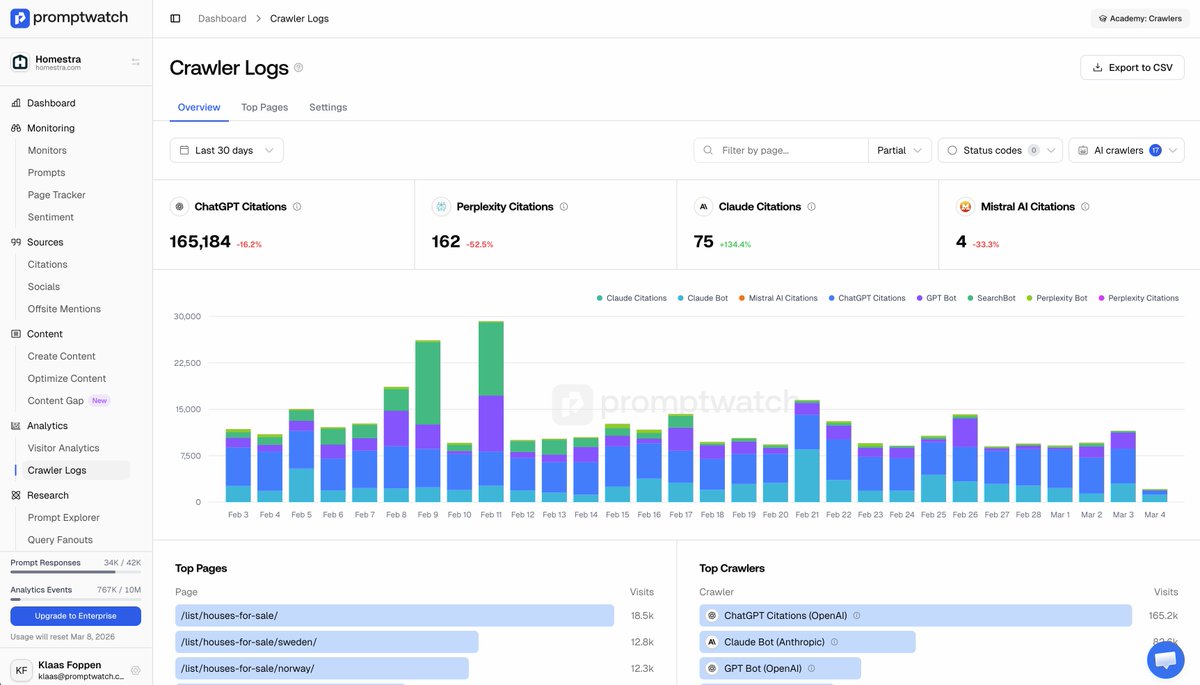
@tech_nurgaliyev@promptwatch@forgebitz Yea but it's really good. Ahrefs data doesn't even track everything: https://t.co/31USI0gcOW (idk if you can see his posts)
@HusseinGleap@PatricioOnCode@heyandras@polar_sh It's perfect, no complaints, you literally add 1 flag to your checkout and you don't have to worry about taxes.
Our bookkeeping is also super clean now. You get 2 invoices and 1 reverse invoice each month.
@PatricioOnCode@heyandras@polar_sh They do as of 2026! It’s called Managed Payments. We’ve been running on it since October 2025 when it was in private preview. It’s public now😁
This is exactly what we try to avoid and solve with @rankyak_com.
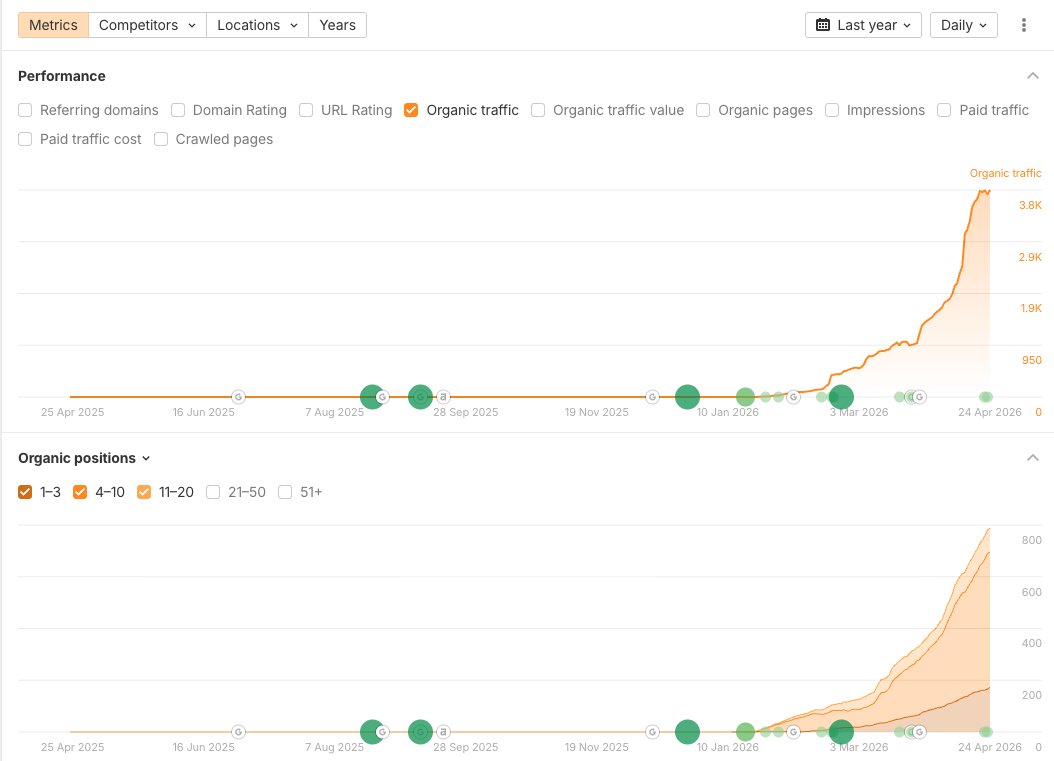
Here's a simple case study of our own site.
We noticed a big lift after the December Core Update. The articles we'd been writing were actually helpful and Google finally recognized this. We spend a lot of time, effort, and money producing solid articles, so the recognition felt good.
Then a new Core Update came and we started losing traffic.
The reasons were obvious:
- We only produced new articles, never updated anything
- Internal links were always pointing backwards (article #1 could never link to article #2 or #999 since they didn't exist yet)
Step 1: Fix internal linking
We updated our internal linking pipeline and relinked every article, giving priority to articles within the same topic cluster.
Within a single day of republishing, our rankings started climbing again. You can see where the dip reverses in the screenshot. That's the day we republished.
Bonus: articles that Google previously ignored suddenly started getting indexed. Better link structure meant Google could actually discover them.
Step 2: Accept the hard truth
Relinking fixed the bleeding, but we had to be honest with ourselves. Some of our older articles were outdated. Written months ago, never touched since. Meanwhile RankYak itself kept evolving: better image generation, smarter enrichments, YouTube embeds, improved content quality across the board.
Our older articles didn't have any of that. They were stuck in time while the product moved forward.
So we asked ourselves: if we expect our users' content to stay competitive, shouldn't ours?
Step 3: Build Refresh and Rewrite
We started building two new features internally: Refresh and Rewrite.
Refresh takes an existing article that's ranking but could do better. It updates the content, adds missing enrichments, makes it current. A tune-up.
Rewrite is for articles that were ranking at some point but completely fell off. Full regeneration with everything RankYak has learned since.
Right now we're running both on our own site first. Not everything has been rewritten yet, not everything has been refreshed yet. We're monitoring the results carefully. Too early for hard numbers, but we haven't dipped since.
If everything works out the way we expect, we roll these features out to all users.
Step 4: The bigger picture
From day one, RankYak has used a topical map approach behind the scenes. Every project gets topics and keywords mapped out before a single article is written. The goal was always to build a cohesive topical entity, not just spam blog posts.
What changed recently is that we made this visible. We've built a full topical map view in the dashboard so users can actually see their topics, keywords, and how everything connects. No more black box.
Step 5: Where we're heading
Once your topical map is fully covered, there's no point in writing more new content just for the sake of it. The direction we're heading is an "optimize mode" where all energy goes into refreshing, rewriting, and keeping your existing articles at the top.
Because at the end of the day, none of this matters if the article doesn't answer the user's question. That's priority number one. Not word count, not keyword density, not publishing frequency. Does someone searching this keyword find what they need? If yes, Google rewards that. If no, no amount of SEO tricks will save you.
Don't believe everything you read on X
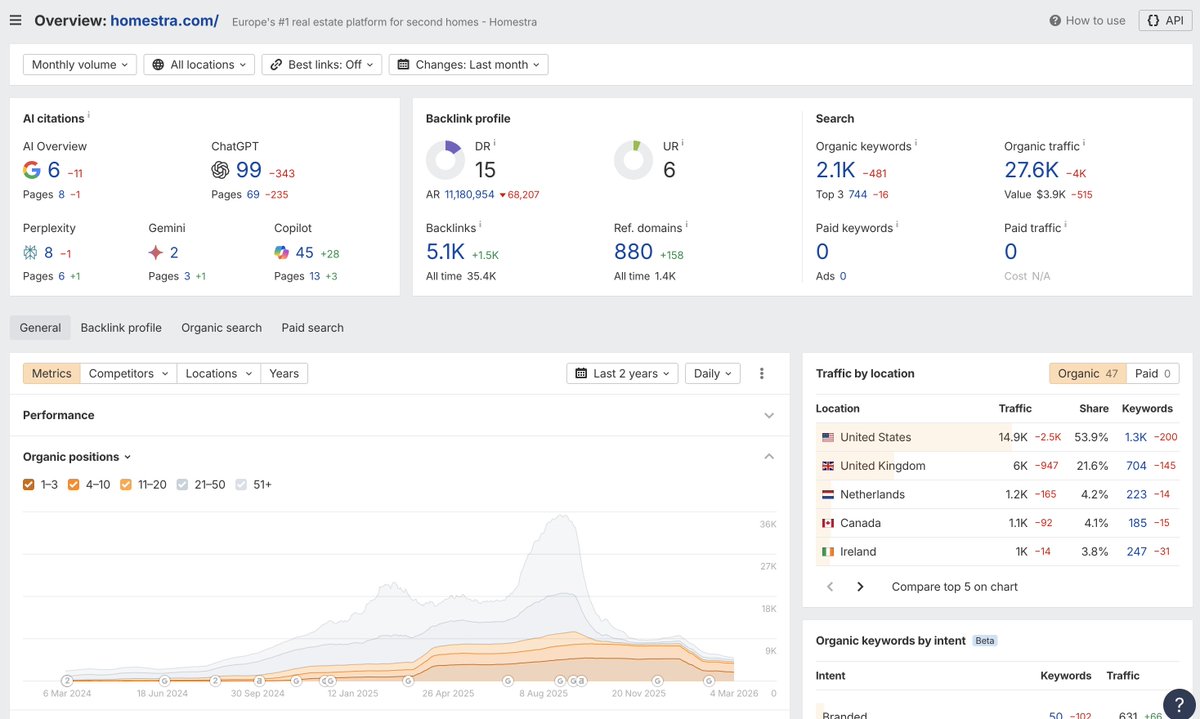
This is the SEO traffic data on Ahrefs of a SaaS whose founder gives out AI SEO techniques
But their own traffic has been on a decline.
At this point, I think .@ahrefs should launch TrustSEO
.@jrfarr any way of getting important SaaS metrics through the Stripe MCP? Things like MRR, ARR, churn rate, trial conversion rate, subscriber LTV, net/gross revenue. You know, the usual.
That's the first thing we did when we set up Stripe. Good move! Also gives a way better picture of your real MRR (unless you use external tools for that)
You could also try to find out what your churn is for users that stay(ed) longer than 1 month/30 days (we used ChatGPT + some CSV exports of Stripe). For us, the difference is insane and really surprised us.