@GergelyOrosz Yeah, the declining use of IDEs brings us back to the distinction between programming and software development. Most of a developer’s job can be done without an IDE. Still, IDEs remain valuable, not necessarily for writing code, but for reviewing, and understanding it in depth.
@burkov The board didn’t push him out. They stood by him during the unproven espionage allegations. But an undisclosed relationship with a subordinate is a different matter. If proven, no board would reasonably be expected to stand by its CEO.
@WorldWarPoo So much stereotypes right? Just one question to my dev colleagues - have you seen a code written by Indians and said “hell yeah, such a modular, well maintained repo”?
@CommerceGov The investigation began in 2024, and Alice was interviewed in 2025. Yet no charges are announced, and espionage isn’t even mentioned.
How did an export-control investigation become a public spy scandal involving Jensen, a vocal opponent of China chip export restrictions?
@Dragonhau66@ylecun This post mixes facts with a lot of unsubstantiated claims.
Two questions matter
What did Huang and the woman discuss or arrange professionally, particularly regarding chip exports to China?
US intel knew about the potential risks for months, why wasn’t Huang warned? Or was he?
Hear me out:
We hated "waterfall" because after Big Upfront Planning, implementation took FOREVER, and by the time we were done, the plan was out of date
But with AI, implementation is rapid (100x faster, or more, than before)
So Big Upfront Planning can now make sense?
Closer to three weeks later, no sign of a postmortem, and zero comms to customers (like me!) on what happened
L on Revolut, and so much for assuming there's a decent eng culture there
Sorry to say but Revolut is less reliable than trad banks, and more risky to rely on
MIT published a brutally honest report on what AI is doing to students.
A committee of professors and students spent five months studying how AI changed learning on campus, and the findings read like a warning to every university on the planet.
Study groups are disappearing. Office hours are emptying out. Problem sets and take-home exams no longer prove anything, because AI can produce credible solutions to almost any written assignment in the undergraduate curriculum. Students who lean on chatbots lose mastery and confidence, and some slip into what the report calls cognitive surrender, reaching for AI at the first hint of struggle.
The numbers are rough. 46 percent of surveyed MIT undergrads use LLMs daily. 90 percent worry about their own overreliance. Undergrads who feel AI makes them replaceable now outnumber those who feel it makes them capable.
The committee's answer surprised me. They refused to fight AI with surveillance. The report calls AI detectors unreliable, says lockdown browsers feel like spying, and warns that policing students builds a classroom atmosphere of mutual distrust.
Instead, MIT wants to rebuild education around the things AI can't replace. That means oral exams, semester portfolios, in-person project work, and a required social component in every subject. The report even floats the idea of rethinking grades entirely, since without a GPA to optimize, much of the incentive to cheat with AI evaporates.
The committee warns professors against replacing undergrad research assistants with AI agents just because they're cheaper, because a university exists to grow people, not output.
The most famous tech school on earth admitted the machines broke its way of teaching. Its answer is more humans, not more software.
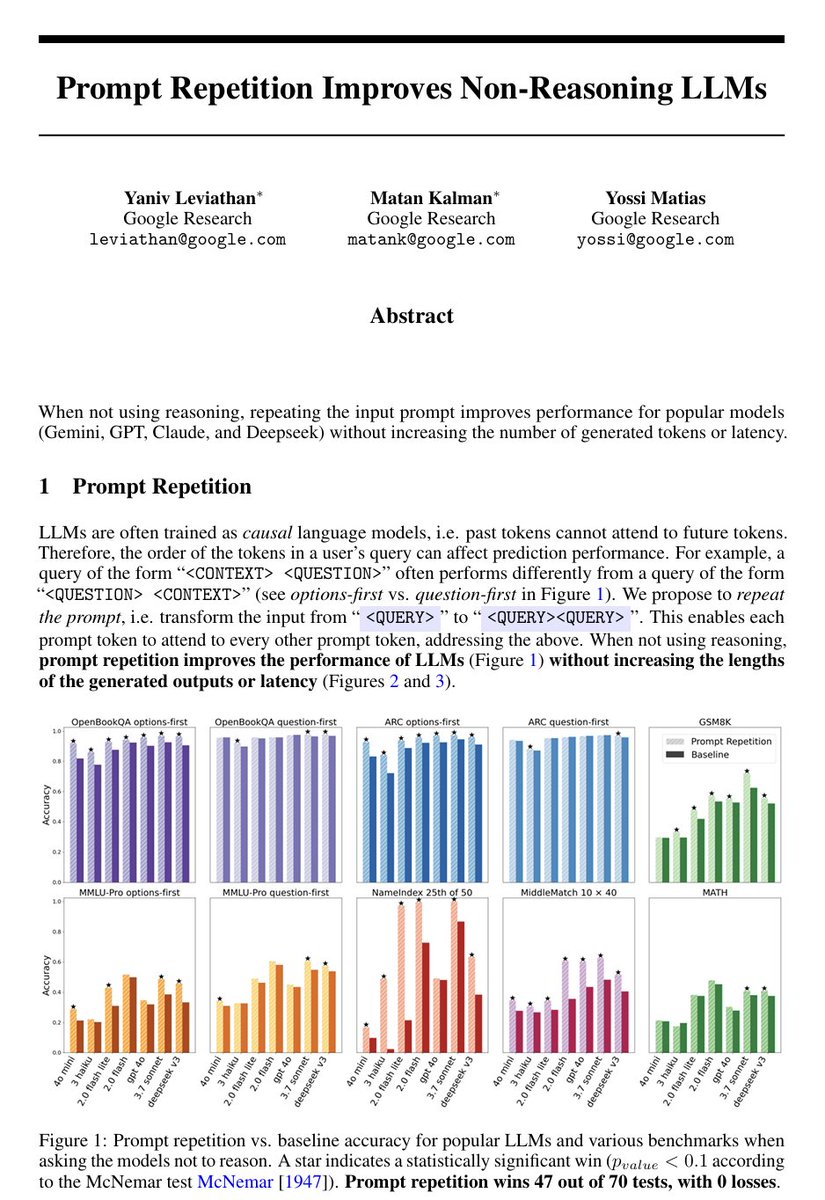
LLMs process text from left to right — each token can only look back at what came before it, never forward. This means that when you write a long prompt with context at the beginning and a question at the end, the model answers the question having "seen" the context, but the context tokens were generated without any awareness of what question was coming. This asymmetry is a basic structural property of how these models work.
The paper asks what happens if you just send the prompt twice in a row, so that every part of the input gets a second pass where it can attend to every other part. The answer is that accuracy goes up across seven different benchmarks and seven different models (from the Gemini, ChatGPT, Claude, and DeepSeek series of LLMs), with no increase in the length of the model's output and no meaningful increase in response time — because processing the input is done in parallel by the hardware anyway.
There are no new losses to compute, no finetuning, no clever prompt engineering beyond the repetition itself.
The gap between this technique and doing nothing is sometimes small, sometimes large (one model went from 21% to 97% on a task involving finding a name in a list). If you are thinking about how to get better results from these models without paying for longer outputs or slower responses, that's a fairly concrete and low-effort finding.
Read with AI tutor: https://t.co/MipHHO6rjX
Get the PDF: https://t.co/XQrqiaGwIO