As @SecYellen announces new initiatives to boost housing supply, see our new @USTreasury blog on housing economics from @laurafeiveson and team. https://t.co/QeVmzzdKgX
And the same is true on a longer horizon. Wages have outpaced inflation overall since before the pandemic: leaving American families able to buy more goods and services than they could in 2019.
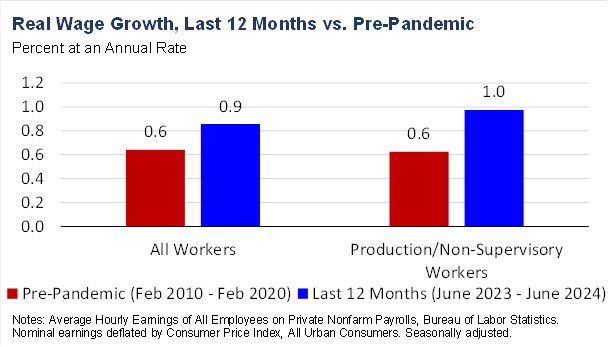
In fact, wages are outpacing prices by even more than usual. Real wage growth, which measures this effect by adjusting earnings growth for inflation, has been stronger over the past year than before the pandemic.
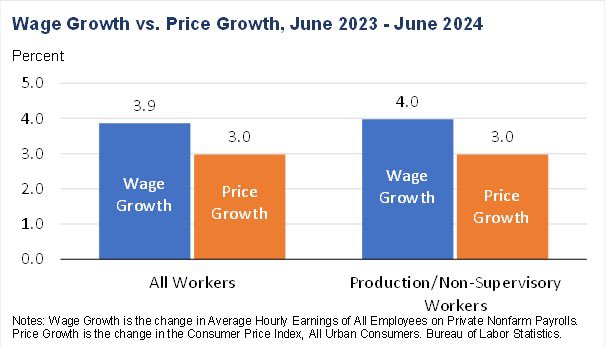
What’s the bottom line from June’s strong labor data and softening inflation? Wages are growing faster than prices. That leaves consumers with more purchasing power: more income to buy the goods and services they did last year, but with extra left over to spend, invest, or save.
One year after @POTUS signed the IRA, our new blog shows two things have become clear:
- Business investment has been stronger post-COVID than in previous recessions
- Private clean energy investments are concentrated in disadvantaged communities
1/9
https://t.co/zGHLUfquCi
Here is a primer to explain the emergence of bottlenecks and price pressures in the US economy and what needs to happen for them to resolve. https://t.co/mmikiHRlve
@alexbellos For sure it only works if both parties don’t want to cheat and are willing to close eyes, etc! But since they are committed to not spreading office gossip, they seemed like upright sorts....:)
@alexbellos But I was trying to think about whether there was a way to map this solution into something more mathy- that doesn’t require material (other than one and paper or calculator) Was unsuccessful, but interested if you or your readers have
@alexbellos Without looking at the other persons piece of cardboard, they line up the pieces and raise them. If they can see through the hole, they match, if they can’t, they don’t. This is closest the cup solution, but uses less material, so much better for the environment 🤓
@thomas_laetsch@WWMGT Yes, same method but yours much more methodically done- I won’t share my chicken scratch. :). Thank you and I would always love to hear of any problems you come across that are particularly engaging!
@thomas_laetsch@WWMGT Hi Thomas, love the problem. I also get log 2. Both by simulation and also by a hack job at infinite series integration where the infinite series is sum of 1/(n*x^n), and then solve for x=2. A little rusty though on this method...
@thomas_laetsch@WWMGT Aha- I was looking for an error in the solution but I see that it is the problem I wrote incorrectly. I should have asked what is the expected percent of boys (or girls) in the population rather than the expected ratio of boys to girls. Thanks for catching!
@thomas_laetsch@WWMGT Hi Thomas, I’m not sure I follow. In the solution, N isn’t stochastic, so N = E[N] and, similarly E[B/N] = E[B]/N. Can you elaborate- do you have another solution in mind? Thanks!
@BetGPS Thank you! I took a new job with less time and there was a transition at popular mechanics, but I do hope that it works out to start them again. I loved writing them. Thanks so much for reaching out! Which riddle was your favorite and do you have any other favorite riddles?
@geekahedron I agree. Just saw that an error was introduced when published. Should be that Kenny played 8 games. Having it fixed now and thanks for the heads up.