I empower individuals with evidence-based nutrition, lifestyle, strength, and endurance coaching to optimize healthspan and lifespan.
Metabolic Health Coach.
Last Friday I boxed the way I had not boxed in years. An hour of jump rope served as the warm-up, and then came ten rounds of sparring with my coach, neither of us holding anything back in tactics or in punches. I took shots to the neck, face, ribs and gut, and I prevailed.
Two days later I managed a recovery walk, and I am still discovering how much effort and pain a truly good sparring session asks of the body. I needed some Tylenol to take the edge off, and the rest has been the quiet work of recovery: rest, good nutrition, hydration, creatine and a generous amount of magnesium.
What amazes me is that at fifty I can go ten honest rounds, then stand, walk and feel my body mending as it should. Today I am very proud of myself.
Your body burns fat most efficiently at moderate exercise intensities, around 50% of your max capacity. Push harder and fat oxidation drops. A new Sports Medicine review explains why intensity determines which fuel your body uses, and reveals how fat tissue functions as an active endocrine organ.
Researchers from the Technical University of Munich and the University of Bonn compiled a comprehensive review covering fat metabolism, the three types of fat tissue, and how exercise transforms the way your body stores and burns energy.
The review addresses a gap in understanding. Most people think of fat tissue as passive storage. The science shows something different. Fat tissue contains nearly 20 distinct cell types and functions as an endocrine organ that communicates with muscles, liver, brain, and immune cells through hormone-like signaling molecules.
What is fat at the molecular level? When we say fat, we typically mean triacylglycerol, also called triglyceride. This is a glycerol molecule bound to three fatty acids. It contains about 9 calories per gram, more than double the energy density of carbohydrates or protein at 4 calories per gram.
During exercise, enzymes break down triacylglycerols stored in fat tissue and muscle into glycerol and fatty acids. These fatty acids travel through your bloodstream to working muscles, where mitochondria oxidize them for energy. This process is called fat oxidation, and the rate depends heavily on exercise intensity.
The intensity-fuel relationship follows a predictable curve. At rest and low intensities, your body relies primarily on fat. As intensity increases toward moderate levels, fat oxidation reaches its peak. Push harder and fat oxidation declines sharply as your body shifts to burning carbohydrates.
Maximal fat oxidation, abbreviated MFO, occurs at approximately 50% of VO2 max in most people. VO2 max is the maximum rate your body can take in and use oxygen during exercise. Think of it as your aerobic ceiling. At 50% of that ceiling, your body burns fat at roughly 0.4 grams per minute.
This value represents an average across populations. Trained athletes may reach slightly higher rates. Untrained individuals typically burn less. The intensity where MFO occurs, called Fatmax, varies between 40% and 65% of VO2 max depending on fitness level, diet, and metabolic adaptations.
Why does fat oxidation drop at higher intensities?
The explanation involves oxygen availability and metabolic pathway efficiency. Fat oxidation requires more oxygen per unit of ATP produced compared to carbohydrate oxidation. When exercise intensity climbs above moderate levels, your muscles need ATP faster than fat metabolism can deliver it.
Carbohydrates become the preferred fuel because they produce ATP more rapidly per molecule of oxygen consumed. This is why high-intensity interval training and sprints rely almost entirely on carbohydrate metabolism, while long, steady rides or runs at conversational pace maximize fat burning.
Fat tissue doesn't just release fuel. It adapts to exercise training through structural and functional remodeling, similar to how muscles grow stronger with repeated training stress.
You have three types of fat cells in your body. White adipocytes store energy as triacylglycerols. Brown adipocytes generate heat through a process called thermogenesis, burning calories without muscular contraction. Beige adipocytes sit somewhere in between, capable of both storage and heat generation depending on signals they receive.
Brown and beige fat contain high concentrations of mitochondria and a protein called UCP1, which uncouples energy production from ATP synthesis. Instead of capturing energy in ATP molecules, these cells release it as heat. This process, called non-shivering thermogenesis, can increase whole-body energy expenditure.
Exercise triggers adaptations across all three fat cell types.
Endurance training increases the density of blood vessels in white fat tissue, improving its ability to release fatty acids into circulation. It also enhances mitochondrial function within fat cells themselves, making them more metabolically active.
Resistance training produces similar but slightly different adaptations.
Studies show strength training increases lipolysis, the breakdown of stored fat into fatty acids and glycerol. Both endurance and resistance exercise also promote what researchers call browning, the conversion of white fat cells into beige fat cells with thermogenic capacity.
The mechanism involves signaling molecules released during exercise. Your muscles secrete myokines, hormone-like proteins that travel through your bloodstream and communicate with distant organs. Your fat tissue responds by secreting its own signals, called adipokines from white fat and batokines from brown fat.
One well-studied example is irisin, a myokine released by contracting muscle that promotes browning of white fat tissue. Another is IL-6, which increases during exercise and enhances fat breakdown. These molecules create a communication network between muscle and fat that coordinates metabolic responses to training.
There are several key training adaptations in fat tissue:
• Increased vascularization, improving blood flow and fatty acid delivery to muscles
• Enhanced mitochondrial density and function in adipocytes
• Upregulation of lipolytic enzymes that break down stored fat
• Conversion of white fat to metabolically active beige fat
• Improved insulin sensitivity in fat tissue
• Changes in adipokine secretion that reduce inflammation
These adaptations explain why regular exercise improves metabolic health beyond just burning calories during the workout itself. Fat tissue becomes more responsive to hormonal signals, better at mobilizing stored energy, and less likely to contribute to systemic inflammation.
The intensity at which you train matters for these adaptations. Moderate-intensity continuous exercise maximizes fat oxidation during the session. High-intensity interval training may burn less fat during exercise but creates a larger post-exercise oxygen consumption, meaning elevated calorie burn for hours afterward.
Neither approach is universally superior. The choice depends on goals, time availability, and individual metabolic characteristics. Someone optimizing for fat loss might benefit from a combination: moderate-intensity sessions to maximize in-session fat burning, and interval sessions to build cardiovascular capacity and increase total energy expenditure.
The review also addresses a common misconception about training in the fat-burning zone. While moderate intensity does maximize the percentage of calories from fat, higher intensities burn more total calories per minute. A 30-minute high-intensity session may burn fewer fat calories but more overall calories than 30 minutes at moderate intensity.
Fat tissue location matters too. Subcutaneous fat, stored under your skin, responds differently to exercise than visceral fat, which surrounds internal organs. Visceral fat is more metabolically active and more strongly associated with cardiovascular disease risk. Exercise preferentially reduces visceral fat even when total body fat loss is modest.
The distinction between fat loss and fat oxidation is worth clarifying. Fat oxidation refers to burning fat for fuel during exercise. Fat loss refers to reducing stored body fat over time. You can have high fat oxidation during a workout without meaningful fat loss if your overall energy balance remains neutral or positive.
Long-term fat loss requires sustained energy deficit. Exercise contributes by increasing energy expenditure and, importantly, by preserving muscle mass during weight loss. Muscle tissue is metabolically expensive, meaning it burns calories even at rest. Maintaining muscle while losing fat improves body composition and helps prevent metabolic slowdown.
The takeaway for training design: there's a physiological sweet spot for fat oxidation around 50% of VO2 max, roughly conversational pace for most people. This intensity maximizes fat burning during the session and triggers beneficial adaptations in fat tissue structure and function.
However, total energy expenditure and consistency matter more for fat loss than optimizing fuel substrate during individual workouts. The best exercise intensity is the one you'll maintain long enough to generate cumulative metabolic adaptations and sustained energy deficit.
Key points:
• Maximal fat oxidation occurs at ~50% of VO2 max, burning roughly 0.4 grams per minute
• Higher intensities shift fuel use toward carbohydrates because they produce ATP faster per oxygen molecule
• Fat tissue contains three cell types: white (storage), brown (heat generation), beige (both)
• Exercise triggers structural remodeling of fat tissue, increasing blood vessels, mitochondria, and lipolytic capacity
• Muscles and fat tissue communicate through myokines, adipokines, and batokines during exercise
• Training promotes browning of white fat, converting storage cells into metabolically active beige cells
• Moderate intensity maximizes fat oxidation during exercise, high intensity maximizes total calorie burn
• Long-term fat loss depends on sustained energy deficit, not optimizing fuel use in single workouts
The decisions you make about training intensity should account for both immediate fuel use and long-term metabolic adaptations. Your fat tissue isn't passive storage. It's an active endocrine organ that responds to exercise by becoming more vascularized, more metabolically flexible, and better integrated into whole-body energy regulation.
Olive Oil is NOT Just a "Healthy Fat" (and what I use)
1/5) People think olive oil is just a "healthy fat." But it's not... Not really.
The fat is a just a vehicle for what makes good extra-virgin olive oil special: a specific family of polyphenols.
This is more than a buzzword. Check THIS out 👇
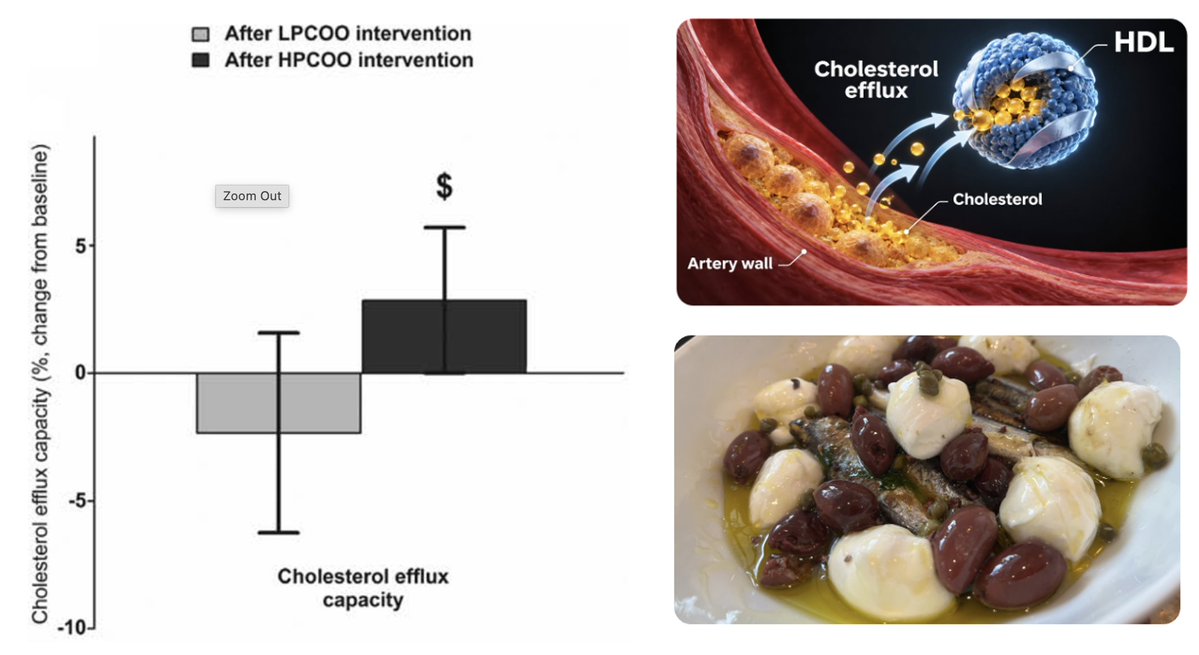
In controlled human trials, high-polyphenol olive oil has been shown to:
🫀Reduce LDL oxidation
🫀Improve HDL function (not levels, FUNCTION)
That's what you're seeing here.
In a randomized trial, high-polyphenol olive oil improved “HDL cholesterol efflux capacity,” which is HDL's ability to get cholesterol out of arteries.
But there's a catch...
El-Sayed is right:
The U.S. has drifted toward corporate socialism, where political influence protects shareholder profits at the public’s expense.
Moving forward requires replacing cronyism with a pragmatic capitalism built on human capital...following Singapore’s example of investing in health, education, and workforce productivity to drive broad economic performance.
@kh505043@incidental_fnd Elimination diet, and slow reintroduction to whole foods diet. Incremental prebiotic and probiotics complementation.
Absolute lifestyle modification program including circadian alignment, strength and aerobic training, sleep conditioning.
@CNN It’s striking to see how deftly the military establishment is boxing Hegseth in ahead of his eventual departure. Once he no longer has the shield of the office, the institutional accountability is going to be swift and thorough.
@SecWar It’s striking to see how deftly the military establishment is boxing Hegseth in ahead of his eventual departure. Once he no longer has the shield of the office, the institutional accountability is going to be swift and thorough.
@KobeissiLetter Wouldn't be surprised if investigations show that these caravans are financed by Trump and his allies, they seem to conveniently appear when Trump loses elections.
Not a fan of coincidences.
🔬🧪LACTATE DOES NOT CAUSE MUSCLE FATIGUE
It is a surrogate marker of metabolic stress and even contributes to improve muscle acidosis during exercise.
During exercise, fatigue develops through metabolic and cellular disturbances, including the accumulation of inorganic phosphate (Pi), changes in ATP turnover, impaired calcium handling, and reduced actin–myosin force production.
Lactate reflects the dynamic balance between glycolytic flux, mitochondrial oxidative capacity and lactate oxidation and clearance.
Lactate is not the enemy. Beyond being the best fuel for cells, lactate is a valuable metabolic signal that helps us understand what is happening inside the muscle.
Understanding this distinction is fundamental to interpreting exercise metabolism, fatigue, and performance.
#Lactate #Mitochondria #ExercisePhysiology #MuscleFatigue #Metabolism #SportsScience
My blood glucose is lower than 99.8% of humans
best month I’ve had:
> mean 79 mg/dL
> best week 77 mg/dL
> HbA1c 4.6%
Elevated blood glucose rusts from within.