@peach_pit_fan@Thinkwert I think that if the original meaning is preserved or students consciously agree to a change, it is okay. Using a thesaurus also sometimes required grammatical changes in sentences. Ultimately, students are responsible for the final wording of the text, so they must agree with it
@peach_pit_fan@Thinkwert Even Microsoft Word on Win XP had spell check and synonyms suggestions. Also, back in 1983, was a kid penalized for not using their own word, but instead choosing a synonym from a thesaurus (this massive paper book)? This is a good way for students to enrich their vocabulary.
@sol_ontheveil I write in my native language too and while my original text even on pangram always gets 100% human, the English version I translate with a little help from google translate and deepl almost always gets flagged as AI, even up to 100% 😖 It's so frustrating. Wonders of being ESL
@THRONEINBLOOD Deepl jest bardzo dobry. Darmowa wersja działa jak google translate. To nie llm(ai jak chatgbt itp) tylko nmt. Opcje ai są dostępne ale nie są standardem. Tłumacz jak ci wygodnie. Jak będziesz pisać długopisem na papierze i wrzucać skany to i tak jakiś hejter zarzucić ci że to ai
@trajektoriePL Jeśli to jest dobre i ma sens to jest AI-assisted, a nie AI-generated . To dwie kompletnie różne kategorie. Jeśli chodzi o prozę to samo AI pisze totalne gówno, gubi wątek i się powtarza.
@Olking07 That's why AI text is watermarked. For example thanks to SynthID Google is not training Gemini on text watermarked with it if it's considered poor quality. Other companies implement similar tools.
@lyrasknife I tired to write a story (~1k words) with AI as a test and to get what I wanted my prompt was as long as the text AI gave me. Only the grammar was better (I'm ESL no wonder) so accidentally instead of AI generated text I got my own writing but ai-assigned
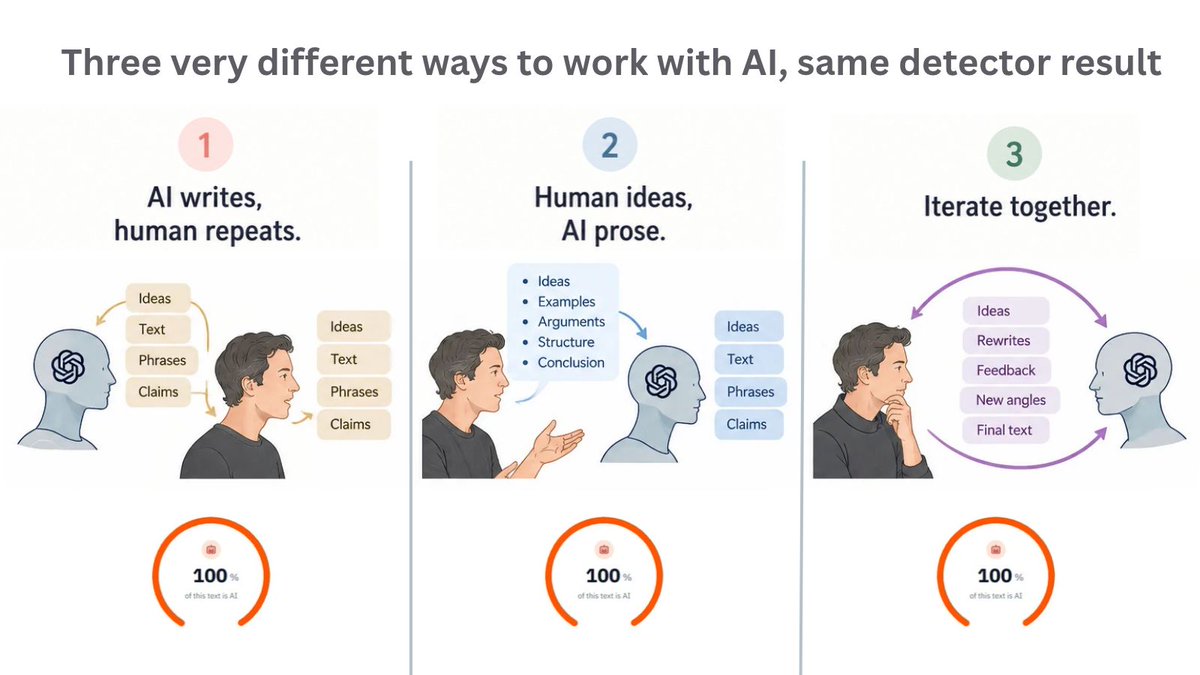
It strikes me that there are three very different ways people use AI which all look the same to @pangram .
1) MEAT PROXY, letting AI do both the thinking and writing for you.
2) Coming to AI with finished thoughts and ideas, using AI to phrase it more elegantly, adding filler words between bullet points etc
3) Iterating back and forth with AI, bouncing ideas, forming a text together.
All three can show up as 100% AI-generated in Pangram, but clearly very different processes and I think can become conflated.
I definitely sometimes do nr 2 and 3 sometimes. Never 1, (But on Twitter I don't use AI-written text)
It's astounding that you don't see the problem with using AI tools like Pangram to detect AI writing, and then relying on the claims of an AI-based AI writing detector to ruin the life and reputation of an up-and-coming author because "how dare they use AI".
You believe anything made by AI is slop, yet you also believe these AI detection tools, which are AI-based, are somehow infallible enough to be irrefutable, smoking-gun proof that an author used AI to write a book, and then you ruin them based on an AI's say-so.
"B-b-but Pangram is 99.98% accurate!"
Who said that? The people who made it? Their fucking marketing department?
LLMs are trained on human-written text. They will only get better and better at replicating human writing, and they already know about the tells these AI-based AI-writing detectors look for and can account for them. If it's not already impossible to detect AI writing, then it will be soon.
All it's going to take is one high-profile defamation lawsuit from an author who extensively documented their process getting falsely accused of using AI and losing a publishing deal over it, then this whole guilty-until-proven-innocent paradigm will come crashing down, and then we will all be looking back and saying, "Hey, remember when stupid people were relying on AI to accuse each other of using AI and then ruining people's reputations before they even got off the ground? That was fucking stupid."
You want to support artists? Making them afraid of false accusations and putting the burden on them to prove their innocence isn't helping.