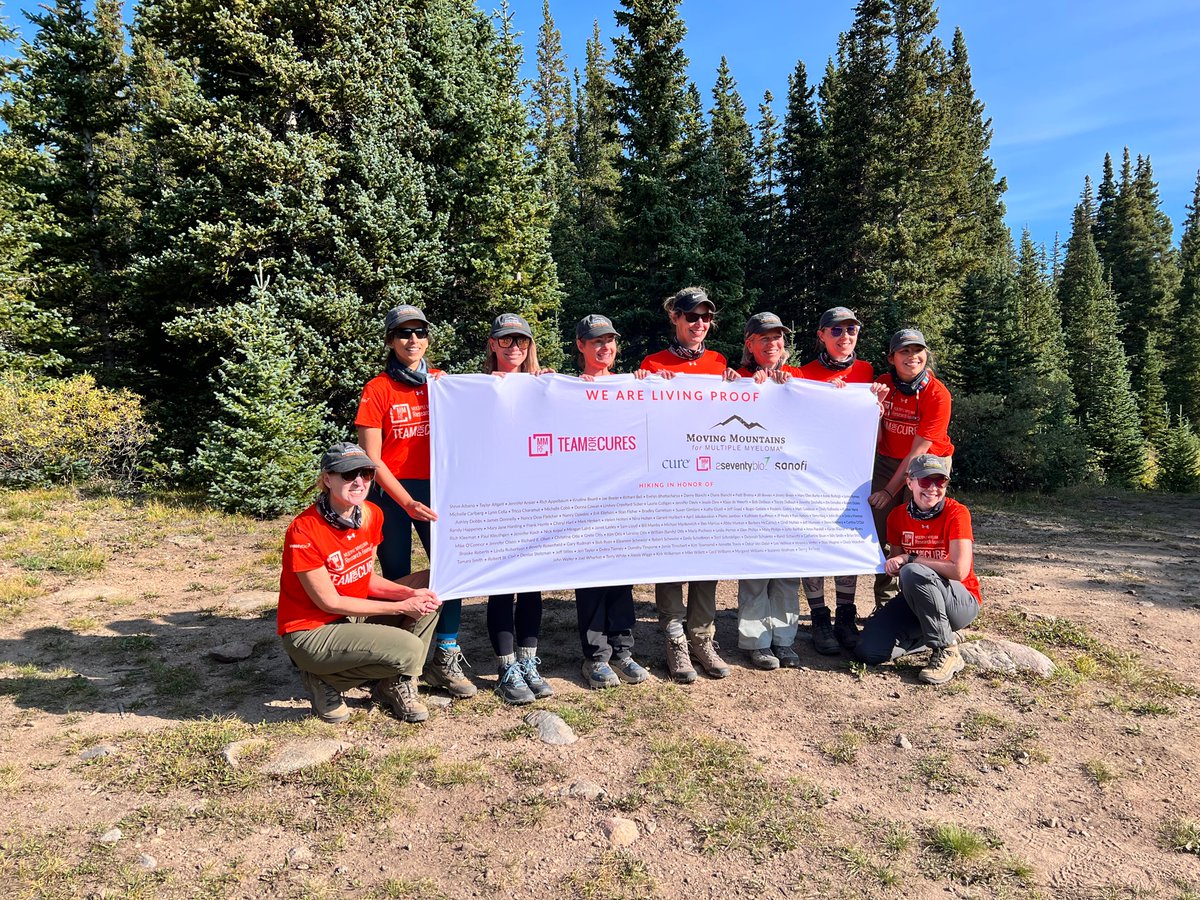
@theMMRF@MMRFTeam4Cures An incredible experience. 30 miles of hiking with new friends. The best part: the team raised $75K for MM research! So grateful for the opportunity @GD_251
Dearest gentle reader, we are delighted to announce a new story from our lab published in @Nature describing how a meal's systemic metabolic changes are interpreted by your immune system to enhance adaptive immunity. A thread 1/ https://t.co/zACqCLxDMU
Thrilled about this collaborative project evaluating venetoclax response in the myeloma subtype I’m so curious about-t(11;14). Grateful to all of the collaborators included here.
@mehndz@RahulBanerjeeMD@VincentRK@OncBrothers@BijoyTelivala@rajshekharucms@Myeloma_Doc 20% is the technical cutoff- determined by the lab. If result is < 20%, you can’t say a result is “positive”. <20% is within the “normal range” because by FISH you can random lost, gained, overlapped signals etc similar to other assays. Assay “noise.”
Standardizing FISH testing in myeloma is critical to reduce lab to lab variability and misinterpretation. We propose guidelines for FISH panel design and reporting to align with the new IMS/IMWG risk stratification. @CG_Consortium @MayoMyeloma
Just out: Guidelines for testing and reporting cytogenetic results in myeloma @BloodCancerJnl #OpenAccess Bookmark!
Allows you to incorporate latest IMS/IMWG high risk criteria in practice.
@lbaughn @RahulBanerjeeMD @Rfonsi1 https://t.co/xzFgvOfpss
@RenoHemonc@AuclairDan Commercial labs like Mayo will be reporting mono and biallelic 1p. This information would also be in the cytogenetics nomenclature in commercial lab reports. Mono del=x1, biallelic del=x0
We will also be providing recommendations to other labs on how to perform and interpret to meet the IMS/IMWG definition with a publication led by @lbaughn in @BloodCancerJnl shortly.
Stay tuned.
Visualize genomic data with ease using gggenomes, an R package that extends ggplot2 to handle and display genomic information intuitively. Whether you’re comparing genomes, analyzing features, or showcasing synteny, gggenomes provides the tools you need to turn complex genomic data into clear, informative visualizations.
Why use gggenomes?
✔️ Genomic-focused visualizations: Specifically designed for handling genomic data, including features, alignments, and comparative analysis.
✔️ Versatile and modular: Create detailed and layered plots for diverse genomic scenarios with flexibility for customization.
✔️ Built on ggplot2: Leverages ggplot2’s familiar framework, making it easy for users to adapt and enhance their visualizations.
The example visualization shown here is taken directly from the gggenomes GitHub repository, demonstrating how it transforms genomic data into compelling plots: https://t.co/FzE2wNzHeP
Curious to learn more about creating data visualizations in R and using tools like ggplot2 and its extensions? Check out my online course, "Data Visualization in R Using ggplot2 & Friends!" Take a look here for more details: https://t.co/ztlEzoEDWv
#datascienceeducation #Statistical #datastructure #RStats
A recently published paper supports the reporting of these unbalanced MYC-R as positive. Nice to see additional support for unbalanced MYC-R as being real abnormalities
https://t.co/FFuNYI4OQv
FISH testing for MYC is part of routine clinical evaluation for high grade B-cell lymphomas. We showed a high false negative rate for the MYC break apart FISH probe (4%) or the MYC/IGH probe (22%). Thus, FISH will not detect all MYC rearrangements in B-cell lymphomas.
@RahulBanerjeeMD@bbehin Agree on del 17p. I would also suggest other high risk abnormalities like 1p del, 1q gain or amplification. If enough sample exists IGH break apart. If abnormal, t(4;14).
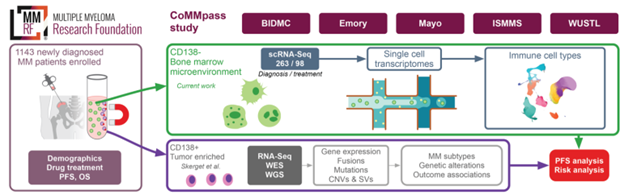
The MMRF Immune Atlas team describes immune cells & clinical outcomes in myeloma. Emory, Beth Israel, WUSTL, MSSM, Mayo & MMRF profiled >1.1 million marrow cells from CoMMpass patients. Preprint at https://t.co/xg1ac2OsYv has details. #myeloma
@RahulBanerjeeMD@adamssperling @alex_epi_tria One question is how to intercept a “relative TP53 loss” (2 copies of TP53) in the context of a trisomy 17. Is this worse than 3 copies of TP53?
@MyelomaAmateur@RahulBanerjeeMD @alex_epi_tria Some trisomies can be present from birth like trisomy 21. In this context however, these trisomies are acquired in the MM clone. Great questions Kate.
@RahulBanerjeeMD @alex_epi_tria Many labs use a probe for TP53 as well as the centromere of 17 (the middle section of the chromosome between the p and q arms).
We have to reach physicians in the community to see how we can get their input. Can @ACCCBuzz help to get this survey out and partnering with them.
Apart from risk stratification, can we report that BCL2 inhibitors can be used in the FISH report.
@PedalheadPHX @lbaughn
@PedalheadPHX @JanakiramMurali@ACCCBuzz I agree with this observation. Do clinicians want this information in a FISH report? Providing not just diagnostic or prognostic information, but information about therapeutic value?