A 178 page survey study for refreshing math and generative AI foundations from University of Huddersfield.
The Little Book of Generative AI Foundations.
Yesterday, I was giving an intro talk to our dept's new PhD students. Technical things aside, my number 1 suggestion has remained the same over the years: Treat your PhD like a job.
- Avoid 1.5h lunch and three tea breaks.
- Avoid gossiping and loitering at work.
- Lab at 9 am and leave at 6 pm. Being productive till 11 pm in the lab is a lie people till themselves when their day starts at 1 PM.
Everything worth doing can be done with high intensity focus during work hours. And having fun in life is the secret to being productive in a marathon.
A professor at MIT spent his life studying uncertainty.
Near the end, he compressed everything into a single one-hour lecture.
No buzzwords. No heavy theory.
Just a clear explanation of how prediction really works.
Not long after, he was gone.
This is that talk.
The idea at its core is simple but powerful:
prediction isn’t about being certain
it’s about understanding probabilities
Most people will scroll past it.
A few will see it and start thinking differently.
Save it.
Dr Fei-Fei-Li (@drfeifei ) explains why and how everyday household chores are so extremely difficult for Robots.
"If you tell a robot to open the top drawer and watch out for the vase, this is actually a really hard task for robots."
because the robot must ground language into the real world. Words like "top", "drawer", and "vase" are abstract. The system has to map them to 3D locations, objects, and relations in a noisy scene. This requires robust perception, object recognition, and spatial reasoning under uncertainty.
The robot also lacks human commonsense. "Watch out" implies predicting consequences, estimating clearances, and understanding that vases are fragile. Encoding such priors, like how heavy a drawer is or how a vase might tip, is very complex and difficult without rich world knowledge.
Learning the behavior from rewards is tough. The success signal is very sparse here, so naive exploration almost never stumbles on a full success sequence. This makes policy learning sample inefficient and brittle, especially when the environment changes between training and deployment.
A sparse reward situation is when the agent only gets a success signal at the very end, and gets little or no feedback along the way. If a robot must open a drawer without hitting a vase, it might get reward only if the drawer ends up open and the vase is intact. Every partial try before that looks the same to the learner, reward equals 0.
---
From "DSAI by Dr. Osbert Tay" YT channel
NEW paper from Meta.
(bookmark this one)
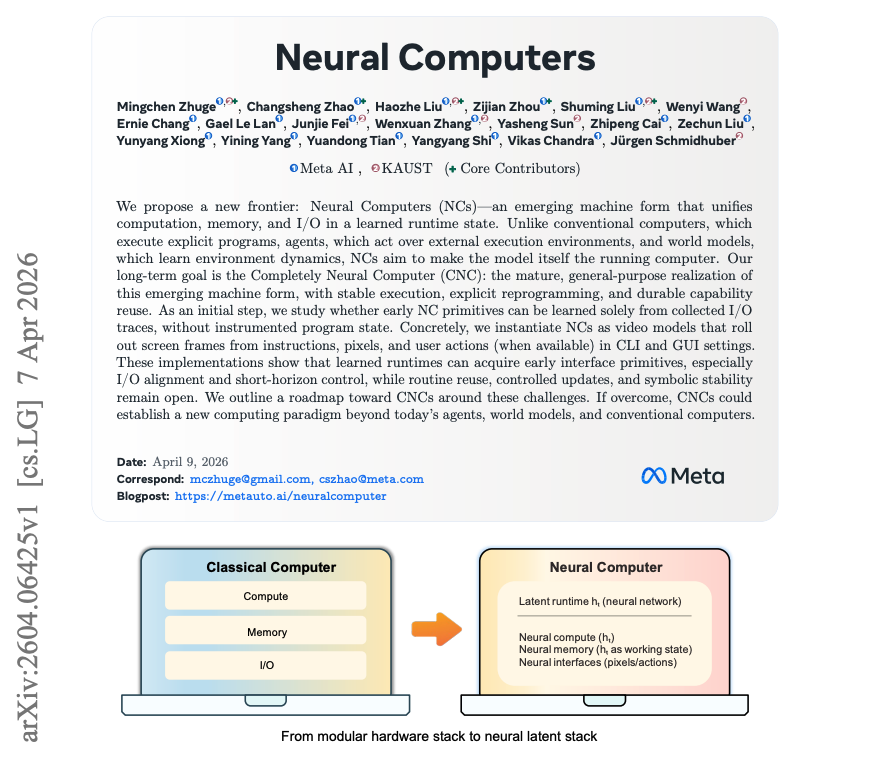
What if the model wasn't just using the computer, but became the computer?
New research from Meta AI and KAUST makes a serious case for Neural Computers (NCs).
The paper proposes NCs as learned runtimes where computation, memory, and I/O live inside a single latent state. Their first prototypes use video models to roll out terminal and GUI interfaces from prompts, pixels, and user actions.
Why does it matter?
Today's agents still depend on external computers to store state, execute actions, and enforce system contracts. Neural Computers point to a different machine form: one where interface dynamics, working memory, and execution are learned together.
The early results are promising but grounded. CLI rendering improves, GUI cursor control reaches 98.7% with explicit visual supervision, and reprompting boosts arithmetic-probe accuracy from 4% to 83%. But symbolic reliability, stable reuse, and runtime governance remain open.
This is less "agents got better" and more "what comes after agents as a computing substrate?"
Paper: https://t.co/CKdclokmer
Learn to build effective AI agents in our academy: https://t.co/1e8RZKs4uX
Leslie Lamport (Creator of LaTex): "If you think you know something but don't write it down. You only think you know something.
It reveals what you haven't said. And that there's steps in there. You may think they're obvious, but you haven't written them down.
And that's where errors come in. That's where that one third of the paper's errors come in, because it really makes you honest."
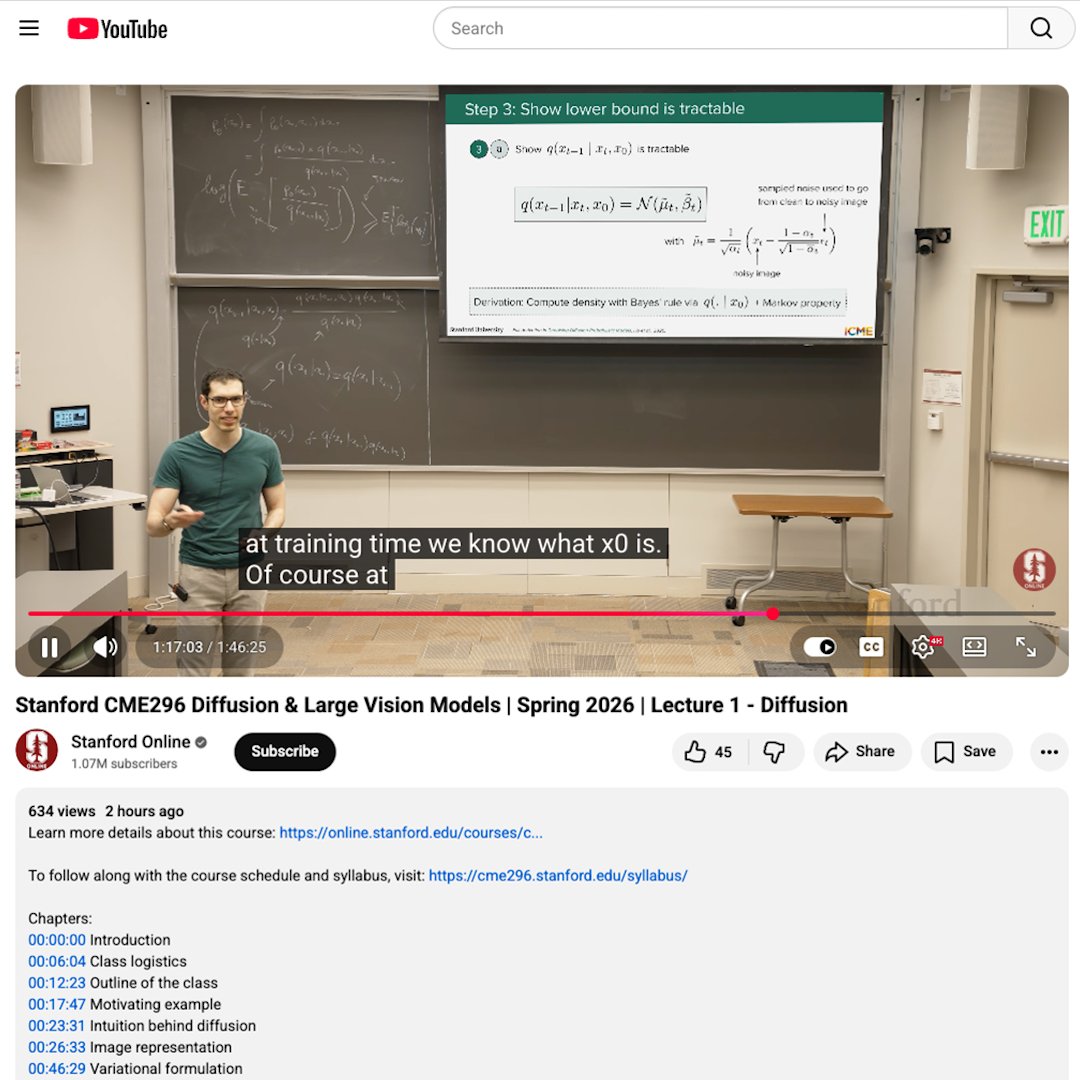
This 2 hour Stanford lecture shows exactly how Stanford trains it's engineers to build AI systems. It's more practical than every Claude tutorial & prompting threads you've seen.
Bookmark & give it 2 hours, no matter what. It'll be the most productive thing you do this weekend.
I keep repeating myself over the same comments when revising the overview figure in a paper.
TL;DR: When you visualize your overview figure as a computational graph, it's instantly 10x clearer!
Sometimes you have to need some equations again and again for the understanding to sink in and you can harmonize it with the other equations or processes. Viewing math equations like an action movie really helps! 😂
#GLORIOUSFEELING
Harvard’s AI Research Experience free course book by @pranavrajpurkar covers the essentials and tips on doing research:
- VSCode, Git, Conda
- PyTorch, W&B
- AWS, colab
- LLMs and VLMs
- reading AI papers
- research progress and organization
this is a must read!
Revolutionizing Connectivity: @sateliot is the first satellite telecom operator for global continuous #IoT connectivity via the #5G protocol #CES2025#MWC25 https://t.co/GilQQgF7mO