Like it or not, the Inflation Reduction Act (IRA) is forcing unprecedented visibility into the 340B program.
@edsilverman of @statnews broke the story that @EliLillyandCo is requiring #340B hospitals to submit claims data or lose access to 340B discounts.
As I told Ed, this is a predictable consequence of the IRA's drug pricing provisions. The law created new pricing obligations for manufacturers, but policymakers never established a reliable way to identify which claims qualify for 340B pricing.
Here's the relevant section from his article:
"The issue has intensified thanks to the Inflation Reduction Act, which imposes a maximum fair price on drugs paid for by Medicare and obligates drugmakers to pay added inflation rebates in Medicare. But the requirement overlaps with the 340B program. Why? Drugmakers must offer hospitals the lower of the maximum fair price or the 340B price — and pay inflation rebates only on drugs not sold at the 340B price.
'The Inflation Reduction Act is forcing transparency into the notoriously opaque 340B program,' said Adam Fein, who heads the Drug Channels Institute and tracks prescription drug pricing and insurance coverage. 'The IRA’s maximum fair price requirements make it impossible to ignore the long-standing lack of visibility into 340B claims.'
He noted, however, that the federal government has not created a mechanism to identify 340B claims, and the HRSA maintains that it lacks the authority to do so. 'The result is a growing compliance dilemma that Congress never intended and regulators have yet to resolve,' he said."
Full article: https://t.co/XTgpm2X6EJ
We are so proud of Camden, a student at Ohio @ConnectionsAcad. He is an accomplished student and loves the flexibility of online school, as he is ranked 55th in the world in pro pickleball! @OCAPride https://t.co/0YtMZ8bZcV
#Ohio libraries help reduce the 'summer slide.' Children can continue to learn and thrive throughout summer break with the help of their local library! @OhioLibraryCncl https://t.co/bWq4thAE2r
𝐓𝐡𝐞 𝐌𝐨𝐬𝐭 𝐈𝐦𝐩𝐨𝐫𝐭𝐚𝐧𝐭 340𝐁 𝐩𝐚𝐩𝐞𝐫 𝐘𝐨𝐮'𝐥𝐥 𝐄𝐯𝐞𝐫 𝐑𝐞𝐚𝐝
If you care about #340B policy, use the long weekend to read this outstanding new paper:
"Stretching Scarce Authorizing Legislation as Far as Possible: A Legislative History of the 340B Drug Pricing Program."
Sayeh Nikpay @saynikpay and her colleagues went back to the early 1990's to reconstruct the program's origins. Their research draws on interviews with 18 key participants and 175 primary source documents spanning 1990–1992.
Their conclusion is difficult to ignore:
340B was originally designed as a narrow policy solution to address an unintended consequence of Medicaid’s best-price provision and to support core safety-net providers.
But the paper makes a compelling case that today’s program extends far beyond Congress’s original intent.
Whether you support or oppose the current structure of 340B, this paper is essential reading for anyone who wants to understand how we got here.
Read it here: https://t.co/MrD8O31wNI
One especially fascinating detail: The disproportionate share hospital (DSH) eligibility threshold of 11.75% was chosen to qualify two specific hospitals and secure bipartisan support from Senator Hatch and Representative Bliley.
In other words, the threshold was not grounded in any broader scientific or policy rationale.
Amazing.
"Foreign mooching off American medical innovation is a real & longstanding problem." Especially in Europe, where drug prices are set, & manufacturers must accept less than fair value for drugs that took decades to develop. https://t.co/Py3H970vje
Some #Ohio libraries offer much more than books: tools, microscopes, board games, zoo passes, BP test kits, and more. Each library has its own collection of a Library of Things! @OhioLibraryCncl https://t.co/TyEiHOrIgZ
An Ohio State Grange member shares her perspective on the impact of Most Favored Nation drug pricing policies on rural health and innovation. https://t.co/fuOiCkUIGA
".@Walmart has announced it will continue its multimillion-dollar investment in #Ohio with plans to improve 18 locations. The modernizations will be for both in-store and online consumers." https://t.co/uMWWEaB8ZZ
We are so proud of Ohio Connections Academy Superintendent Marie Hanna! Marie is the inaugural recipient of the Ohio Council of Community Schools' Lifetime Achievement Award. @ConnectionsAcad https://t.co/uSg2ODqjLt
"Every month, each of @Walmart’s eight Northeast Ohio stores holds Act of Kindness Days, which finds employees volunteering at area nonprofits." https://t.co/Yw15YQT925
"Ohio is finally winning a war that has taken far too many of our neighbors, our veterans and our kids. .... and Gov. Mike DeWine has a chance to make a decisive next move." https://t.co/h32JXz6Mzr
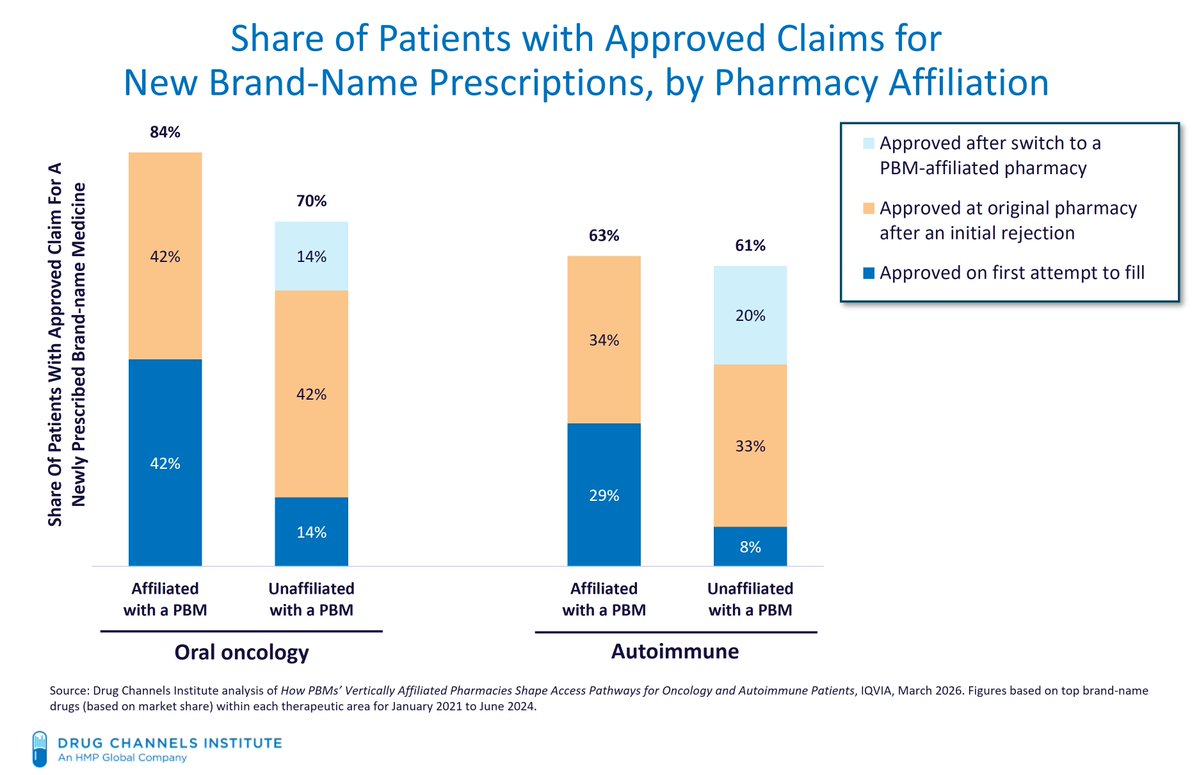
New IQVIA data shows how PBMs steer specialty prescriptions to their own pharmacies.
For patients starting a new brand-name drug:
• Oral oncology: 84% approval at PBM-affiliated pharmacies vs. 70% at unaffiliated pharmacies
• Autoimmune: 63% vs. 61%
But the pathway matters:
• First-fill approvals are far higher at PBM-affiliated pharmacies (42% vs. 14% in oncology; 29% vs. 8% in autoimmune)
• At unaffiliated pharmacies, many patients only get approved after switching (14% oncology; 20% autoimmune)
The result: PBM-owned pharmacies capture a disproportionate share of specialty volume.
Full report: https://t.co/EWauwCgOO2
"In addition to remaining a supplier, Sergi-Schumann has been “a valued advocate” to @Walmart through her early participation in Open Call and continued support of its U.S. Manufacturing initiative..." https://t.co/giSj4QDR21
"As U.S. hospitals face an increasing risk of encountering measles, and pressure to immediately spot it, health care workers face an unusual barrier: Many don’t know what it looks like." https://t.co/8E74klWDJf
"In central Ohio alone, the biotech industry generated more than $13.1 billion in 2023 across hundreds of sites, like cell and gene therapy companies Andelyn Biosciences or Forge Biologics" https://t.co/BzGNmz6WSG