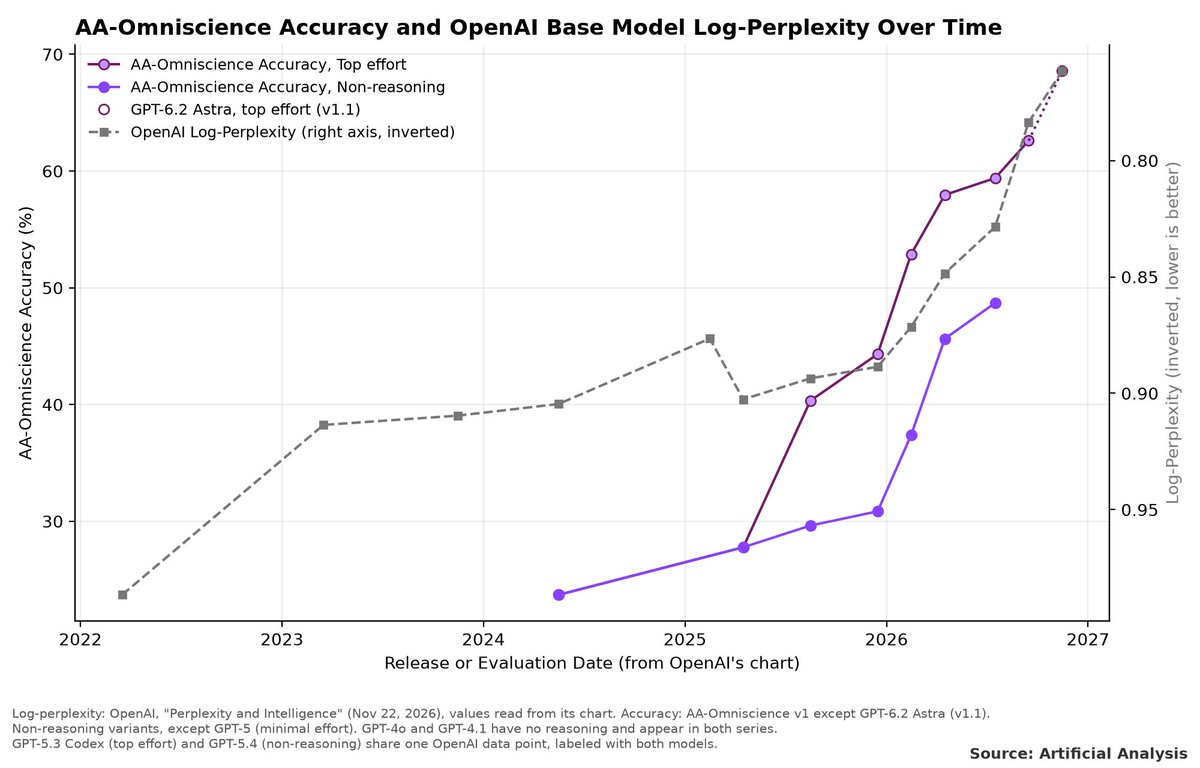
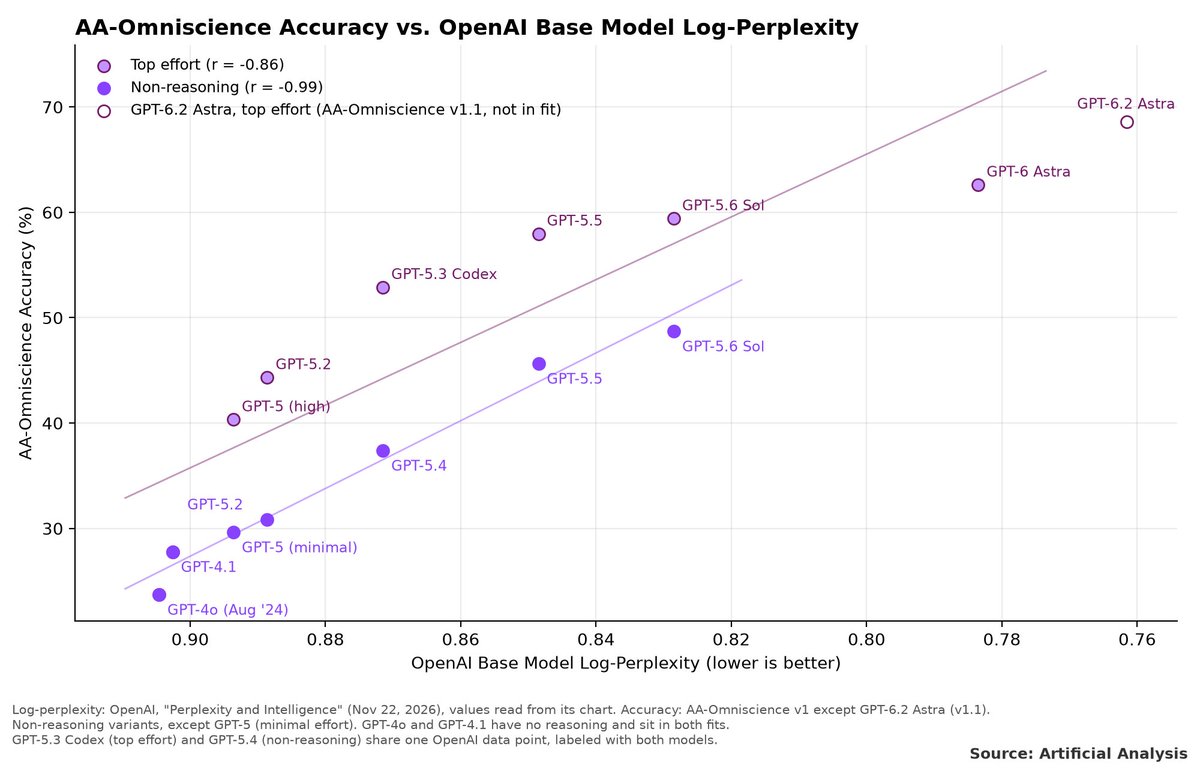
Here I added some major Claude models to the trend lines based on their AA-Omniscience scores, and a second chart I made for AA-Omniscience **net** score, which penalizes hallucinations, as opposed to just treating all non-correct responses as neutral (0 points).
I was a bit curious, so I did a bit of number crunching; OpenAI's new base-model perplexity figures closely track AA-Omniscience accuracy
FYI: AA-Omniscience tests factual knowledge across six domains. Accuracy and log-perplexity correlate at r = −0.99: each 0.01 drop in log-perplexity comes with ~3 points of accuracy.
At top effort the fit is looser (r = −0.86), and hallucination rate shows no consistent link
@SKinam71144@dummerspast39@benchaupt OpenAIs neural scaling laws paper released in 2020, before GPT-3 release and 2 years before the grokking paper. The people actually building these systems were clearly quite convinced by this point that this is something that scales, regardless of whether you think it was ass.
Update on this tweet now that both GPT-5 and GPT-6 have released: My final statement I made in the tweet "The true future might lie somewhere between these two projections" seems to have held true for both generations.
It's recently reported that OpenAI has reached $50B ARR, and that's between my stated range for GPT-6 of $49B and $1.2T ARR, it could have a lot more room to grow before GPT-7, but likely would still be under the $1.2T upper bound stated.
For GPT-5, OpenAI reported $2B per month ($24B ARR) in March 2026 when GPT-5 was their SOTA, and that is between the $22B ARR and $60B ARR bounds I stated for GPT-5.
For GPT-7 I'd be comfortable predicting at least a lower bound of $75B ARR for OpenAI within 12 months of a model called "GPT-7" releasing, but that almost sounds too obvious to be worth treating as a prediction, so I'm going to work on some more refinements of the methodology here, and I'm guessing I will eventually conclude a lower bound for GPT-7 that is significantly higher than that.
Funnily enough, if you retrodict an exponential trend of 20X revenue for each GPT generation, it seems to kind of line up to reasonable values?
GPT-4 = ~$3B ARR
GPT-3 = $150M ARR (seems reasonable to me from roleplay market, translation, and coding autocomplete, although GPT-3 API real revenue was likely lower.)
GPT-2 = $7.5M ARR (seems reasonable to me from translation and niche autocomplete use-cases)
Rather than just do retrodiction though, we can turn this into a prediction too, lets check back in the future and see if GPT-5 ends up being able to achieve $60B ARR. (I have roughly 40% confidence in GPT-5 actually meeting or exceeding this figure) GPT-6 on this same trend would be $1.2T ARR.
What might be more likely is if it's something like an attenuated exponential growth, such as:
GPT-6 = $49B ARR(2.25X of GPT-5)
GPT-5 = $22B ARR (7.25X of GPT-4)
GPT-4 = $3B ARR (26X of GPT-3)
GPT-3 = $115M ARR (101X of GPT-2)
GPT-2 = $1.14M ARR
The true future might lie somewhere between these two projections (GPT-6 earning less than $1.2T ARR, but more than $49B ARR).
@Danmoreng@giffmana@ChrSzegedy GPT-5.5 from April solved 50+ open problems with only $50 per problem, and the latest models are even better cost/accuracy. Now a newer OpenAI model solved over 300 open problems, all with natural language solutions, with an average compute equivalent of 3 hours of ChatGPT Pro.
1. Having margin expansion and higher useful life is not mutually exclusive to the market bringing your stock price down.
2. Looking at 6 month horizons of declines seems quite flawed here to treat as some sort of disproof, a company can be underpriced and simultaneously go down in value even further below the point at which it's underpriced, especially on time horizons as short as months.
3. Interpreting these statements as if he's saying that the market sentiment will be clearly bullish in just a few months time seems even more silly. He said himself in that same blog in your screenshot that the market sentiment has turned increasingly negative. The projects of these companies are on the scale of years, and the projections for these industries to be reasonably profitable fully up and downstream is several years out by SemiAnalysis own reports, 6 months isn't even enough time for a single one of most datacenter sites to be constructed.
4. That's not to say that these companies can't or won't fail, but making such judgments based on just a 6-month observational window, and technical analysis alone at that, reflects deeper flaws with the intention and methodology of the investor themselves.
5. Before someone accuses me of shilling for these stocks, I don't have a single dollar in any of the 3 companies shown here.
@ali_taha It seems strange that you decide to highlight that quote "odds of reaching SOTA again have dropped to zero"
It was contained in a free blog section, not behind a SemiAnalysis pay wall, and they say both negative & positive statements about nearly every AI corp including google.
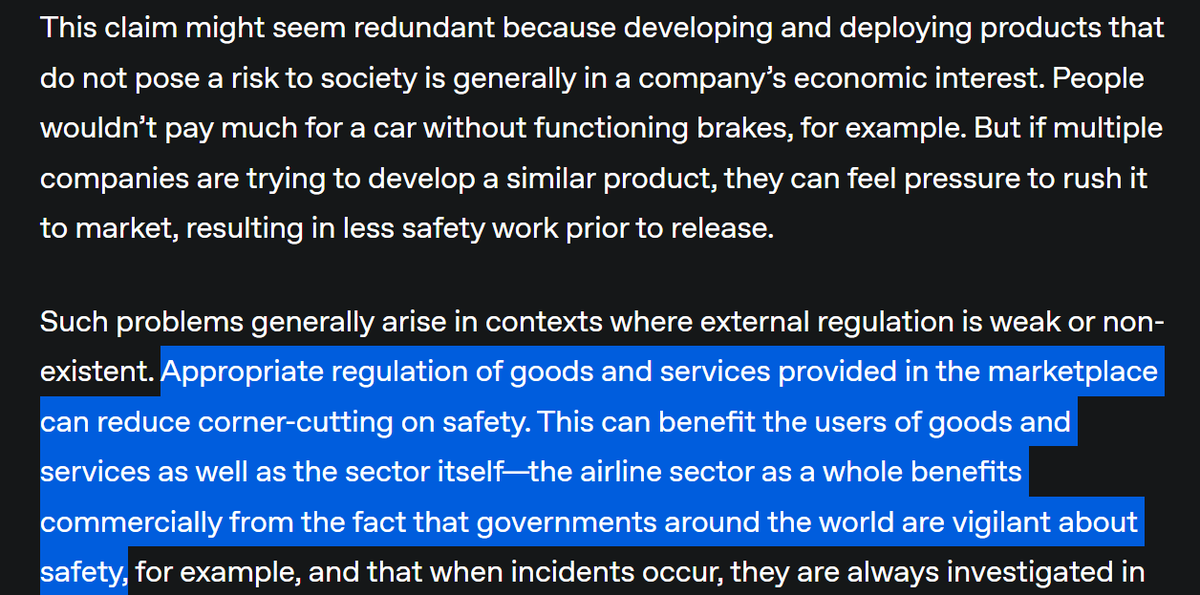
@DougCalidas@TheMidasProj OpenAI has explicitly talked about the benefits of regulation for years, even before ChatGPT came out. This below image is directly from their 2019 article, 3 years prior to ChatGPT coming out.
@RobS142@spicey_lemonade Kimi K3.1 Pro model (released today) is already at a higher mean and median score for the available benchmarks against both the original Fable and Mythos. And the claim is obviously referring to the Mythos 5.0 model and not some future version like Mythos 5.1 or 5.5.
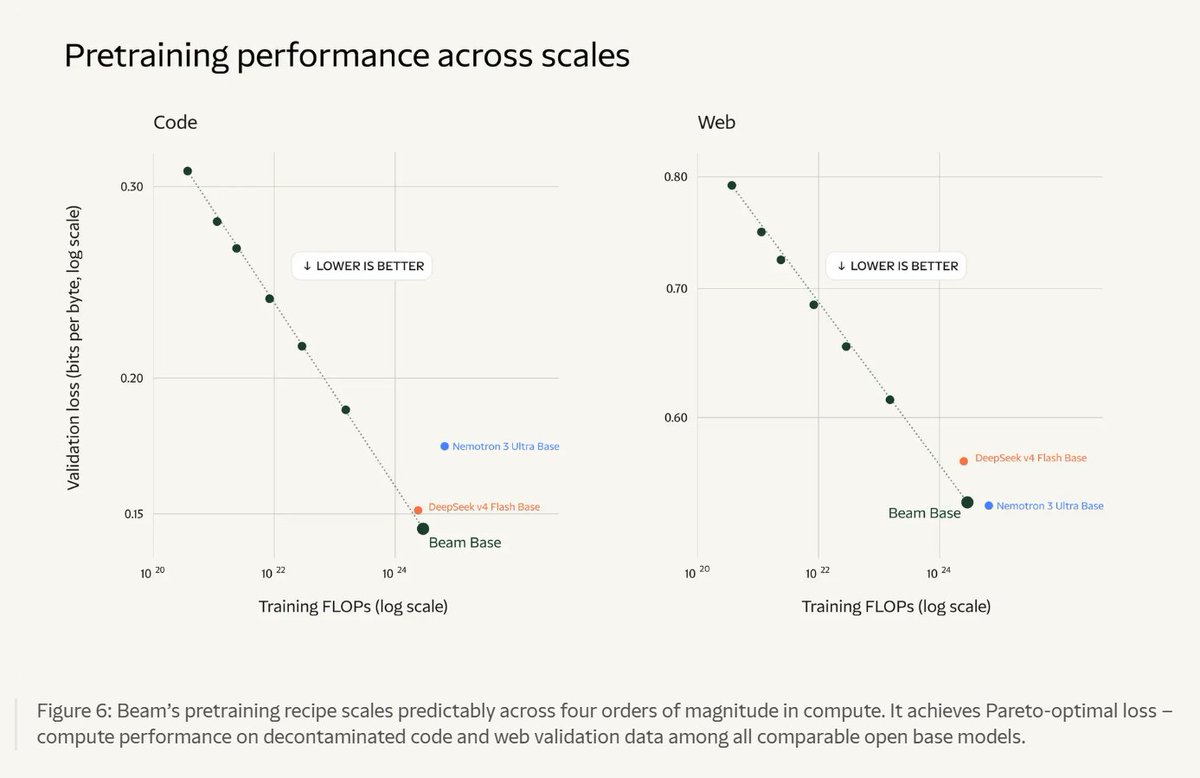
@teortaxesTex Maybe I'm missing it but I don't see how that proves anything against Reflections claim, your tweet doesn't compare any loss values. Unless you just mean that the MFU is worse? But pretraining efficiency in this context is explicitly about loss for a given flops amount, not MFU.
We're having a renaissance of American open models, and they seem to be competing not just against Chinese models, but also against closed source labs in the efficiency metrics that matter most: training-efficiency, cost-per-task, speed-per-task, flops-per-task.
Just in the past 2 weeks:
- October 5th: Reflection announced their first model which they're making open: Beam 501B-A23B, trained on 10K+ GB300s, Artificial Analysis has early access and says "Early indicators suggest Beam will be one of the most token-efficient open models we've seen for its level of intelligence." Reflection is also claiming to beat the pretraining efficiency of Deepseek V4 Flash.
Now in just the past 48 hours:
- October 14th: Paper Instruments announces Ultramarine Flash 320B-A18B, an open model RL'd from GLM-5.3-flash that seems to trade blows with the full GLM-5.3 itself, claiming to reach a significantly greater pareto frontier of cost/task in real-world enterprise CUA workloads.
- October 15th, just hours ago today: Nvidia announces a native 2-bit 74B-A9B model, competing with the latest models from china and other labs that have a similar native flops and VRAM footprint.
- October 15th in the past 1 hour: Meta announces Muse Spark Open 816B-A42B, having SOTA score amongst all open models in JobBench, HLE-Diamond, AA-omniscience and MCP-Atlas, while also having video input, audio input, image input and text input. If the original Muse Spark 1.3 benchmarks are anything to go by, this will be very competitive in reasoning efficiency too. (while GLM-5.3 is still beating its absolute scores in most benchmarks, the reasoning efficiency curves might make this SOTA for cost per task and speed per task at similar capability.)
notes:
- Both me and Ajeya were/are using effective compute relative to 2020 for all the mentioned aspects, which takes into account training efficiency gains too, not just raw compute alone.
- I use Epochs observed trend of~15 ECI points increase per year happening since 2024, to calculate the annual effective compute jump for April 2024 and beyond.
-I use my calculations from comparing various recipe-controlled scenarios against ECI, to conclude that a 10 point increase in ECI corresponds to a ~10X increase in effective compute (convenient coincidence but also independently derived by an anon acquaintance)
- I use the GPT-3 model released in 2020 for the effective compute reference, and use Leopolds and EpochAIs in-common math of GPT-4 being ~1,000X the effective compute of GPT-3, to fill in the effective compute gap between GPT-3 and the starting point of the earliest models we have ECI data for, like GPT-4.
Six years ago in 2020, the same year OpenAI published their seminal neural scaling laws paper, @ajeya_cotra had discussions with Dario Amodei and Paul Christiano about leveraging biological anchors to better forecast AI capabilities, which led to her creating a bio anchor based analysis for forecasting the arrival of TAI (Transformative Artificial Intelligence).
The below image leverages my 2024-2026+ calculations estimating effective compute values and trends from Epoch ECI data (relative to 2020), combined with Ajeya's 2020 weighted mixture visualization for the compute equivalence of evolution, genome, and human lifetime bio anchors.
If the 2024-2026 ECI trend holds, the remaining anchor probability density peaks will be met around:
- Genome anchor ~late 2027
- Medium horizon neural network anchor ~mid 2028
- Long horizon neural network anchor ~2029
- Evolution anchor ~2029
@DadaJudith@Kevin_Indig This is not consistent with your chart. It says Learning-on-the-fly is using ARC-AGI 3. But your chart says learning-on-the-fly had 0 improvement in the last 12 months. Meanwhile ARC-AGI 3 scores for frontier models went from below 1% to over 60% in just the past ~6 months.
@DadaJudith Additionally significant improvements in arguably all 4 are clearly shown in robotics benchmarks for Astra like this (especially learning-on-the-fly and sensorimotor skill)
https://t.co/If7CWVk5Mh
I didn't get what GPT-6 meant for robotics until I actually tried it.
GPT-6 Astra just does physical ICL out of the box.
we drop a recording of a human doing a novel task into 𝗰𝗼𝗱𝗲𝘅 app. Prompt it to drive a robot arm the same way.
It just works on the first pass!
@DadaJudith Strongly disagree with learning-on-the-fly, sensorimotor skill and planning/persistence not noticeably improving in the past 12 months, to suggest visual-spatial reasoning has only marginally improved also seems inaccurate.
DrivingBench demonstrates all 4 with a real car:
@ReadySetBrian@ElCucharaGrande@samim Even for land animals it's very important since over 95% of the fluid in the eye itself is made up of water.
So a vast majority of the light even for humans must pass through the water in the eye before it reaches the light receptors in the back of the eye.