From BTC to AXBT: Non-Custodial Liquidity Through Soft Covenants on Bitcoin L1
Bitcoin is excellent collateral. The challenge is putting it to work in DeFi without handing it to an intermediary or moving it off Bitcoin.
#CRC20 explores an approach built around Taproot vaults, $AXBT debt and $LEAF, its native utility token, designed to support its Bitcoin L1 DeFi ecosystem and liquidity mechanisms.
1. Opening an AXBT Vault (CDP)
The user locks BTC in a Taproot vault and chooses a term that determines the CSV timelock and influences the amount of AXBT that can be issued.
The position is overcollateralized:
- BTC collateral exceeds the AXBT debt.
- Longer terms require higher collateral ratios, approximately 110%–150%.
BTC remains on Bitcoin L1, inside a UTXO governed by specific spending conditions.
2. Vault Architecture
The funding transaction creates:
- A Taproot output holding the net collateral.
- Exit tickets for the owner and liquidation.
- A CRC-20 marker identifying the vault-opening operation.
Two exit transactions are prepared in advance:
- Owner exit: the owner repays the debt to recover BTC.
- Liquidation exit: after the specified delay, a third party can repay the debt and use the liquidation path.
Once validated, the CRC-20 ledger credits AXBT and records the debt. BTC remains locked until a valid exit is confirmed.
3. AXBT Is Debt, Not Wrapped BTC
AXBT is a debt token backed by BTC collateral, not simply wrapped BTC.
- Recovering BTC depends on repaying the debt.
- Auxiliary outputs from the funding transaction are excluded from the net collateral calculation.
- The CRC-20 application layer tracks AXBT balances and debt.
4. The LEAF/AXBT Pool
AXBT can be used in the LEAF/AXBT pool, a constant-product automated market maker (AMM).
The pool holds LEAF and AXBT reserves. Each swap:
- Charges a 1% fee on the input token, allocated to liquidity providers.
- Calculates the output using the reserves and effective input amount.
The pool price depends on the reserve ratio. It does not guarantee a BTC redemption price.
5. Liquidity Positions
Liquidity providers deposit $LEAF and AXBT according to the pool ratio.
At maturity, settlement may return their share of the reserves and accumulated fees.
The amounts returned may differ from the original deposit as the reserve ratio changes. Returns are not guaranteed and depend on trading volume and pool activity.
6. Closing the Vault
There are two main paths to recover BTC:
- Owner exit: repay the full debt and use the prepared exit transaction.
- Liquidation exit: after the specified delay, a third party repays the debt and uses the liquidation path.
The first valid spend confirmed on Bitcoin wins. The indexer finalizes the debt settlement only after verifying the confirmed exit.
Issuing AXBT does not allow unrestricted access to the locked BTC at any time.
7. What Are Soft Covenants?
CRC-20 uses Taproot scripts, pre-signed transactions and CSV timelocks to constrain spending paths.
Bitcoin verifies signatures, scripts, timelocks and UTXO spending under its existing consensus rules. This approach requires no new opcode or Bitcoin soft fork.
Two layers work together:
- Bitcoin consensus layer: signatures, scripts, timelocks and UTXOs.
- CRC-20 application layer: AXBT debt tracking, swap calculations and liquidity settlement, supported by the indexer and client-side verification.
Bitcoin enforces on-chain spending conditions, while CRC-20 handles application-level accounting.
The Complete Flow
BTC locked in a Taproot vault
→ AXBT issued as overcollateralized debt
→ AXBT circulates through the CRC-20 ledger
→ $LEAF/AXBT liquidity pool
→ Potential fees for liquidity providers
→ Debt repayment
→ BTC recovered through an authorized exit path
BTC remains the on-chain collateral.
CRC-20 explores new financial mechanisms on Bitcoin L1 without moving the collateral off the Bitcoin blockchain.
9. PRECOP and PRECOPSCAN
PRECOP stands for Predictive Covenant Oracle Protocol.
It is part of the CRC-20 approach to exploring new financial mechanisms around Bitcoin UTXOs, Taproot and spending conditions.
PRECOP aims to support these mechanisms, while PRECOPSCAN allows users and developers to explore ecosystem activity: transactions, assets, vaults and protocol operations.
The goal goes beyond creating new assets. Developers and users also need tools to understand how the system works, follow activity and analyze interactions between its components.
Bitcoin primitives. Programmable financial mechanisms. Infrastructure to explore what’s being built on Bitcoin L1.
10. Documentation and developer access
The official documentation at https://t.co/6PiCQBcpV3 and https://t.co/WhxJxy5OXu provide resources for understanding the protocol and exploring ecosystem activity.
These tools can help developers, wallets, exchanges and other platforms evaluate assets and potential integrations.
For an ecosystem to grow, accessible documentation and reliable data matter just as much as the underlying financial primitives.
11. MASKED Wallet integration
@masked_wallet announced CRC-20 and $LEAF support in version 2.18, adding another wallet integration to the ecosystem.
12. The bigger picture
CRC-20 brings together several ideas:
- LEAF: the first CRC-20 token.
- AXBT: BTC-backed collateral.
- WUSD: a stablecoin mechanism.
- CRC-21 Koala: digital collections connected to the ecosystem.
- PRECOPSCAN: tools for exploring on-chain activity.
- Documentation and APIs: resources for developers and potential integrations.
The ambition is to explore new financial applications built around Bitcoin's existing infrastructure.
Follow the work of @tap3leaf and @laz1m0v to learn more about the research and ideas behind this ecosystem.
Bitcoin as the foundation.
Collateral as the starting point.
Liquidity as the goal.
Developers as a driving force.
That's why CRC-20 is worth watching.
**(2/2) 🧵
CRC-20 is now live inside Masked Wallet.
You can hold LEAF right next to your
BRC-20 tokens and choose whether to keep it public or shielded. When you send to an sp1 address, it lands on a one time address that isn’t linked back to you. No node required, no extra app just the Chrome extension.
Most Bitcoin wallets still treat privacy as an afterthought. This one is built around it and just added support for CRC-20 without making you run anything extra. Free and open source. @masked_wallet@leaf_btc@tap3leaf@laz1m0v
Reinventing Finance on Bitcoin L1 🟠
What if Bitcoin could become more than the world's hardest money?
BTC-backed debt, liquidity pools, stablecoin experiments, digital asset collections and new applications — all built around Bitcoin L1.
That's the ambition behind #CRC20 : exploring new financial primitives using Bitcoin's building blocks, without necessarily relying on a sidechain or federation.
1. The challenge
Bitcoin solved money, but its financial potential remains largely untapped.
Historically, putting BTC to work has often meant relying on wrapped assets, custodians, external chains or infrastructure that introduces additional trust assumptions.
CRC-20 explores another approach, using existing Bitcoin primitives, scripts, cryptographic commitments and pre-signed transactions to build new financial mechanisms without requiring a Bitcoin consensus upgrade.
2. Taproot, soft covenants and consensus
CRC-20 builds on Bitcoin technologies such as Taproot, Tapscript, Schnorr signatures and timelocks.
Its architecture also uses a 32-byte Commitment Merkle Root (CMR) to commit to a program.
The idea behind “soft covenants” is to explore spending-control mechanisms using scripts and pre-signed transactions, without claiming that new covenant rules are already part of Bitcoin’s consensus.
One distinction matters:
Bitcoin L1 validates transactions and spending conditions under its existing consensus rules.
The CRC-20 protocol layer handles its own application-level rules and asset accounting.
The goal is to explore new financial mechanisms using Bitcoin’s existing rules, rather than implying that Bitcoin consensus itself has changed.
3. The address is the state
Vaults and liquidity pools are built around Taproot UTXOs.
Instead of relying on a conventional global account ledger, the design uses individual on-chain outputs and committed program logic to define how specific states can be spent or updated.
The address is the state.
This is one of the core ideas behind the CRC-20 approach.
4. $LEAF: The first CRC-20 token 🍃
LEAF is the first CRC-20 token and sits at the heart of the ecosystem.
It plays a central role in the vision of connecting Bitcoin-backed collateral, liquidity pools and new financial applications.
Understanding LEAF is key to understanding how the different components of CRC-20 can interact.
5. $AXBT: Bitcoin as collateral
AXBT is designed as a BTC-collateralized debt asset.
The basic pathway:
BTC locked in a vault → AXBT issued → AXBT used in swaps or liquidity pools.
AXBT connects Bitcoin collateral with the broader CRC-20 ecosystem, while vault rules govern the conditions for recovering the underlying BTC.
6. Liquidity is the goal
With LEAF and AXBT introduced, the next step is liquidity.
Swap LEAF for AXBT. Provide liquidity to AXBT/LEAF pools. Collect potential trading fees. Use the resulting liquidity to move between ecosystem assets.
The central idea is to make Bitcoin-related assets more liquid and create additional ways to interact with BTC-backed financial instruments.
Liquidity provision carries risks, and fees are not guaranteed.
7. $WUSD: A stablecoin mechanism
WUSD adds another proposed financial primitive to the ecosystem.
Its model connects stablecoin issuance and burning with AXBT and collateral-backed mechanisms.
The broader objective is to explore how stable-value assets could interact with Bitcoin L1 collateral and liquidity markets.
8. CRC-21 Koala: Ordinals meet DeFi 🐨
CRC-21 combines CRC-20 with Ordinals, opening up new possibilities for digital collections and programmable transfer conditions on Bitcoin L1.
Discover the Koala collection: @merklemonkey
The Koala ecosystem aims to connect its Ordinals collection to DeFi through an economic loop:
Koala → LEAF purchases → AXBT/LEAF liquidity → trading fees → redistribution to Koala holders.
The vision is to connect digital collectibles, token liquidity and ecosystem participation.
**(1/2) 🧵
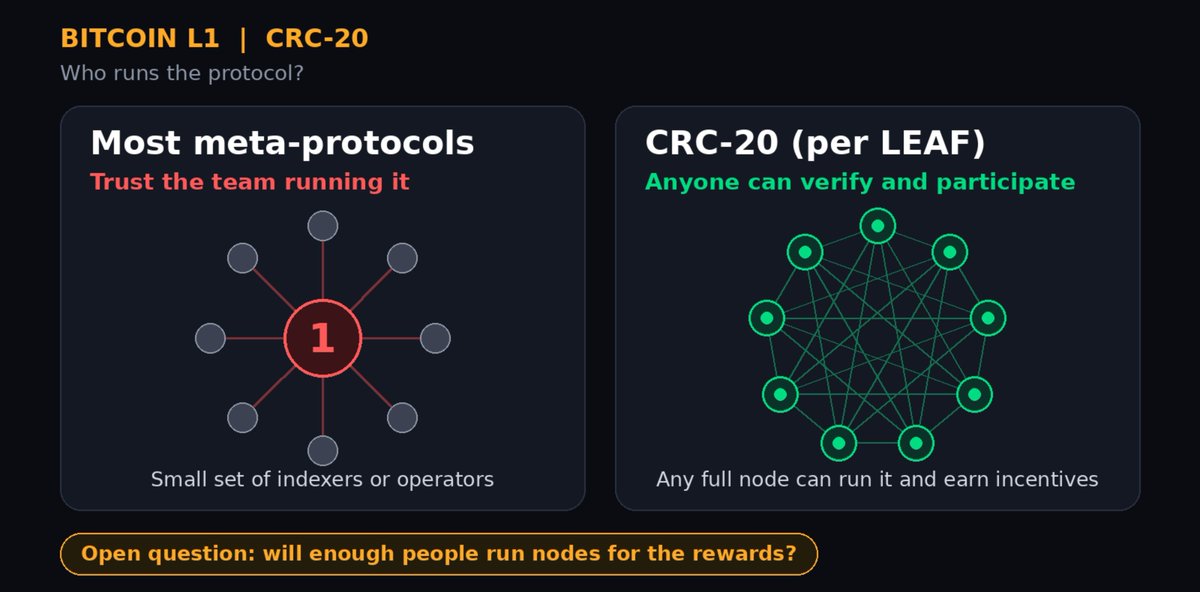
LEAF is pushing the idea that CRC-20 should be runnable by anyone.
They’re saying the operator role shouldn’t stay centralized. Full nodes should be able to run the protocol themselves and earn from the incentives. That shifts the model from “trust the team running it” to “anyone can verify and participate.”
Most Bitcoin meta-protocols still rely on a small set of indexers or operators. If CRC-20 actually works the way they’re describing where regular full nodes can run it and get paid for it it removes one of the usual trust assumptions. Whether enough people will bother running nodes for the rewards is still the open question.
They’re framing it as the last meta on Bitcoin. The transparency angle is the part worth watching. @leaf_btc@tap3leaf 🌱
Transparency is the key.
We will prove by usage that the operator's responsibility should go directly to full nodes.
Anyone should be able to run CRC-20 on Bitcoin today and earn from the protocol incentives.
The last meta on Bitcoin 🌱
CRC-20 just crossed 10 $BTC volume.
The vaults lock bitcoin.
The pools generate yield.
The script enforces the paths.
Congratulations to all participants.
Let's grow! 🌱
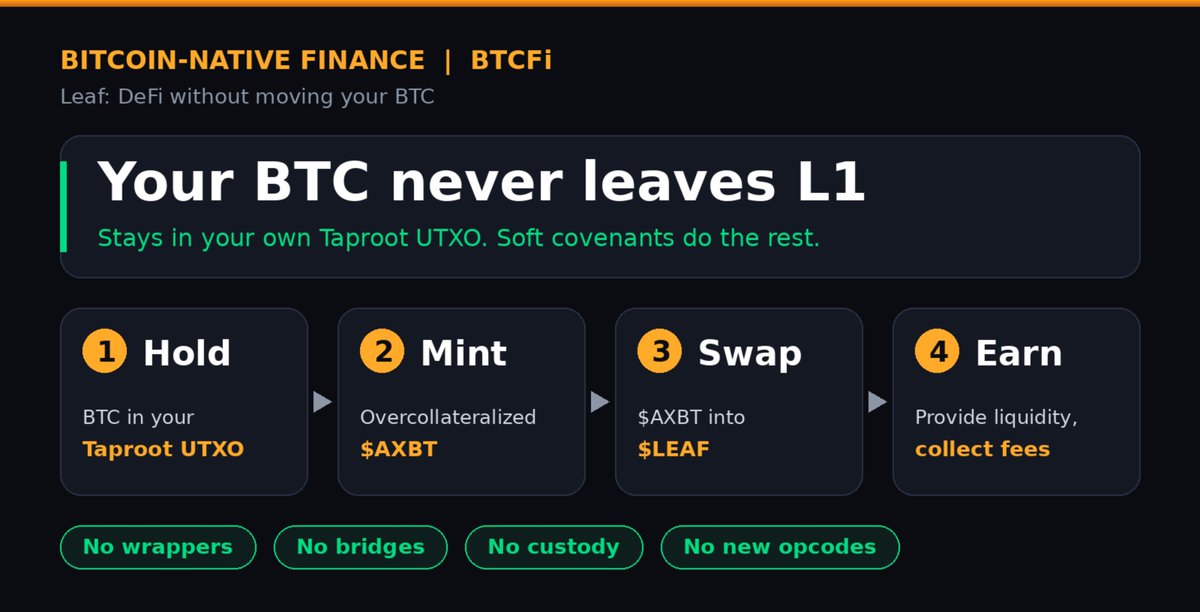
This is one of the cleanest explanations of real Bitcoin-native finance I’ve seen.
No wrappers.
No bridges.
No “trust us with your keys.”
Your $BTC stays in your own Taproot UTXO on L1. Soft covenants do the rest. You mint overcollateralized $AXBT, swap into $LEAF, provide liquidity, earn fees… and the Bitcoin never leaves the chain.
Most “BTCFi” still ends up moving the coin somewhere else. This one actually keeps it on Bitcoin.
Big respect to @tap3leaf and the whole @leaf_btc crew for building this the hard way no new opcodes, no consensus changes, just pure L1.
This is the direction that actually matters.
Let’s grow 🌱
#crc20 #Bitcoin #BTCFi
@tap3leaf Bitcoin has the best collateral on earth. 🌱
Now #CRC20 is turning it into liquid finance without leaving Bitcoin L1.
No bridges. No wrapped BTC. Just a new way to unlock Bitcoin's potential. 🚀
$LEAF to the moon
10 steps to understand #crc20.
1. bitcoin solved money. it's the best collateral on earth, but it just sits there. it never solved finance.
2. there is a liquidity paradox: to make ur btc work, u always had to give it away. a wrapper, an exchange, another chain.
3. every "btcfi" before took the coin off bitcoin. every time, someone else ended up holding the keys (we all know how that ends).
4. bitcoin made money honest. today, crc-20 makes it liquid. soft covenant is the core idea.
5. ur $btc goes into a vault: a taproot utxo, on L1, with time locks and spending paths bitcoin itself enforces (here, soft covenants).
6. from that vault u mint $axbt, a debt token backed by more $btc than it's worth (110% to 150%), with a (guarantee) term counted in blocks.
7. $axbt moves. swap it for $leaf. add liquidity to the pool. trade it. liquidate matured vaults. while ur $btc stays exactly where it is.
8. the yield: 1% swap fees to liquidity providers. and matured unpaid vaults go to whoever repays their debt.
9. every locked vault counts as tvl. $btc that was sleeping is now working. and u can verify every vault, every lp, every swap.
10. bitcoin where ur coins stay on L1, in ur own utxo, and still become liquid finance. none of it needed a fork. no new opcode. no consensus change.
let's grow (🌱)
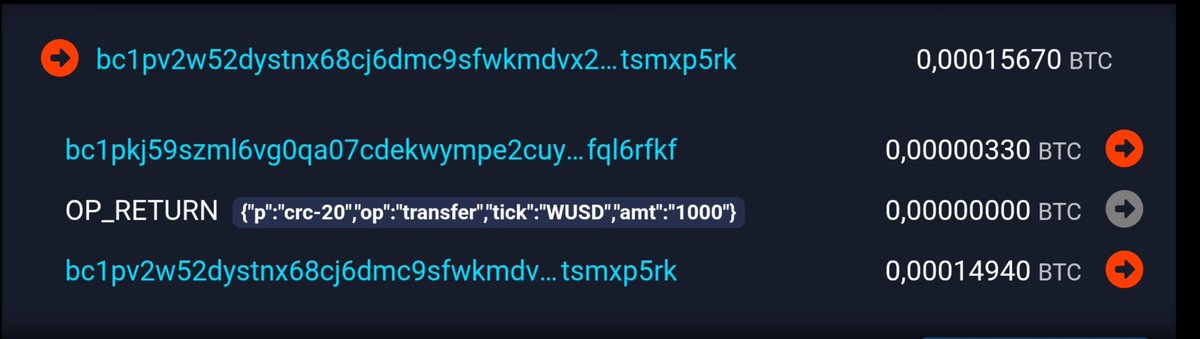
The first stablecoin governed by covenant math on Bitcoin L1? $WUSD could be coming soon.
🔹 BTC vault →AXBT
🔹 AXBT ↔ WUSD swap
🔹 WUSD burn
🔹 1,000 WUSD transfer in just 222 vB
The pieces are starting to show up on-chain. 👀
Bitcoin L1 DeFi is getting real.
$LEAF #CRC20
LEAF just posted a short thread calling the whole thing highly experimental, running 32 bytes at a time, and sitting directly on Bitcoin.
That’s pretty honest. Most projects in this space overpromise. @leaf_btc is openly saying the system is still experimental while showing it’s actually executing on L1. The 32-byte constraint is interesting because it forces everything through small, verifiable pieces instead of big smart contract calls. It limits what you can do in one step, but it also means the state changes stay tightly bound to Bitcoin’s existing rules.
They already went from basic token minting to AMMs and now a stablecoin pool. Seeing them keep emphasizing that it’s experimental while shipping these pieces is better than the usual “this is the future of finance” posts. Still early, liquidity is thin, and a lot can break, but @tap3leaf and the Precop team are building actual financial primitives on Bitcoin instead of waiting for soft forks or moving everything to a sidechain.
Curious to see how the first stablecoin pool behaves once people actually start using it. @theprecop@laz1m0v