Empowering the Bittensor community through accessible knowledge sharing. Explore, learn, and master $TAO with guides, articles, and other resources. 🧠🌐
Just realizing that we forgot to add the right category into the URL 🫣
To read more about Locked Stake & Conviction go here: https://t.co/y4hVjE1ms7
🔒Locked Stake & Conviction are Being Proposed for Bittensor
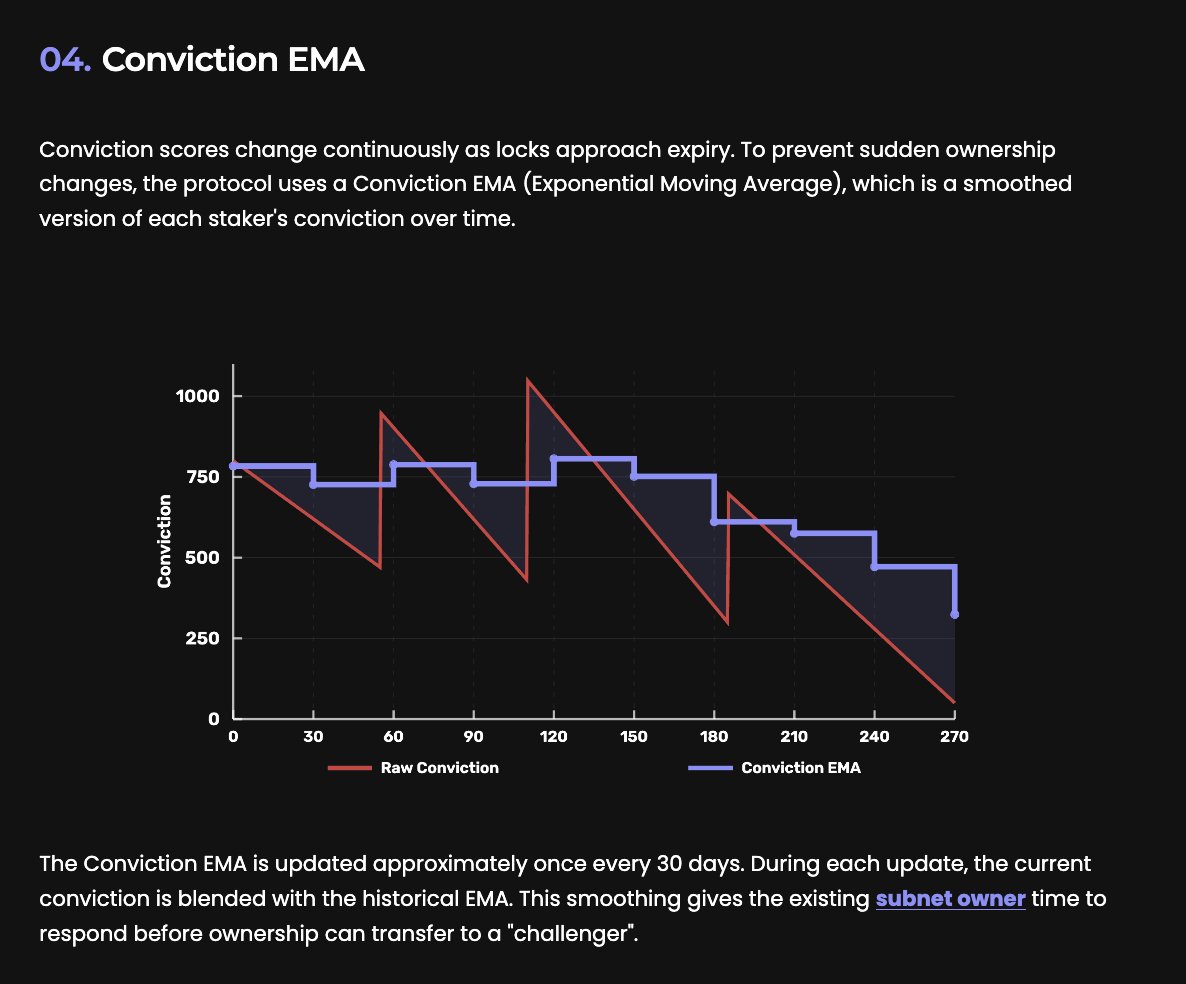
Subnet ownership may be about to change. BIT-0011 proposes that anyone can challenge for ownership of a subnet by locking their ALPHA stake and building "conviction."
Right now, inactive subnet owners can hold onto subnets indefinitely. 'Locked Stake' would make ownership a contest of commitment, giving motivated participants a path to take over neglected subnets.
How it works:
- Lock ALPHA on a subnet for a chosen duration to build conviction
- Conviction starts at the full locked amount and decays linearly to 0 at expiry
- Every 30 days, the staker with the highest conviction EMA becomes the subnet owner
- The EMA smoothing prevents anyone from briefly locking a large amount to "snipe" ownership
Learn More: https://t.co/YpHcT5Nth3
NOTE: This is a draft proposal (BIT-0011) currently being discussed. The implementation and design may change or be replaced completely.
If not mistaken Chutes uses a smart contract where their owner emissions go, which currently seems to hold 37K TAO worth of SN64 ALPHA. If the team were to lock all of it (and then also for a long period of time), someone would need to exceed that. So the malicious actor would need to spend a lot of TAO and then lock their ALPHA.
There doesn't seem enough incentive to do so, as the previous owner and ALPHA holders could likely decide to unstake (causing the value of the ALPHA from the malicious actor to decrease, just to "get" the slot).
Seeing different "Emission %" between @taoapp_ and other explorers? Here is why:
If a subnet's price falls below its "Emission %", then the chain uses a portion of the subnet's TAO emissions to buy the subnet token (also known as "Chain Buys"). TAOapp uses the protocol's TAO flows to calculate the accurate "Emission %" including both these portions, because that's the share the chain actually allocates to each subnet.
More questions? Let Savant explain in depth: https://t.co/6egyHGoPF8
If you have questions, then leave them down below, or read this post by OTF on what changes and what stays the same after the TAO halving: https://t.co/YC9sfDGkQE
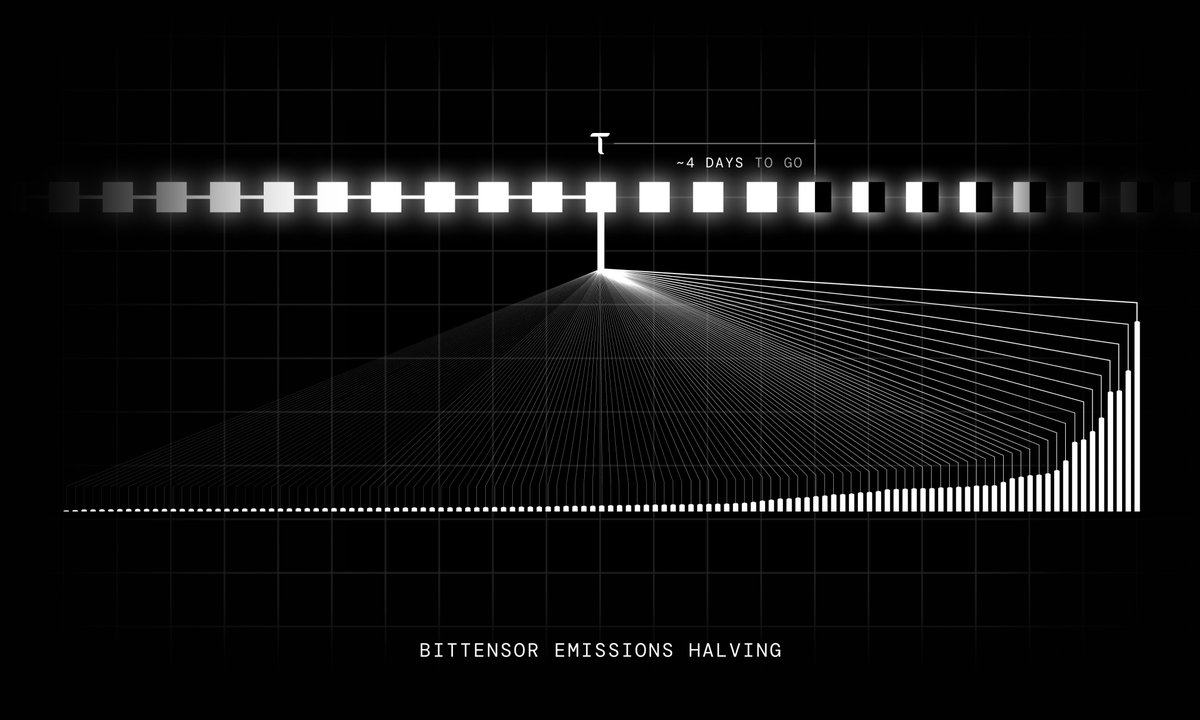
Tracking the TAO halving? If your ETA keeps moving, that's normal. The halving triggers at exactly 10,500,000 TAO circulating TAO, and recycling of TAO shifts the timeline.
https://t.co/JauCl7e2aH's countdown reads the from the blockchain and recalculates every ~12s, so you can celebrate on time! 🥳
Why is our halving countdown the most accurate & always in sync?
tldr: we pull each piece directly from the chain and recalculate every 12 sec. (more details 👇🧵)
Accuracy matters when every block counts. See for yourself: https://t.co/rFQqw6XnjD
🚨 TAO Emissions Got an Upgrade in Dynamic TAO
How TAO gets distributed just changed. Instead of TAO emissions being determined by the EMA prices, the protocol now uses the net TAO inflows to decide which subnets gets "incentivized".
The "old" way was to distribute TAO emissions based on their EMA price. This meant that subnets where the ALPHA price was higher got more TAO emissions.
This caused multiple "problems":
- It made TAO emissions biased by the liquidity of a subnet's pool
- Subnet's with high ALPHA prices and higher liquidity, were able to easily absorb negative net inflows
- The injections of TAO and ALPHA reinforced the subnet's current EMA price (fixating them)
TAO emissions now are using an EMA of the "net TAO inflow", this is the sum of TAO staked minus TAO unstaked (at every block). Subnets with stronger, more sustainable net inflows will get larger emission shares.
Learn More: https://t.co/WKnAanaAbH
How it works?:
- Net inflow EMA smooths over 87 days to prevent temporary volatility
- Subnets with positive net inflow EMAs receive TAO emissions
- Subnets with negative inflows receive no emissions until they turn positive
Plus: Introducing "Root Claim"
With the newly added root claim feature root stakers are able to choose how they want to claim their dividends.
Based on the provided content and the example X posts you've shared, here's a suggested X post introducing the new net inflow-based TAO emissions and Root Claim feature:
- 🔄 "Swap" - Convert ALPHA → TAO (default, like before)
- 💎 "Keep" - Hold ALPHA on subnets you're earning from
Learn More: https://t.co/dmQn807XoQ
The "Keep" option allows root stakers to support subnets by reducing their sell pressure on ALPHA while providing exposure without risking your staked TAO.
NOTE: Currently an all-or-nothing choice. An update will be made where you will be able to keep only ALPHA from the subnets of your choice!
🔄 Subnet Deregistration is Being Proposed Again for Dynamic TAO
Subnet deregistrations are back on the table, and could free up TAO emissions and resources from inactive subnets with the introduction of BIT-0016. Here's how the proposal works:
When Would It Trigger?
Deregistration triggers when the protocol reaches its subnet limit, set to start at 256 subnets, and a new subnet wants to register. It then picks an existing subnet to remove.
The ALPHA Distribution Ratio (ADR)
Only subnets with an ALPHA Distribution Ratio (ADR) less than 1 are eligible for deregistration. This means more ALPHA tokens are held in the subnet's pool than by users, indicating lower demand for the ALPHA token.
Protection for New Subnets
New subnets get a 6-month immunity period where they cannot be deregistered, giving teams time to establish themselves.
Learn more about the DTAO-compatible subnet deregistration: https://t.co/sxRN0mfaB8
💡 NOTE: The term "NAV" seems to cause confusion. That's why we prefer "ALPHA Distribution Ratio (ADR)" as a clearer term, that better reflects what the metric actually measures.
⛏️ TAOHash (SN14): Community-Owned Mining Pool
Miners on subnet 14 have built a community-owned Bitcoin mining pool that peaked at 5 EH/s shortly after launch, representing 0.55% of Bitcoin's total network hashrate.
Unlike traditional pools where operators keep all fees, ALPHA holders "will" own the pool. The 2% pool fee is claimable by ALPHA holders, creating shared ownership instead of corporate control.
Miners compete based on share value rather than raw hashrate, earning both BTC rewards and ALPHA tokens that represent pool ownership stakes.
Learn how community-owned mining works on TAOHash: https://t.co/j6IStzpdXk
Next up: Smart contracts for automated BTC rewards to miners and pool revenue distribution to ALPHA holders, and a hashrate rental marketplace.
🖥️Chutes (SN64): Serverless AI Compute at Scale
Miners on subnet 64 have built a serverless AI platform processing 160 billion tokens daily across 400,000+ users at 90% lower cost than other specialized platforms.
Miners run "chutes" (AI models or computational tasks) and compete through bounty mechanisms. When users request "cold models", miners race to launch them first, earning bounties that increase over time until someone responds.
The platform operates like "Squarespace for AI" - developers deploy models without managing servers, GPUs, or infrastructure.
Learn how serverless AI compute works on Chutes: https://t.co/bSawbd7LpO
Next on the Roadmap: Long Jobs for extended tasks (like training) and enterprise security features.
We are now starting to cover all the subnets, like we did with SN3/Templar few days ago: https://t.co/m2oJGbTGfD
Going forward the coverage will be filled starting with the highest emission subnets first.
Regards to your second point about inactive/active subnets, we will show an indicator for that in the next update, otherwise you can see which subnets are inactive on most platforms like https://t.co/rkNWDVUFcA, https://t.co/732RQbWRga or https://t.co/74tazFbxLh