India designs 20% of the world's chips.
It fabricates none of them yet and when it finally does, in December 2026, the node will be 28nm.
That's not a rounding error.
28nm is the node TSMC perfected around 2011.
Indian engineers at Qualcomm, Intel, AMD, and Nvidia's Bangalore and Hyderabad design centers are taping out 3nm and 2nm silicon for someone else's fab, while the Tata-PSMC plant at Dholera brings up its first wafer at a process node the rest of the world left behind a decade ago.
That's not a failure.
Starting at 28nm is the correct move, mature nodes for auto and power management is where the yield and the money actually are right now.
But it means the country with a fifth of the world's chip design brainpower is about to become a first-time fab operator on a node its own engineers stopped designing for years ago.
Design and manufacturing are finally in the same country.
They're not yet in the same decade.
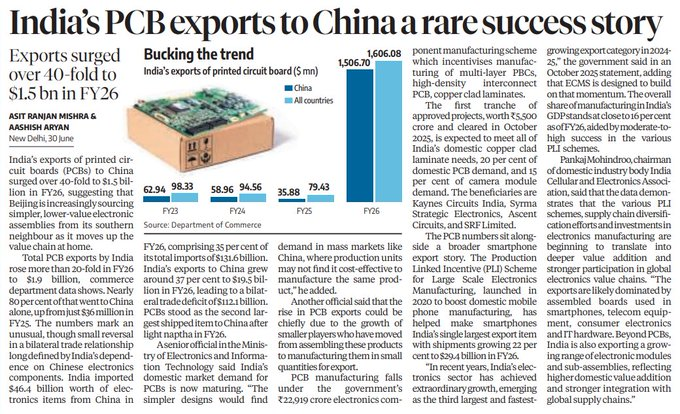
India's PCB Exports to China a Rare Success Story — Exports Surged Over 40-Fold to $1.5 bn in FY26
The Rare Reversal
India's exports of printed circuit boards (PCBs) to China surged over 40-fold to $1.5 billion in FY26, suggesting Beijing is increasingly sourcing simpler, lower-value electronic assemblies from its southern neighbour as it moves up the value chain at home
Total PCB exports by India rose more than 20-fold in FY26 to $1.9 billion, per commerce department data
Nearly 80% of that went to China alone, up from just $36 million in FY25
The numbers mark an unusual, though small, reversal in a bilateral trade relationship long defined by India's dependence on Chinese electronics components
Bucking the Trend — PCB Export Numbers
FY23: Exports to China stood at $62.94 million, while exports to all countries totaled $98.33 million
FY24: Exports to China declined to $58.96 million, with total exports at $94.56 million
FY25: Exports to China fell further to $35.88 million, while total exports dropped to $79.43 million
FY26: Exports surged to $1,506.70 million to China, while total PCB exports jumped to $1,606.08 million
India-China Trade Context
India's exports to China grew around 37% in FY26, leading to a bilateral trade deficit of $112.1 billion
PCBs stood as the second largest shipped item to China after light naphtha in FY26
India imported $46.4 billion worth of electronics items from China in FY26, comprising 35% of its total imports of $131.6 billion
Why China is Buying India's PCBs
A senior official in the Ministry of Electronics and Information Technology: India's domestic market demand for PCBs is now maturing
"The simpler designs would find demand in mass markets like China, where production units may not find it cost-effective to manufacture the same product"
Another official said the rise in PCB exports could be chiefly due to the growth of smaller players who have moved from assembling these products to manufacturing them in small quantities for export
Government Schemes Driving the Push
PCB manufacturing falls under the government's ₹22,919 crore Electronics Component Manufacturing Scheme (ECMS), which incentivises manufacturing of:
Multi-layer PCBs
High-density interconnect PCBs
Copper clad laminates
First tranche of approved projects, worth ₹5,500 crore and cleared in October 2025, is expected to meet:
All of India's domestic copper clad laminate needs
20% of domestic PCB demand
15% of camera module demand
Beneficiaries: Kaynes Circuits India, Syrma Strategic Electronics, Ascent Circuits, and SRF Limited
Broader Electronics Story
PCB numbers sit alongside a broader smartphone export story
PLI Scheme for Large Scale Electronics Manufacturing (launched 2020) has helped make smartphones India's single largest export item, with shipments growing 22% to $29.4 billion in FY26
"In recent years, India's electronics sector has achieved extraordinary growth, emerging as the third largest and fastest-growing export category in 2024-25", the government said in an October 2025 statement
Overall share of manufacturing in India's GDP stands at close to 16% as of FY26, aided by moderate-to-high success in various PLI schemes
Industry View
Pankaj Mohindroo, Chairman, India Cellular and Electronics Association: data demonstrates that PLI schemes, supply chain diversification efforts, and investments in electronics manufacturing are beginning to translate into deeper value addition and stronger participation in global electronics value chains
"The exports are likely dominated by assembled boards used in smartphones, telecom equipment, consumer electronics and IT hardware. Beyond PCBs, India is also exporting a growing range of electronic modules and sub-assemblies, reflecting higher domestic value addition and stronger integration with global supply chains"
Core Theme:
India's 40-fold surge in PCB exports to China represents a remarkable, if nascent, reversal in the India-China electronics trade dynamic — as China moves up the value chain at home, India's lower-cost PCB manufacturing (enabled by PLI schemes, ECMS, and a growing ecosystem of smaller manufacturers) is finding a receptive market in Beijing; while this remains a small reversal in a $112 billion bilateral deficit, alongside India's $29.4 billion smartphone export story, it signals that India's electronics sector is beginning to participate meaningfully in global value chains beyond mere assembly — a structural shift that could deepen significantly as ECMS projects ramp up and domestic PCB manufacturing capacity scales.
🚨🇮🇳 BIG: Indian Army now has 50,000+ drones —up from just a few hundred 2 years ago
Outgoing Army Chief Gen Upendra Dwivedi says the fleet could double in the next 2–3 years.
India is also raising dedicated Baaz Battalions to lead the next era of drone warfare.
Korea Taps Samsung, SK in $576 bn AI Chip Drive — Initiative Centres on Semiconductors, Physical AI & Data Centres
The Sweeping Strategy
South Korea on Monday laid out a sweeping industrial strategy centred on semiconductors and artificial intelligence, as President Lee Jae Myung unveiled over $576 billion in chip investment to secure global dominance and rebalance growth
Plan, anchored by Samsung Electronics and SK Hynix, marks Lee's boldest push yet to align South Korea's AI and chip ambitions with his pledge to narrow domestic regional disparities and revive economies beyond the Seoul metropolitan area
The "Triple Axis" Vision
Flanked by the chiefs of the world's two biggest memory chipmakers, Lee cast the initiative as a "great leap forward", centred on the "triple axis" of semiconductors, physical AI, and data centres
President Lee: "We must secure the core elements of AI faster than any other country", he said in a televised address
AI Playbook — Key Points
President Lee says projects to secure overwhelming industrial strength
Chip investments by Samsung, SK Hynix and local governments top $576 billion
Expected southwest chip hub plan aims to ease Seoul-area concentration
Critics question infrastructure, skilled labour, and political motives behind the plan
Investment Breakdown
Samsung and SK Hynix will invest 800 trillion won ($518.30 billion) to build two new chip fabrication sites each in South Korea's southwest region, industry minister Kim Jung-kwan said
The country's southwestern city of Gwangju and South Jeolla province will also invest 5-20 trillion won in the projects
A further 81 trillion won is expected for a chip packaging cluster in the Chungcheong area near Seoul
Why the Southwest Push
Lee said the southwest will host major chip production clusters, drawing on abundant, underused power
"To meet the rapidly increasing demand for semiconductors, we need to quickly complete the production hubs that are currently under construction", Lee said
"At the same time, we must secure overwhelming production capacity in advance through large-scale new investments, including in the southwestern region. Existing sites centred around Yongin and Pyeongtaek have already reached their limits"
Industry Reaction — Promise and Skepticism
Industry experts say diversifying chip investment beyond Seoul could ease infrastructure bottlenecks, but warn that building cutting-edge fabs requires vast electricity and water, advanced logistics, deep supplier networks, and highly skilled labour — elements that may not scale quickly enough in a new region to meet surging AI demand
Lee Jong-ho, Professor, Department of Electrical and Computer Engineering, Seoul National University: "To execute something of this magnitude properly requires an extraordinary amount of deliberation. I am sure there has been extensive internal review, but from the outside, it still appears to be moving too fast"
Core Theme:
South Korea's $576 billion AI chip drive represents a deliberate dual-purpose strategy — leveraging the scale of Samsung and SK Hynix to cement the country's global semiconductor dominance in an AI-driven era, while simultaneously using massive southwest regional investment to address long-standing economic disparities outside Seoul; though framed as a "great leap forward," the plan faces real skepticism from experts who question whether infrastructure, skilled labour, and logistics can scale fast enough to support cutting-edge fab development in a new region within the aggressive timelines being set.
Centre Clears Rs 1.25 Trillion Semiconductor Mission 2.0, Biggest-Ever Push For India's Chip Ambitions: Report
🏭 The proposed corpus is a sharp jump from the Rs 76,000 crore set aside under ISM 1.0
🔬 ISM 2.0 is designed to deepen backing for chip manufacturing, design and skilling
https://t.co/JnDFTpfu9n
🚨 BIG: 🇯🇵 Japan's Daikin Industries will establish a new R&D subsidiary in 🇮🇳 India and build a research centre in Haryana by 2028 to develop advanced cooling solutions for the Global South.
India’s Automotive Electronics Market is emerging as one of the most attractive opportunities
Market size is already above $12 Bn & is expected to grow at 20% CAGR
This is nearly 3x the growth rate of the Industry !
Vehicles are becoming more electronic, more connected & more software driven
In EVs, electronics already account for 35-45%+ of vehicle value, which makes this one of the most important value pools in the mobility ecosystem
What is driving this opportunity
1. EV adoption & electrification
EVs have 2-3x higher electronics content compared to traditional vehicles. As EV adoption rises, the demand for battery management systems, power electronics, digital dashboards & integrated control systems also rises sharply.
2. Software defined vehicles
Vehicles are now becoming more software led. Features like OTA updates, connected dashboards & centralized control systems are creating new opportunities.
3. Connected vehicles
Vehicles are increasingly becoming like connected devices. Telematics, remote diagnostics, 4G/5G connectivity & in car infotainment are becoming standard features.
4. Advanced safety and ADAS
Safety features are becoming a big growth driver. Features like lane assist, blind spot monitoring, cameras, radar & sensors are seeing higher adoption.
5. Localization & semiconductor ecosystem
India is trying to build more local capability in electronics & semiconductors through policy support.
Digital clusters, infotainment & e-cockpit is one of the most attractive sub segments within automotive electronics
Multiple adjacent segments are also opening up:
- ADAS & active safety : AEB, lane assist, cameras, radar & ultrasonic sensors
- EV power electronics : BMS, inverters & on board chargers
- Sensors : MEMS, LiDAR, radar, ultrasonic & position sensors
- Body electronics : keyless entry, power windows, ambient lighting & comfort electronics
- Telematics & connectivity : e-SIM, 4G/5G, fleet management & remote diagnostics
- ECUs & domain controllers : shift from distributed ECUs to domain & zonal control
The future of auto components will not only be about mechanical parts, but also about software, sensors, displays, connectivity, safety systems & integrated electronics.
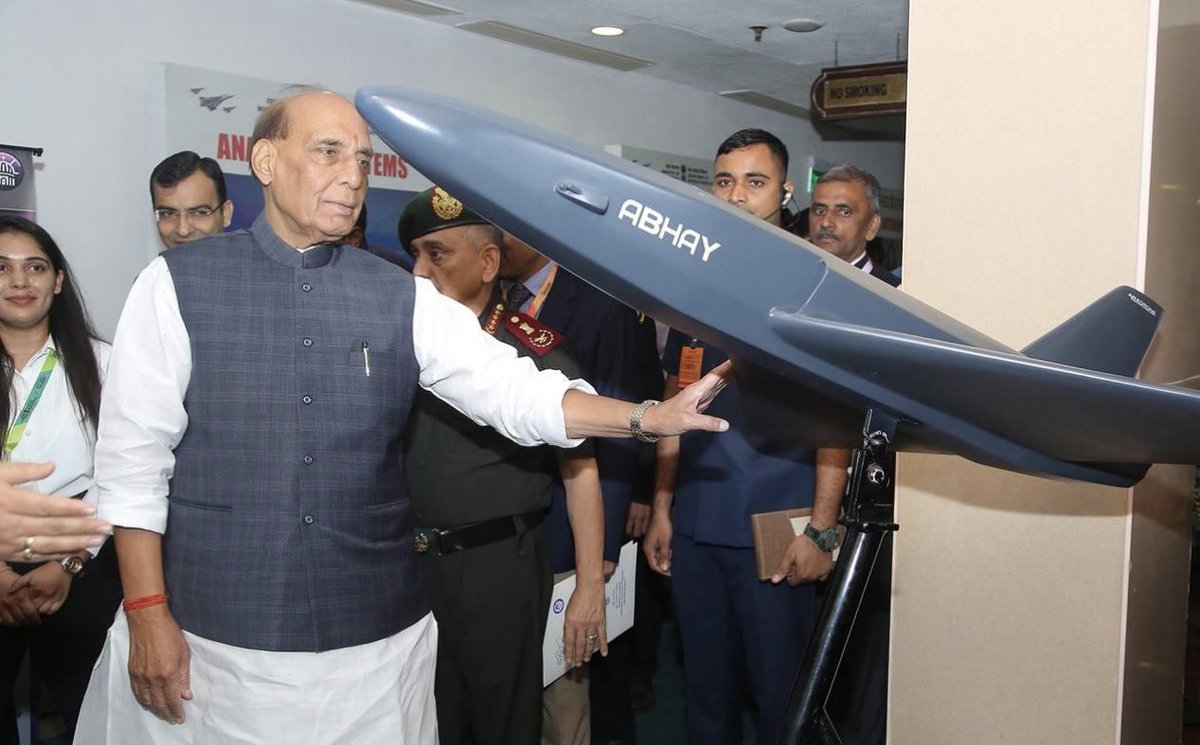
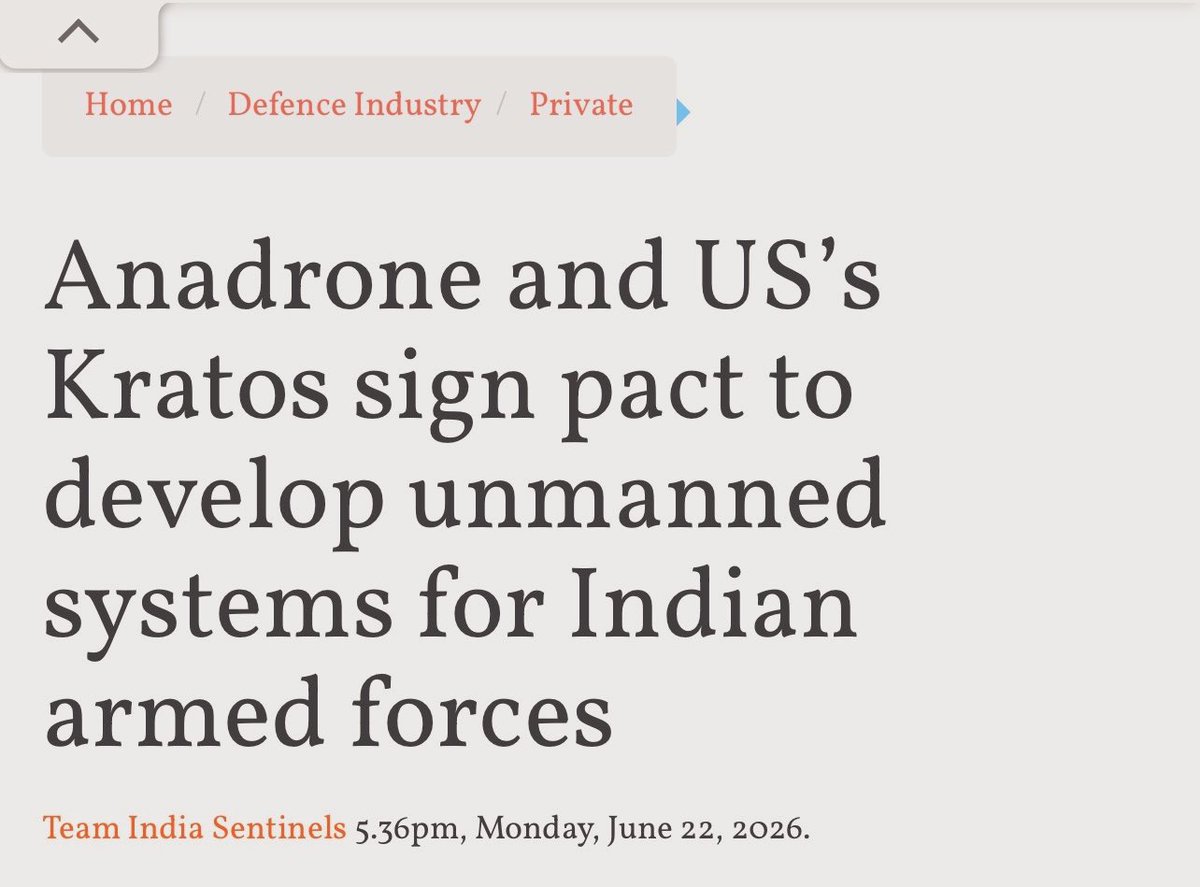
Odisha-based drone startup Anadrone has signed a strategic partnership with US defence major Kratos.
The collaboration aims to develop advanced unmanned systems for the Indian Armed Forces.
Anadrone has two manufacturing units in Odisha(Khordha and Ganjam).
Another milestone for Odisha’s growing defence manufacturing ecosystem. 🇮🇳
DRDO just successfully flight tested the 4th generation VSHORADS 🇮🇳
Very Short Range Air Defence System completed another validation trial, advancing toward production clearance.
And what this system actually does matters more than the headline 👇
• VSHORADS is shoulder fired, man portable air defence weapon for frontline troops
• 4th generation variant incorporates advanced seeker technology and improved target acquisition
• Designed to counter low altitude threats including helicopters, drones and cruise missiles
• Effective range extended compared to earlier variants, still classified
• Can be deployed in minutes without requiring permanent air defence infrastructure
• Complementary to larger systems like Akash, S-400 and Project Kusha
• Flight trial validates guidance system, propulsion and warhead functionality before production
Modern warfare increasingly happens in the low altitude domain where fixed air defence cannot reach.
A soldier with a VSHORADS on his shoulder becomes an air defence asset everywhere.
That distributed capability is exactly what India's multi-layered air defence strategy requires 🇮🇳
I request everyone to go through this twitter thread and learn from this triangle strategy it works fantastic have traded many stocks based on triangle setups apart from rectangle darvas box and has made money
Do share , retweet and like this tweet everyone that would help others too ,do not forget to follow and share my twitter handle with others
Thank you for your attention to this matter 🙏