Policy analyst, currently working on master’s in social innovation, policy innovation, design, experimentation, Analyste de politiques, innovation sociale
Mila is excited to launch AI Advantage, a new interactive online workshop designed to help public servants harness generative AI in their work, guiding them to reflect on their workflows, mapping out areas where AI can add value and efficiency. https://t.co/Qs5EiwIgYz
@ppforumca
Mila est ravie de lancer Avantage IA, un nouvel atelier interactif en ligne conçu pour aider les fonctionnaires à exploiter l'IA générative dans leur travail en identifiant les domaines dans lesquels l'IA peut ajouter de la valeur et de l'efficacité. https://t.co/nlbY80c4En
@ppforumca
Speaking with +500 policy folk today at the Policy Festival helped me understand that I think about policy innovation like a collage artist: overlaying & juxtaposing disciplines, methods & approaches to achieve something more beautiful & ultimately more long-lasting.
⏩The Narrow Corridor serves as a framework for digital practitioners who are both excited and concerned about the potential of digital technologies.
IIPP's @daeaves writes on what it takes to build high-functioning states.
🔗Read the blog here: https://t.co/Rv47LtOqWs
Dear managers: Raising productivity is not about monitoring people. It's about motivating them.
94 studies: Surveillance fails to improve performance—and increases stress, distrust, and dissatisfaction.
Tracking people is not a substitute for respecting and valuing them.
LinkedIn is now using everyone's content to train their AI tool -- they just auto opted everyone in.
I recommend opting out now (AND that orgs put an end to auto opt-in, it's not cool)
Opt out steps: Settings and Privacy > Data Privacy > Data for Generative AI Improvement (OFF)
#ICYMI: #ImpactCanada joined the 1st International Sludge Academy with @OPSIgov & @NSWCustomer! 🌍
Read how 16 teams from 14 countries worked to reduce unnecessary frictions in gov interactions: https://t.co/6KjHdwQsXk
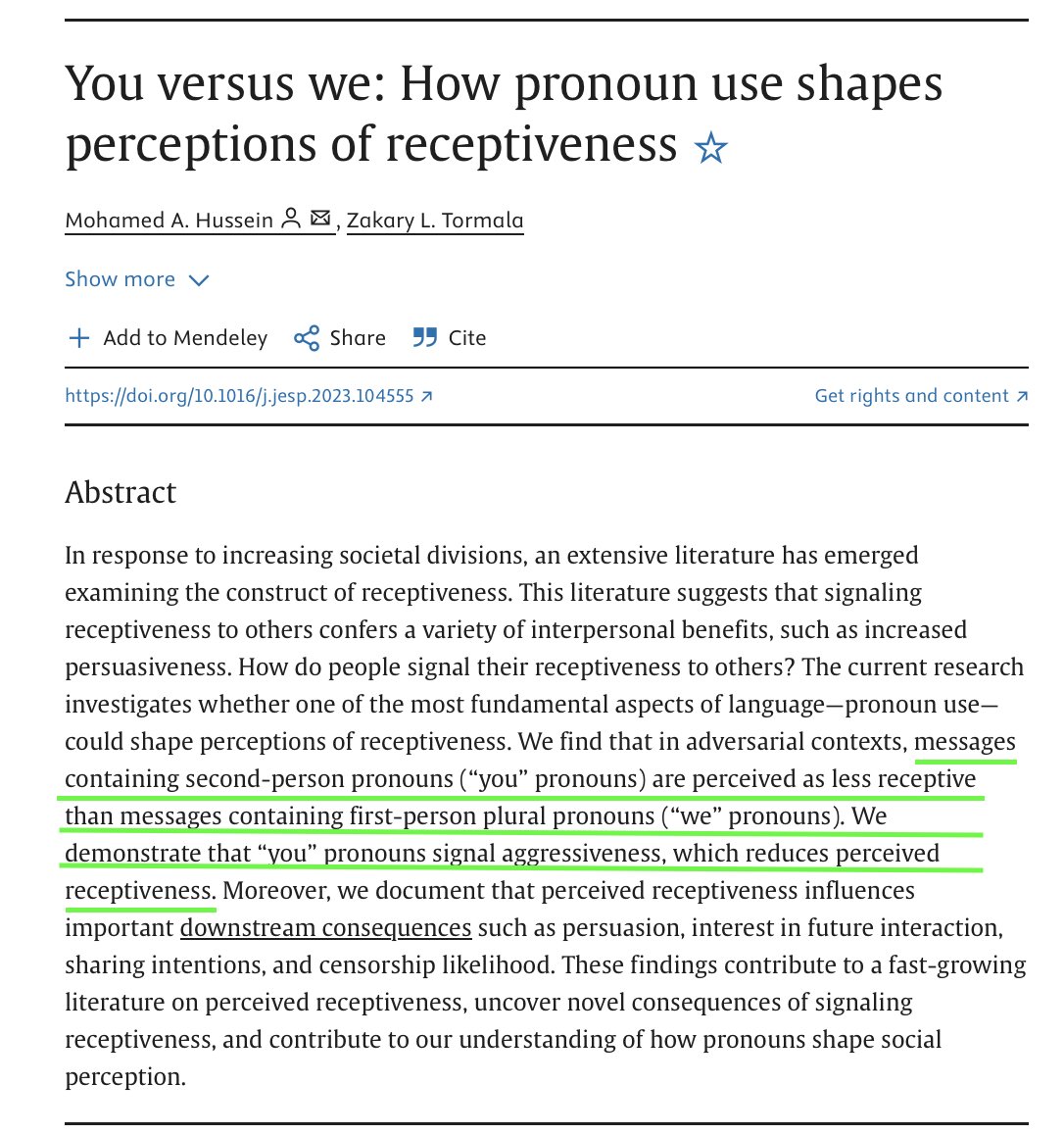
💬 "You" vs. "We"—which pronoun is more persuasive?
New research shows that “we” increases receptiveness and trust by signaling inclusivity.
But "you," by seeming aggressive, can weaken one's message now and in future encounters.
"We" is stronger than "you.”
🌟 Integrating evidence and public engagement in policy work: an empirical examination of three UK policy organisations
👏by @clemhilloconnor @ProfKatSmith @DrEllenStu
Read this #OnetoWatch article, free to access in the collection until 30 Sept!
https://t.co/Kf1ZTUGFz9
📣 Design of services or designing for service? The application of design methodology in public service settings
👏by Kirsty Strokosch & @StephenOsborne1
Read this #OnetoWatch article, free to access in the collection until 30 Sept!
https://t.co/LbwItH2hp4
"We propose a new type of portfolio practice that invites orgs to develop the capacity to radically open up the governance & operation of portfolios as a distributed network of actors, actions, & assets, aligned by a common intent" https://t.co/UsyfILlhLn @DarkMatter_Labs
New #openaccess article in PAR: Abductive analysis in qualitative public administration research by Merlijn van Hulst and E. Lianne Visser: https://t.co/fUM5M25Slo
Attention all government leaders! Last week, we released a new report titled "Building the AI-Ready Government: An Essential Action Plan for Leaders."
Read the full report today: https://t.co/zIHwhRp6zY ✨
Just one week left to sign up for this free, online event! Expert speakers will join us, sharing tools and techniques for systems mapping to help you visualise complexities and elevate your analytical and problem-solving skills. ⚙️
Register now: https://t.co/Bhdil8Qfxw
"We set out a vision for a different path for AI. It starts with a recognition that, on technology, governments and public-interest orgs don't have to be relegated to
the role of rule-makers. They can be inventors, builders, market-shapers, maintainers" https://t.co/L9kAiUQSgc
In a complex adaptive system there is no linear
causality... Forecasting & backcasting assume a degree of predictable relationship between cause & effect; so in complexity, we focus on sidecasting: casting around in the present to discover opportunities https://t.co/x25BSJppCZ
🚨 [AI & PRIVACY] Singapore's Data Protection Authority publishes its "Proposed Guide on Synthetic Data Generation," and it's an interesting read for everyone in AI & privacy. Info & quotes:
➡ Among other topics, the proposed guide discusses a five-step approach to generating synthetic data, especially in the context of a Privacy-Enhancing Technologies (PETs) perspective:
➡ Step 1: Know your data
"Before embarking on any synthetic data project, it is necessary to have a clear understanding of the purpose and use cases of the synthetic data and the source data that the synthetic data is to mimic. This will help to determine whether use of synthetic data might be relevant and identify the possible risks of using the synthetic data."
➡ Step 2: Prepare your data
"To ensure that the synthetic data can meet the business objectives, organisations need to understand and identify the trends, key statistical properties, and attributerelationships in the source data that need to be preserved for analysis e.g., identify relationships between demographic characteristics of population and their health conditions."
➡ Step 3: Generate synthetic data
"There are many different methods to generate synthetic data, for example, sequential tree-based synthesisers, copulas, and deep generative models (DGMs). Organisations need to consider which methods are most appropriate, based on their use cases, data objectives, and types of data. (...)Thereafter, organisations may consider splitting the source data into two separate sets e.g., 80% as training dataset, and 20% as control dataset for assessing re-identification risks of the synthetic data."
➡ Step 4: Assess re-identification risks
"After the synthetic data is generated and utility measurement is assessed to be acceptable, organisations should assess and perform the re-identification risk assessment based on their internal acceptance criteria. (...). As synthetic data generally does not replicate its training data points, re-identification risk cannot be deduced directly from scrutinising whether the generated synthetic data contains any personal data."
➡ Step 5: Manage residual risks
"In this final step, organisations should identify all potential residual risks and implement appropriate mitigation controls (technical, governance, and contractual) to minimise the identified risks. These risks and controls should be documented and approved by the management and key stakeholders as part of the organisation’s enterprise risk framework."
➡ It's an interesting guide, especially for those involved with AI development and Privacy-Enhancing Technologies (PETs). There is much more to read in this guide by the @PDPCSingapore, make sure to check it out below.
➡ To stay up to date with the latest developments in AI policy & regulation, join 29,300+ people who subscribe to my weekly newsletter (link below).
What does it take to deliver missions in practice? This new deck from @nesta_uk and @instituteforgov sets out the key components of mission-driven government
https://t.co/a5HFVkSvZ5










![LuizaJarovsky's tweet photo. 🚨 [AI & PRIVACY] Singapore's Data Protection Authority publishes its "Proposed Guide on Synthetic Data Generation," and it's an interesting read for everyone in AI & privacy. Info & quotes:
➡ Among other topics, the proposed guide discusses a five-step approach to generating synthetic data, especially in the context of a Privacy-Enhancing Technologies (PETs) perspective:
➡ Step 1: Know your data
"Before embarking on any synthetic data project, it is necessary to have a clear understanding of the purpose and use cases of the synthetic data and the source data that the synthetic data is to mimic. This will help to determine whether use of synthetic data might be relevant and identify the possible risks of using the synthetic data."
➡ Step 2: Prepare your data
"To ensure that the synthetic data can meet the business objectives, organisations need to understand and identify the trends, key statistical properties, and attributerelationships in the source data that need to be preserved for analysis e.g., identify relationships between demographic characteristics of population and their health conditions."
➡ Step 3: Generate synthetic data
"There are many different methods to generate synthetic data, for example, sequential tree-based synthesisers, copulas, and deep generative models (DGMs). Organisations need to consider which methods are most appropriate, based on their use cases, data objectives, and types of data. (...)Thereafter, organisations may consider splitting the source data into two separate sets e.g., 80% as training dataset, and 20% as control dataset for assessing re-identification risks of the synthetic data."
➡ Step 4: Assess re-identification risks
"After the synthetic data is generated and utility measurement is assessed to be acceptable, organisations should assess and perform the re-identification risk assessment based on their internal acceptance criteria. (...). As synthetic data generally does not replicate its training data points, re-identification risk cannot be deduced directly from scrutinising whether the generated synthetic data contains any personal data."
➡ Step 5: Manage residual risks
"In this final step, organisations should identify all potential residual risks and implement appropriate mitigation controls (technical, governance, and contractual) to minimise the identified risks. These risks and controls should be documented and approved by the management and key stakeholders as part of the organisation’s enterprise risk framework."
➡ It's an interesting guide, especially for those involved with AI development and Privacy-Enhancing Technologies (PETs). There is much more to read in this guide by the @PDPCSingapore, make sure to check it out below.
➡ To stay up to date with the latest developments in AI policy & regulation, join 29,300+ people who subscribe to my weekly newsletter (link below).](https://pbs.twimg.com/media/GSkecbRWMAAuZaW.jpg)


