🚨 AMERICANS NEED TO UNDERSTAND WHAT IS HAPPENING RIGHT NOW.
Most people are still viewing President Trump’s foreign policy through the old post-WW2 lens. That lens is obsolete. What P Trump is attempting is not a minor policy adjustment. It is a complete restructuring of the global economic and geopolitical order.
Read that again.
For 80 years, America operated under a “globalist” framework:
• America paid the bills
• America defended everyone
• America opened its markets
• America carried NATO
• America protected shipping lanes
• America subsidized allies
• America tolerated trade imbalances
• America exported democracy while factories disappeared and debt exploded at home
That system enriched multinational corporations, global institutions, foreign economies, and permanent bureaucracies.
But millions of Americans watched:
- manufacturing collapse
- wages stagnate
- communities hollow out
- endless wars drain trillions
- China rise into a superpower using America's own economic system against itself
President Trump is trying to replace that model with something entirely different:
👉 A transactional, America First economic coalition built around ENERGY, TRADE, SECURITY, MANUFACTURING, and STRATEGIC DEALS.
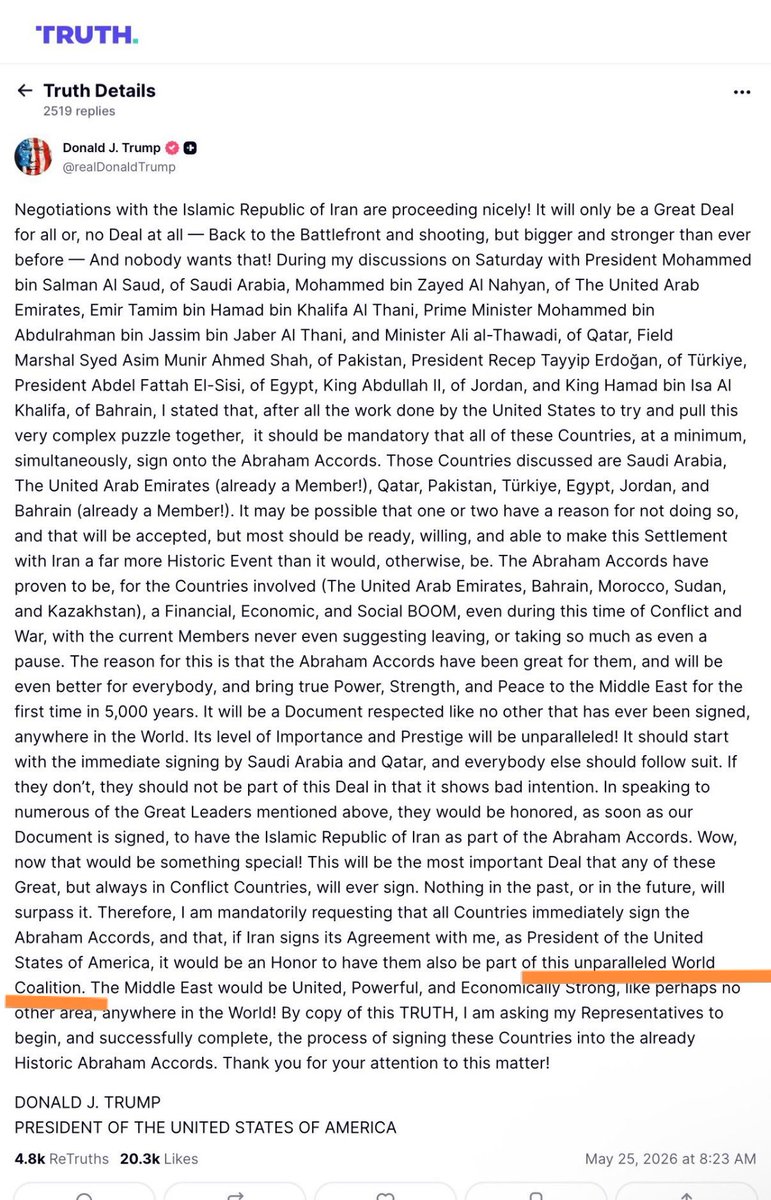
That Truth Social post about the Abraham Accords wasn’t just another statement. It was a blueprint.
If this succeeds, you are looking at the construction of a massive economic/security network that could include:
- The United States
- Saudi Arabia
- UAE
- Qatar
- Egypt
- Jordan
- Israel
- Pakistan
- Türkiye
- India
- parts of Latin America
- strategic Indo-Pacific partners
- and critically, a normalization framework with BOTH China and Russia where competition still exists, but catastrophic conflict is avoided through economic leverage, negotiated spheres of influence, energy coordination, and transactional diplomacy
This is one of the most misunderstood parts of President Trump’s geopolitical strategy.
Many Americans still think in Cold War terms:
America vs Russia.
America vs China.
Permanent hostility.
Permanent escalation.
But President Trump’s approach is far more transactional and realist.
Instead of trying to ideologically remake the world, the strategy appears focused on:
- preventing direct great-power war
- reducing the chance of nuclear escalation
- using trade leverage instead of permanent military occupation
- creating economic interdependence where possible
- forcing burden-sharing among allies
- and positioning America as the central negotiating power between rival blocs
That does NOT mean “surrendering” to China or Russia.
It means recognizing a reality many in Washington refused to accept for decades:
China is already an economic superpower.
Russia remains a military and energy superpower.
The question is no longer whether they exist as major powers.
The question is whether America can position itself at the center of a new balance of power that benefits Americans instead of endlessly draining American wealth trying to maintain a fading unipolar system.
This is why you are seeing:
• negotiations instead of immediate escalation
• energy diplomacy
• tariff wars instead of troop surges
• pressure campaigns tied to trade access
• selective partnerships instead of blind alliances
• attempts to split rival coalitions apart through deals
President Trump is essentially trying to create overlapping economic zones where America is no longer carrying the world for free - but instead sits at the center of the world’s most powerful deal-making network.
Combined economic power? Potentially $65-75+ TRILLION in GDP. Over HALF the global economy.
Think about what that means.
This is about:
✅ energy dominance
✅ shipping lanes
✅ critical minerals
✅ AI infrastructure
✅ manufacturing chains
✅ food security
✅ military positioning
✅ trade corridors
✅ investment flows
✅ currency leverage
✅ stabilizing relations between major powers where possible
✅ isolating hostile behavior through leverage instead of endless occupation wars
And younger Americans especially need to understand this part:
THIS DIRECTLY IMPACTS YOUR FUTURE.
If America remains trapped in the old system:
- debt keeps exploding
- jobs continue leaving
- housing becomes less affordable
- wages get crushed by global competition
- endless foreign entanglements continue
- America slowly declines like other aging empires
But if America successfully repositions itself at the center of a new energy/manufacturing/trade coalition:
- industrial jobs return
- energy prices stabilize
- strategic industries reshoring accelerates
- infrastructure investment increases
- supply chains become more secure
- America regains leverage instead of bleeding leverage
This is why you see such aggressive pushes around:
• tariffs
• domestic manufacturing
• energy independence
• critical minerals
• Middle East normalization
• India relations
• securing trade routes
• reducing dependency on hostile supply chains
• stabilizing great-power relations through leverage and economic pressure instead of permanent military escalation
This is not random.
This is an attempt to build a new geopolitical architecture for the next 50 years.
And whether people like President Trump or hate him personally is becoming irrelevant to the scale of what is unfolding.
The Abraham Accords themselves are historic because they shift the Middle East from perpetual religious/geopolitical conflict toward economic interdependence.
Peace through prosperity.
Trade instead of proxy wars.
Economic incentives instead of permanent instability.
That changes everything:
- investment floods in
- shipping stabilizes
- energy markets calm
- regional growth accelerates
- tourism expands
- infrastructure projects explode
- security cooperation increases
And if normalization frameworks eventually extend outward toward Russia and even portions of China’s economic system, you could be looking at the emergence of the largest interconnected economic balancing structure in modern history.
Not a utopia.
Not permanent peace.
Not the end of competition.
But a system where economic incentives and strategic leverage become more powerful than endless military occupations and ideological crusades.
The old order was based on permanent management of conflict.
This new model attempts to monetize stability.
Will it fully work? Nobody knows yet. There are enormous risks, contradictions, and power struggles involved. Traditional allies are nervous. Global institutions hate it. Rival powers are cautious. Some countries will resist. Others will attempt to manipulate it.
But Americans should at least understand the scale of the play being attempted here.
This is not “normal politics.”
This is a potential civilizational realignment.
And if younger Americans do not start paying attention to economics, geopolitics, energy, trade, manufacturing, and global power shifts now - they are going to inherit a world they do not understand.
Read. Research. Think critically.
And SHARE this so more Americans understand what may be unfolding in real time.
Strategy has completed the repurchase of $1.5 billion of its 2029 Convertible Notes at an ~8% discount to par, generating an incremental 0.7% BTC Yield and lowering aggregate debt to $6.7 billion. $MSTR $STRC https://t.co/cbx4BlpsKV
$MSTR
The value proposition of @Strategy as an operating company is still largely misunderstood by the market.
Since $IBIT launched in January 2024, $MSTR has significantly outpaced it in total returns.
The single factor people are still waking up to is that $IBIT is simply a passive vehicle tracking Bitcoin’s price, while @Strategy is a management team that has continuously found ways to add value to shareholders regardless of market conditions.
Despite the turbulent year Bitcoin has seen, Strategy has still outperformed it year to date.
A single operating company outpacing the accumulation generated by an ETF run by the largest asset manager on the planet.
Last year’s pushback on Strategy’s model was that it relied too heavily on the issuance of common shares at a premium to accumulate Bitcoin.
And while that was an extremely profitable run, the company continued to innovate.
The preferred line of equities followed.
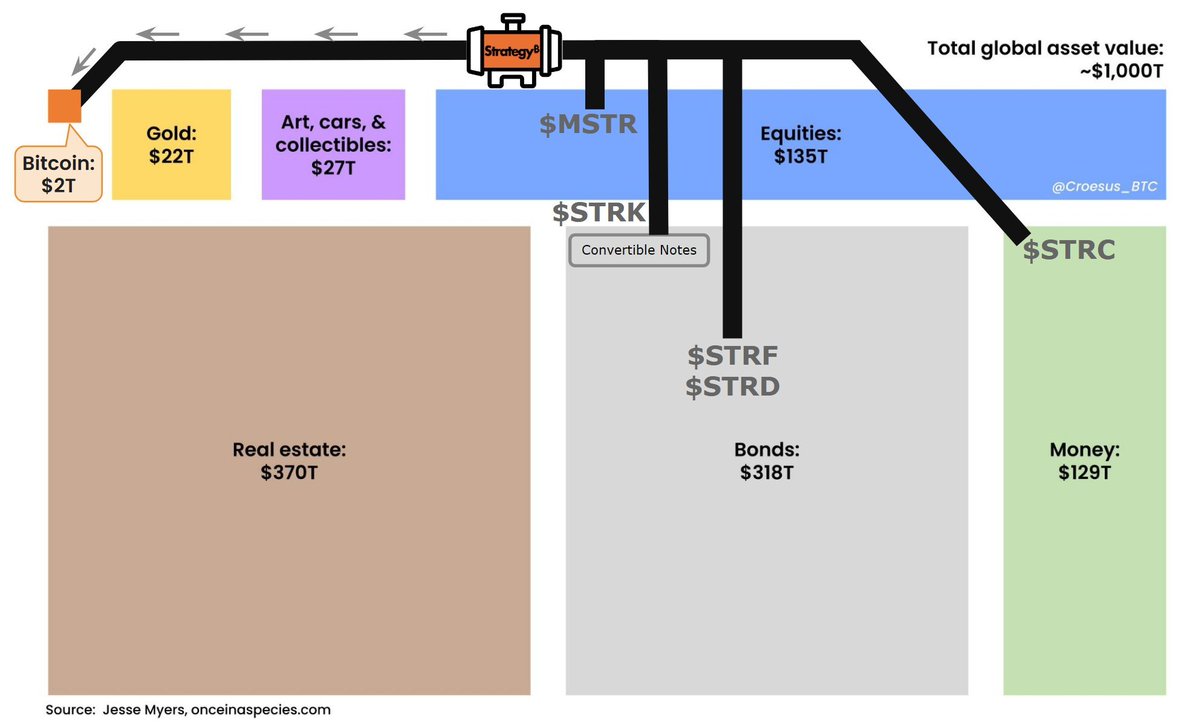
And then $STRC arrived, which has now become the primary driver of accumulation.
Last week alone, $STRC contributed close to $2 billion in capital raised while $MSTR common contributed a mere $80 million.
A clear indication the flywheel has shifted.
And through it all, the premium has held.
Bitcoin retraced close to 50% from its October 2025 all time high of $126,000, bottoming around $60,000 earlier this year.
Strategy pulled back further from its peak.
And yet the company never traded at a sustained discount to NAV.
Even now, with Bitcoin still relatively suppressed, @Strategy continues trading at a premium.
The larger institutions understand the value proposition.
The broader market is still catching up.
Not only are you outperforming spot Bitcoin with $MSTR, you are doing it without a management fee.
And your exposure to the Bitcoin held by the company grows over time.
Every week that Strategy raises capital and acquires Bitcoin, each share controls a slightly larger piece of that accumulation.
In a world where Bitcoin reaches a million dollars, the market will price $MSTR correctly.
It is just a matter of time.
$BTC $MSTR $STRC
THE JAPAN TRADE. weekend reading
Everyone's seeing the charts on their feed: JGBs hitting record yields. Yen >158. US 10Y >4.5%.
But do you understand what it actually means, and why it’s important?
I’m going to break it down here, and explain the implications and how it relates to Japan, the US, Bitcoin and #Metaplanet. Because believe it or not, Japan is probably the most important macro story in the world
1/ The data. JGB 10Y at 2.7% — highest since May 1997 (29 years). JGB 30Y at 4.00% — all-time record. JGB 40Y above 4% — first time any JGB maturity has been here in 30+ years. USD/JPY around 158, with the BOJ spending ¥5.48T ($35B) on intervention this month alone. This is not pocket change, and had little to no effect besides a short term bounce.
2/ But this isn't 1997. Look at the JGB 10Y chart (posted below). The yield is back where it last was in May 1997 — 2.70%. The country however, is not. In 1997, Japan's debt-to-GDP was ~100%. Today it's 248%. So it’s the same nominal yield, applied to a debt stack roughly 2.5x larger. Today's reported interest bill (¥13T) is still mild because most outstanding JGBs carry sub-1% coupons issued during the ZIRP/QE era — but every bond that rolls now reprices to today's curve.
3/ Which sets up an impossible trilemma. Three things Japan is trying to do at the same time: (a) keep debt service affordable, (b) prevent the yen from collapsing, (c) let rates normalize to reflect actual inflation. You can only pick two out of three.
— Pick (a)+(b): keep BOJ buying bonds to suppress yields, burn FX reserves to defend the yen. This is the path that got Japan to 46% BOJ ownership of JGBs and ¥5.48T of intervention in a single month. Every quarter the exit gets harder.
— Pick (b)+(c): let BOJ hike to close the US spread, yen stabilizes. But every 100bps higher reprices a ¥1,300T+ debt stack on rollover. Fiscal crisis looming.
— Pick (a)+(c): hike slowly, keep fiscal stimulus, let yen find its level. Yen drifts to 170, 180. Imported inflation crushes consumers. Foreign capital starts selling JGBs. Fiscal crisis through a different door. The trap is circular: every solution produces the problem you tried to avoid. That's why this isn't a riddle you can solve. It’s a can you keep kicking down the road, until the market eventually forces a choice.
4/ Then PM Takaichi said the quiet part out loud. She said "break free of the spell of excessive fiscal austerity." Her plan: ¥21.3T supplementary stimulus, a ¥122.3T FY26 budget (biggest ever, +6.3%), tax cuts and record defense spending. And the bond market is responding.
5/ The fiscal math doesn't work anymore. Interest spending in FY26: ¥13 trillion — about 10.6% of the entire ¥122.3T budget. Total debt service (interest + principal redemption): ¥31.3T, roughly one-quarter of the budget. Japan now spends about ¥1 of every ¥10 of its budget just on interest, before a yen is allocated to defense, healthcare, or anything else.
Sensitivity: every 1% rise in yields adds ~¥3–4T to annual interest cost in the near term as JGBs roll (MOF rule of thumb). Over a decade of full repricing across the ¥1,300T+ debt stack, it adds ~¥13T — effectively doubling today's interest bill.
The budget already had to bump its assumed bond rate from 2.0% (FY25) to 3.0% (FY26). The 30Y is currently quoting 4.00%.
6/ The BOJ wants to hike. It can't move fast. Policy rate is 0.75% (still negative in real terms). Core CPI forecast for FY26 is 2.5–3.0%. April PPI: +4.9% YoY and accelerating. Three board members already dissented for 1.0%. But every hike makes the fiscal hole deeper. They're trapped between inflation and insolvency.
7/ Which is why the yen keeps falling. US 10Y: 4.57%. JGB 10Y: 2.7%. Spread: ~190bps. As long as that gap exists and the Fed isn't cutting, the yen wants to weaken. Tokyo's ¥5.48T intervention may have bought them a few weeks, but it didn’t fix anything.
8/ Now the global piece — the carry trade. For a decade-plus, the world borrowed yen at ~0% to buy higher-yielding assets globally. Estimated notional: $350–500B+. As JGB yields rise and yen funding gets expensive, that trade unwinds. Japanese capital comes home. Foreign assets get sold. The biggest one: US Treasuries.
9/ That's why US 10Y just crossed 4.5%+. It's not only US inflation. It's the marginal Japanese buyer becoming a marginal seller. Japan holds ~$1.1T in US Treasuries — the largest foreign holder. If even 5% repatriates, that's ~$55B of supply hitting an already-fragile market.
10/ The deeper story is debasement. Japan printed ¥700T+ over the last decade. The BOJ balance sheet is now ~130% of GDP. They finally got the inflation they worked so hard for. The cost: yen debasement, a bond market revolt, and a central bank that owns half its own debt. There is no clean exit.
11/ Bitcoin is the hedge against exactly this. Debt monetization that can't be reversed. Currency as the release valve. Bond markets that have stopped trusting central planners. BTC corrected with bonds this week on the risk-off — but the structural reason it exists just became clearer.
12/ So the real question. Not "who owns BTC." Not "who's Japan-listed." Which balance sheet is actually built for this regime — capital structure designed for a debasing yen, a rising US 10Y, and a global capital pool that's starved for real yield? I think you can guess who that is.
13/ Metaplanet is the bridge architecture. Metaplanet ($MPJPY / $MTPLF / $3350.T) is the only treasury company designed to bridge three pools: a Tokyo-listed parent equity, US institutional appetite (the deepest BTC-proxy demand pool in the world), and Japanese yield-starved capital. Into one ecosystem. It’s a structural setup @gerovich and @DylanLeClair have been quietly putting together, while the market is too focused on the short term price action.
14/ The Japan engine is already running. 40,177 BTC on the balance sheet; the largest holder outside the US and third largest globally -> likely to jump to second by end of Q2. Perpetual preferred shares being built from scratch as a first time innovation with extremely high barriers to entry, albeit exact timeline is uncertain.
15/ The US engine is being built right now. I laid out the full chronology in detail in my last post. The short version: this didn't start last week. Apr 2025: Miami subsidiary established. Sep 2025: US Income Corp (BTC income generation, US jurisdiction). Dec 2025: Sponsored Level 1 ADR live ($MPJPY), Deutsche Bank depositary, MUFG custodian. Mar 2026: strategic-disclosure day — Asset Management + Ventures + JPYC investment, all on the same day. Thirteen months of compounding setup.
16/ The fee-waiver is the tell. Metaplanet opened a 60-day fee-free window for converting $MTPLF → $MPJPY ADRs, running April 13 to June 12, 2026. Translation: management wants the ADR float deep, clean, and institutionally ready before something lands on top of it.
17/ The likely product — and why it fits the macro. The most plausible first product is a USD-denominated perpetual preferred, run on the same 144A playbook Strategy used for $STRC / $STRD / $STRF. And the macro story is exactly what makes the two-pool structure powerful: Japan is yield-starved (a 5–6% coupon clears domestically), the US is yield-rich (BTC-treasury perps already clear at 10–14%). Metaplanet can issue into both worlds at their respective rates, building optionality and taking advantage of the two deepest capital pools in the world as they evolve over the coming years.
18/ No other company has this structural setup. A debasing-currency balance sheet, holding the asset that hedges debasement, raising in the world's deepest dollar capital market — while its home market produces the structural tailwind.
19/ What this means for the US and Bitcoin. For the US: Japan is the leading edge, not the exception. US debt-to-GDP is ~125%, the 10Y is 4.59% — the same arithmetic eventually applies. Higher rates → higher debt service → political pressure on the Fed → yield curve control, dollar debasement, or both. The US is roughly 10–15 years behind Japan on the same curve. Japanese repatriation is one of the reasons that curve is being pulled forward right now.
For the dollar: short-term strength as the yen weakens further. But every reserve currency with high debt-to-GDP and aging demographics ends up where Japan is. The dollar's privileged reserve currency status buys time, but we are already seeing this start to unwind.
For Bitcoin: BTC is the only macro asset whose supply is fixed regardless of what any central bank decides. When bond markets stop trusting central planners — and the JGB curve is the first to break that trust at scale — Bitcoin's value proposition stops being abstract.
Short-term, BTC trades with risk-on/risk-off. It sold with bonds this week. But the structural bid keeps building: corporate treasuries, sovereign accumulation, capital fleeing fiscally-trapped currencies. Each Japan-style episode makes Bitcoin's reason for existing more obvious, not less.
The 2029 $MSTR Convert Buyback Is Not What It Looks Like
It's been a while since I posted on MSTR because there's generally a lot of coverage - and I'd rather only post when I have something to add to the discourse. Like many of you probably, @saylor orange pilled me (MSTR class of 2022) and I haven't looked back since.
There's been some important developments lately, and I'd like to weigh in.
Saylor is an incredibly intelligent financial engineer (I'm sure even @JoshMandell6 would agree). And I think that reading friday's $1.5B convertible buyback as deleveraging actually misses the trade.
While it may look like they're just retiring less favorable debt for a 'healthier' balance sheet, the actual action is a clean short on MSTR's implied vol.
Here's how the numbers work out.
Strategy is buying back $1.5B of its $3B 0% convertible senior notes due Dec 2, 2029. Settlement around May 19. Conversion price: $672.40 per share. $MSTR price: ~$175. For these notes to convert into common stock at maturity, the stock has to achieve a 284% gain in 3.5 years (46% CAGR).
A year ago, $MSTR was $400+. Those same 2029 converts traded above par because the embedded call option had real conversion value. Today, with the stock at $175, that call is deeply out of the money. The bond traded at roughly 92 cents on the dollar.
Enter Saylor.
The headline trade.
$1.5B face retired for $1.38B cash. An 8% discount to par. Roughly a 2.3% annualized IRR on the debt itself. By bond-math standards, that's nothing remarkable.
But that's not the trade.
The actual trade.
The actual trade is the dilution being retired.
$1.5B face divided by a $672.40 conversion price equals approximately 2.23 million potential shares. If MSTR rerates above $672.40 by maturity, those shares would have been issued. Every dollar above $672.40 is equity dilution to existing holders.
So consider the asymmetry. If MSTR sees $1,000 by Dec 2029, those 2.23 million shares represent $2.23B of dilution Saylor just retired — an ~$850M saving vs. doing nothing. At $1,500, the dilution retired is $3.34B — nearly $2B in savings. And if MSTR stays below $672.40, the converts wouldn't have converted anyway, and Saylor still banks the $120M discount and clears the 0% debt early.
Who's on the other side.
Convertible arbs. When MSTR fell from $400+ to $175, their hedge worked. The embedded call decayed. Their position printed and now they want their capital back.
They sold optionality they had stopped pricing.
This is the equivalent of a cash-secured-put run in reverse. When implied vol on a name you have conviction in compresses, you buy back the convexity you originally sold. Saylor isn't selling vol here. He's buying it back.
Where this is wrong.
If MSTR stays below $672.40 through Dec 2029, the converts never convert. The buyback economics / return shrink to a small one. Not a disaster, but not the trade of the year. The asymmetry really pays if MSTR rerates. That's the bet Saylor is making.
Make of it what you will. Issuing the converts was Saylor selling MSTR's upside (even if he said otherwise at the time); buying them back is Saylor purchasing it. He's not telling you he's bullish — he's paying paying $1.38B to buy it back.
#Bitcoin
JUST IN: World's most profitable hedge fund Renaissance Technologies just disclosed it bought 1.17 million shares ($204.6 M) more of #Bitcoin treasury company Strategy $MSTR and now holds a total of 2.13 million shares ($371.5 million).
123% increase. They know what's coming👀🔥
$MSTR
The more you watch what is happening in this space, the more you find yourself asking the same question.
When will people see it?
Trump signed an executive order establishing a Strategic Bitcoin Reserve, directing the government never to sell its Bitcoin. His cabinet and the incoming Fed share the same conviction.
BlackRock launched the fastest growing ETF in history through $IBIT
Morgan Stanley and major banks are openly discussing custody and holdings.
And @Strategy , a single company, is absorbing billions in Bitcoin weekly, on its way to becoming the largest holder of the asset on the planet before the end of this year.
And yet.
Silence from the broader market.
—
I’ve been trying to understand why.
And the more I think about it, the clearer one thing becomes.
For most people, the only indicator that matters is price.
The only time my friends asked me about Strategy was when we were hitting all time highs.
The broader market stops caring about Bitcoin the moment it drops below a significant number.
Fundamentals do not move people.
Price does.
And this isn’t new. It has never been new.
Every major financial shift in history has followed the exact same pattern.
The internet. Amazon after the dot com crash. Gold in the seventies.
The people who acted early always looked irrational until they looked like geniuses.
And the trigger was never the fundamentals. It was always price.
Price is the alarm clock that wakes the world up.
Most people are simply going to sleep through everything happening right now.
And they will wake up when the number is loud enough.
Saylor understood this a long time ago.
Most people will never take the time to understand Bitcoin.
Let alone an equity like Strategy.
And so he built something that does not require understanding.
$STRC speaks the language most people already know.
Pay me regularly.
Promise me returns I can recognize.
Do not ask me to do any work.
This is the natural state of the human condition
Those who do the work will look back on this moment and understand exactly what it was.
Those who don’t will spend a long time asking why they didn’t.
The alarm is currently going off. Most people haven’t heard it yet.
Have you?
$BTC $MSTR $STRC
Some people dislike $STRC, $SATA, and the idea of “digital credit” because they approach Bitcoin ideologically instead of practically.
They say: “Bitcoin doesn’t generate cash flow, so there should be no yield from it.”
But that misses the point.
The cash flow is not coming from Bitcoin itself. It is coming from a capital structure built on top of a Bitcoin balance sheet.
For some investors, owning Bitcoin directly is the right answer. They want the full upside, full volatility, and no intermediary layer. That makes sense.
But not everyone has the same goal.
If you are 35 and trying to compound aggressively, Bitcoin may be ideal.
If you are 85 and need monthly income, lower volatility, and less upside, digital credit may be far more useful.
That is what Strategy is building with $STRC and $SATA: not a replacement for Bitcoin, but a risk-segmented version of Bitcoin exposure.
Common equity gets the most upside and most volatility.
Bitcoin holders get pure monetary exposure.
Preferred holders get income, seniority, and more limited upside.
That is not anti-Bitcoin.
That is financial engineering that makes Bitcoin useful to more people.
The ideologues want one product for everyone.
Strategy is building a capital stack for everyone.