One of the most incredible aspects of the World Cup in the United States is what we DIDN’T have to do to prepare for it.
Qatar built multiple brand new stadiums, a metro system, roads, hotels, and entire districts.
South Africa built new stadiums, parking, etc.
Brazil spent billions on stadium and transit projects.
Russia built and rebuilt venues across the country.
Meanwhile, the U.S. was like: “We’re good.”
Like, we modified the playing surface in some stadiums and that was it.
The sport venue infrastructure in the US mogs every other country on earth and it’s not even close.
>Plot centers entirely around fighting extreme government taxation and overreach
>The Sheriff of Nottingham literally collects taxes from the church poor box
>Friar Tuck gets so fed up with the state disrespecting the Church that he physically throws hands with the Sheriff
>Casts the Crusades in a positive light
>Male protagonist who risks his life for his people
>Unapologetically traditional romance with Maid Marian without any modern subversion
>Climax is literally a raid to break political prisoners out of a corrupt jail
>Story resolves when the rightful, divinely-appointed monarch returns from the Holy Land to crush the corrupt politicians
>Ends with a beautiful church wedding and a happily ever after
We need to make Kid's stories based again
The fact that a woman gave her all for her family just for her own daughter to tell the internet that it was waste because she (the daughter) became a feminist later in life… is utterly disgusting.
Reminder for all young parents:
You only get:
- 1 Summer with your baby
- 3 with your toddler
- 9 with your child
- 5 with your teenager
This time is precious. Don’t rush it.
Another reason I love paedocommunion- my children know they are included in coming to the Lords table, not because of what they have done, but because of what Jesus has done. Pure grace. Pure joy.
“Come, taste and see that the Lord is good.”
My 2 year old is a sweet little chunk.
Every Sunday, try as we may to explain the concept of communion, he bursts into tears at the altar, certain he is being intentionally targeted for exclusion by the Priest.
Husband, in urgent whisper: “Max, it’s NOT a snack” (for the zillionth time)
Max, in tears: “…but Daddy, I want to eat”
The drama continues.
I will do all I can to make sure my children can buy houses in our community, make enough money to get married and have children young, and build our family name into a shorthand for fruitful Christian faithfulness in their time—and teach their children to do the same in theirs.
This requires a two-pronged approach to inheritance: The first major prong occurs when they are coming of age—helping them get established in the vocations of manhood and womanhood and start having children.
The second major prong occurs when I die—blessing my children's children. The inheritance should land on the grandchildren when I die at least in strong part, because I have already helped my children get established. They are now working on their grandchildren's inheritance.
The goal isn't primarily for me to have a ton of wealth in my old age that I still personally control, but to have built and manage a productive estate that includes my children and their children and which they increasingly manage.
We're building something together—a good name—not a bunch of separated things alone.
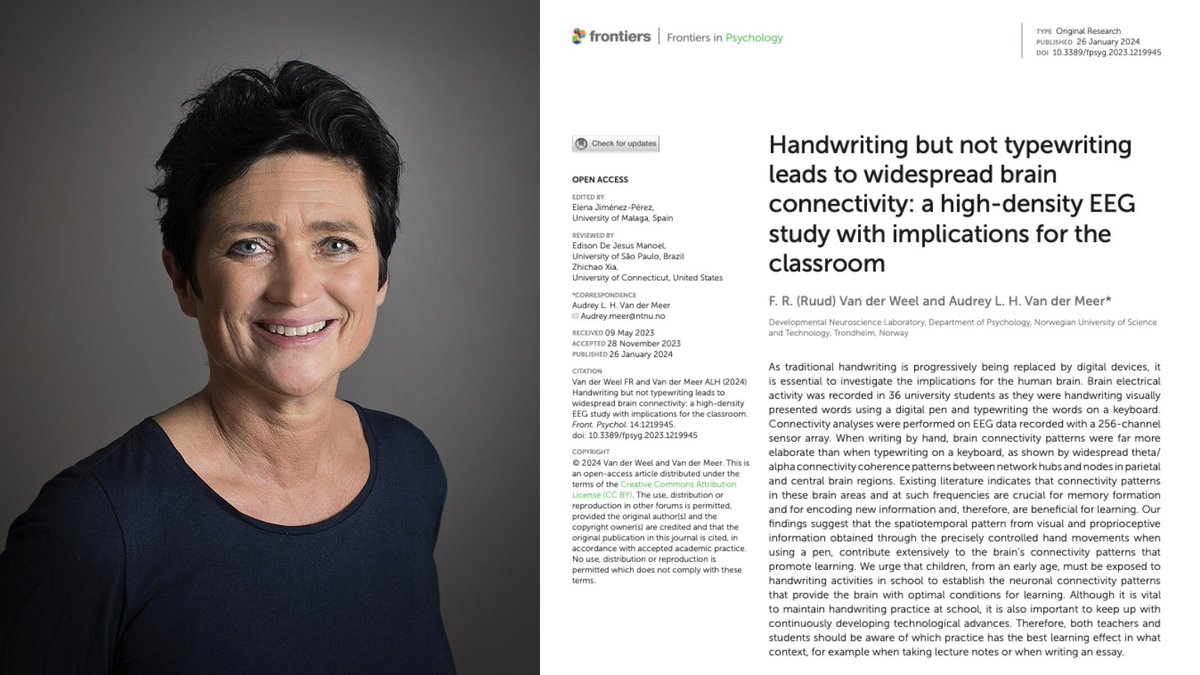
A Norwegian neuroscientist spent 20 years proving that the act of writing by hand changes the human brain in ways typing physically cannot, and almost nobody outside her field has read the paper.
Her name is Audrey van der Meer.
She runs a brain research lab in Trondheim, and the paper that closed the argument was published in 2024 in a journal called Frontiers in Psychology. The finding is brutal enough that it should have changed every classroom on Earth.
The experiment was simple. She recruited 36 university students and put each one in a cap with 256 sensors pressed against their scalp to record brain activity. Words flashed on a screen one at a time.
Sometimes the students wrote the word by hand on a touchscreen using a digital pen, and sometimes they typed the same word on a keyboard. Every neural response was recorded for the full five seconds the word stayed on screen.
Then her team looked at the part of the data most researchers had ignored for years, which is how different parts of the brain were communicating with each other during the task.
When the students wrote by hand, the brain lit up everywhere at once.
The regions responsible for memory, sensory integration, and the encoding of new information were all firing together in a coordinated pattern that spread across the entire cortex. The whole network was awake and connected.
When the same students typed the same word, that pattern collapsed almost completely.
Most of the brain went quiet, and the connections between regions that had been alive seconds earlier were nowhere to be found on the EEG.
Same word, same brain, same person, and two completely different neurological events.
The reason turned out to be something nobody had really paid attention to before her work. Writing by hand is not one motion but a sequence of thousands of tiny micro-movements coordinated with your eyes in real time, where each letter is a different shape that requires the brain to solve a slightly different spatial problem.
Your fingers, wrist, vision, and the parts of your brain that track position in space are all working together to produce one letter, then the next, then the next.
Typing throws all of that away. Every key on a keyboard requires the exact same finger motion regardless of which letter you are pressing, which means the brain has almost nothing to integrate and almost no problem to solve.
Van der Meer said it plainly in her interviews.
Pressing the same key with the same finger over and over does not stimulate the brain in any meaningful way, and she pointed out something that should scare every parent who handed their kid an iPad.
Children who learn to read and write on tablets often cannot tell letters like b and d apart, because they have never physically felt with their bodies what it takes to actually produce those letters on a page.
A decade before her, two researchers at Princeton ran the same fight using a completely different method and ended up at the same answer. Pam Mueller and Daniel Oppenheimer tested 327 students across three experiments, where half took notes on laptops with the internet disabled and half took notes by hand, before testing everyone on what they actually understood from the lectures they had watched.
The handwriting group won by a wide margin on every question that required real understanding rather than surface recall.
The reason was hiding in the transcripts of what the two groups had actually written down.
The laptop students typed almost word for word, capturing more total content but processing almost none of it as they went, while the handwriting students physically could not write fast enough to transcribe a lecture in real time, which forced them to listen carefully, decide what actually mattered, and put it in their own words on the page.
That single act of choosing what to keep was the learning itself, and the keyboard had quietly skipped the choosing and skipped the learning along with it.
Two studies. Two countries. Same answer.
Handwriting makes the brain work. Typing lets it coast.
Every note you have ever typed instead of written went into your brain through a thinner pipe. Every meeting, every book highlight, every idea you captured on your phone instead of on paper was processed at half depth.
You did not forget those things because your memory is bad. You forgot them because typing never woke the part of the brain that would have made them stick.
The fix is the thing your grandmother already knew.
Pick up a pen. Write the thing down. The slower road is the faster one.
This is what local accountability looks like:
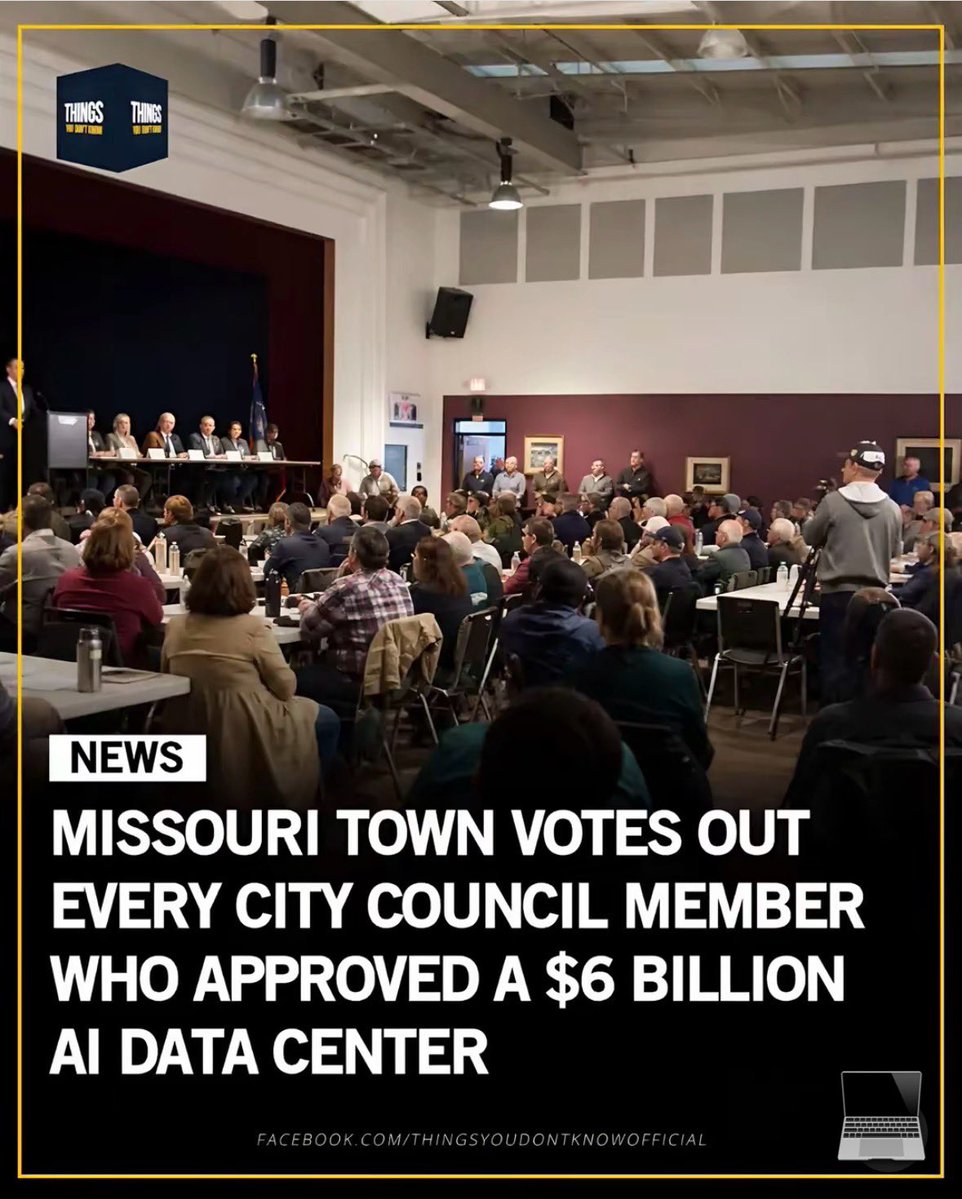
In Festus, Missouri, a town of about 14,000 people, the city council quietly approved a $6 billion Ai data center to be built on 360 acres just north of Highway 67.
Residents say they were never properly heard. Meetings were held in private. Documents were released too late. A week after the approval, the town held a regular election. Voter turnout jumped 129 percent.
Every single council member who had voted yes lost in a landslide. A 70-year-old first-time candidate beat an 8-year incumbent by 40 percentage points.
Now a recall petition is circulating to remove the mayor as well. The lawsuit against the city is already filed.
Has your local government ever been held accountable like this? 🔥
Theo Von’s honesty about Jesus’s question “Do you want to be healed?” shows remarkable transparency.
I encourage you to have the same kind of introspection and pray for the Lord to keep working in @TheoVon 🙏🏼
As one who has said, “Yes” to Jesus, I confirm He is with it.
If you think I am "just posting tips about housekeeping", well -- I have been tracking feminism since I was a young girl in the 60s and 70s. I have come to the conclusion that it’s a snare and a delusion to spend precious time complaining and worrying over something that is not real (equality) — there’s so much to be done, so much that the woman can contribute. I have my thoughts and I’ll write them out sometime, but at the moment, we’re losing ground.
The home is the rarest commodity right now… rarer than rare earth metals or whatever it is that people go to war for.
There’s so much to study, so much to learn, so much to recover (the most basic things! Almost lost!) — so much to GIVE.
Several years ago I listens to a talk by a seasoned mom of many kids, some grown, some still in the home. She was sharing various ideas for how to teach your kids to live a disciplined life. Two things in particular stuck with me.
1) She said to remember the phrase: You can’t expect what you don’t inspect (this is in relation to following up with what you’ve asked your children to do). It’s proven to be incredibly helpful to me.
2) She encouraged us, once our kids have shown to be diligent about doing a task as they’ve been taught, to occasionally surprise them and do it for them. This truly gives them the vision for both the satisfaction of hard work and the delight of surprising with (and being surprised by) acts of service.