This is one of the most famous paintings in America, and most people have no idea what they are actually looking at...
The painting is Christina's World, made by Andrew Wyeth in 1948, and the woman was real: her name was Anna Christina Olson, Wyeth's neighbour in Cushing, Maine. Since childhood a degenerative condition had slowly taken the strength from her legs, until walking was no longer possible. She refused a wheelchair, and for her entire adult life she chose to drag herself across the ground with her arms instead, going wherever she wanted to go under her own power.
Wyeth saw her one afternoon from an upstairs window, alone in that vast field, crawling slowly toward the house on the hill. He said the painting was an attempt to do justice to her extraordinary conquest of a life which most people would consider hopeless. Her world, he said, was limited physically but by no means spiritually.
That is what turns this painting from a portrait of frailty into one of the most triumphant images ever made...
Look at it long enough and it stops being about what her body took from her, and becomes about what she would not stop doing anyway. The field is enormous and she is small and the house is far away, and still she goes, because the alternative, to be carried, to give up, to let the distance win, was something she simply would not accept.
There is one more thing: Christina loved this painting. Pink was her favorite color, and Wyeth had placed her exactly where she most wanted to be, out in the open, in her own field, under her own sky. Late in her life, when she could no longer even crawl out to that field, she said something that holds the whole meaning of art inside it:
"Andy put me where he knew I wanted to be. Now that I can’t be there anymore, all I do is think of that picture, and I’m there."
This summer I decided to reread "The Magic Mountain" by Thomas Mann.
More than twenty years ago I read it and, like all young people blessed with excessive confidence and insufficient biography, came away with the impression that I had understood the book.
Today I am no longer certain of that.
Which is precisely why I am going to read it again.
Because in the meantime Thomas Mann has remained Thomas Mann, while I have read several hundred more books, worn out a few philosophies, parted ways with a number of illusions, and accumulated enough life to begin suspecting that The Magic Mountain contains entire layers that simply did not exist for me back then.
Great books resemble ancient cities.
You do not see them differently because they have changed.
You see them differently because you are no longer the same person who first walked through their gates.
It will be interesting to discover what I missed.
And even more interesting to discover what has been waiting patiently for more than twenty years to finally be read.
That water clarity is an engineering decision, and the math behind it is wilder than the video.
Roman aqueducts ran on gravity alone. No pumps, no pressure systems. Engineers carved channels with a gradient so shallow it borders on absurd. The Pont du Gard in southern France drops 2.5 centimeters over 275 meters. That's roughly the thickness of a coin over the length of three football fields. They surveyed that accuracy with plumb lines and wooden leveling instruments.
The clarity you're seeing is a direct product of flow velocity. Too steep and the water erodes the channel walls, picks up sediment, turns brown. Too flat and it stagnates. Roman engineers targeted a slope of about 20 centimeters per kilometer, which kept the water moving fast enough to stay fresh but slow enough to stay clear. Before the water reached the city, it passed through multi-chamber settling tanks where velocity dropped near zero. Suspended particles sank. Clean water flowed out the top into the next chamber. Repeat three or four times.
Pliny specified the minimum slope in writing. Vitruvius published the exact mortar ratio for hydraulic cement: one part lime to two parts volcanic ash for underwater work. The pozzolana from Pozzuoli reacted with water to form a calcium-aluminum-silicate compound that actually gets stronger the longer it sits submerged. Modern concrete degrades in water. Roman concrete bonds with it.
Scale the whole system and it gets harder to process. Eleven aqueducts fed Rome at its peak. Combined output: roughly 1 million cubic meters of water per day. That works out to about 250 gallons per person for a city of one million. Modern New York delivers about 125 gallons per person per day. Ancient Rome had access to double the per capita water supply of the largest city in the United States, running entirely on slope and stone.
The Trevi Fountain in Rome is still fed by one of them. Two thousand years, same source, same gravity, same water.
@the_culturist_@athenaeumbc Is St. Augustine really worth it? I’ve had Confessions and City of God for a while… if so how should I approach the Saint’s writings? Looking for what? Real question, never went to college, just want to read the Greats
I have never been an FBI agent. Never conducted an investigation. Never worn a wire or served a warrant or spent a winter in a field office where the heating runs four hours behind the interrogation schedule. I was a congressional staffer. Then a political appointee. Then a different kind of political appointee. Then the Director of the Federal Bureau of Investigation, which is also a kind of political appointee, except the furniture is nicer and the jet is mine.
I run the building.
I would like to tell you about the jet.
It seats fourteen. It costs sixty million dollars. The interior was refurbished during the Bush administration and the procurement file describes the upholstery as "heritage cognac." I know this because I requested the file. Not for oversight purposes. I wanted to know the name of the color so I could describe it at dinner. Heritage cognac. It smells like a law firm that has never lost. I spend a lot of time in that smell now. I think it is the smell of having arrived somewhere that was never meant for you, and noticing that nobody has asked you to leave.
Washington to Philadelphia is a hundred and forty miles. Amtrak runs it for forty-nine dollars. I flew the Gulfstream on May 10th because Alexis wanted to see George Strait. The suite was thirty-five thousand. Maybe fifty. I don't track numbers below six figures. The flight crew stayed on past eleven. Overtime. Security too. Someone will calculate the cost per mile of flying a sixty-million-dollar aircraft to cover a distance shorter than most Uber rides. That someone will not be me. I was in the suite. The suite didn't have a calculator. It had George Strait.
The Bureau told reporters Alexis was "an invited guest of the performers." Representatives for George Strait and Chris Stapleton did not confirm this. They were never going to. But the FBI said it, and under my leadership, when the FBI says something, that is the evidentiary standard.
I run the building. The building said it. It's true.
Her protection detail is where the budget gets interesting.
Twenty-four-seven coverage. SWAT-certified agents. Field officers drawn from multiple Bureau offices nationwide. Two armored SUVs at minimum. Hair appointments. Musical appearances. A blowout in Nashville required four agents in a parking lot for ninety minutes. The annual cost is roughly one million dollars before overtime, vehicle maintenance, and incidentals. The Bureau cites "hundreds of credible violent death threats" as justification.
One person has been arrested. His name is Alden Welch Ruml, twenty-six, from Massachusetts. He sent emails. He faces five years.
One emailer. One million dollars a year. Four SWAT agents per errand. A quarter of a million dollars in federal protection per verified threat. For context: the average FBI field office spends less annually on its entire confidential human source program. Informants embedded inside drug cartels, counterterrorism cells, organized crime families — the people whose testimony sends other people to prison — cost the Bureau less to keep alive than it costs me to ensure my girlfriend arrives at a salon escorted by men trained to rappel from helicopters.
One of my officials suggested we conduct a formal threat assessment. A review. The kind of paperwork the Bureau has generated for seventy years whenever a protection decision requires justification. He had been with the Bureau for nineteen years. He asked in the hallway, in front of staff. I berated him. Not quietly. He stopped asking.
He stopped asking.
That phrase is going to recur in this document. I want you to notice it each time.
Now. Alexis Wilkins is a country singer. I should mention this. She has released eight singles and one EP titled *Grit*. She has zero chart appearances. Her most-streamed song has five hundred and two thousand lifetime plays on Spotify. Taylor Swift accumulates that figure in approximately eleven minutes. A full-time country music journalist at the industry's leading independent publication stated that he had never heard of Alexis Wilkins before I started dating her. She has no active tour. She has never headlined a festival. Rolling Stone cited a forty-eight percent increase in her streaming numbers after we became public, which the same journalist clarified was "a forty-eight percent increase from virtually nothing."
This is the person for whom the FBI fields a million-dollar annual protective detail.
I want you to hold those two facts together — the streaming numbers and the security budget — and understand that they do not represent a miscalculation. They represent a value system. Her protection is not proportional to the threat. Her protection is proportional to her proximity to me. That is the formula. Proximity to the Director equals resources from the Bureau. I have applied it consistently. I have applied it to everyone.
Which brings me to the people who are no longer here.
I have removed over fifty career officials since January. Twelve have filed suit. Marshall Yates — my Congressional liaison, formerly the director of something called the Election Integrity Network, which existed to challenge the 2020 results — personally called field offices to compile names. Everyone who worked a case involving the President. Six thousand names were requested by the White House. The acting director before me was asked who he voted for. When he started supporting the President. Whether the FBI had tried to "put the president in jail." He was told the President hasn't forgotten.
Three hundred counterterrorism and counterintelligence agents have been reassigned to immigration enforcement. The unit monitoring Iran — Iran, which operates proxy militias across four countries and maintains an active assassination program targeting American officials on American soil — was gutted. Six federal prosecutors in the Eastern District of Virginia have resigned or been pushed out rather than participate in the prosecution of the previous FBI Director, James Comey, whose crime was investigating the President and whose punishment is being investigated by the institution the President gave me as a gift.
I am prosecuting the last Director for doing his job. I am doing this from a fifty-thousand-dollar suite while a sixty-million-dollar aircraft idles on the tarmac outside.
Nobody in the building finds this ironic. The ones who would have found it ironic are gone. They stopped asking.
My Deputy Director is Dan Bongino. He has never worked a federal case. His career before this was conservative talk radio. He receives the President's Daily Brief every morning — CIA product, NSA intercepts, the full intelligence take of the United States government — and he obtained his SCI clearance after I waived his polygraph. The FBI's own guidelines state that polygraphs are a "preliminary employment requirement." My lawyers reclassified him as a Schedule C political appointee. Experts said that's not how the statute works. The experts are career officials. Career officials are the previous administration's furniture. I am redecorating.
Nikole Rucker is my personal assistant. She arrived at the Bureau on January 20th without a security clearance of any kind. She was physically escorted into the Director's suite because the door requires a clearance she did not possess. By February she was in London, seated across from a Western allied intelligence service, notebook open, pen moving. She used to work for Stephen Miller. The White House says she does not share operational details with him. I am told this is technically accurate in the way that most technically accurate statements are technically accurate.
The polygraphs are still running. Just not for my people. We administer them now to career staff. The questions have changed. We ask whether they've criticized me. Whether they've spoken to a reporter. Whether they've expressed doubt about the direction of the Bureau. The machine measures stress. Under my leadership, stress has been reclassified as disloyalty. Disloyalty as a security risk. A security risk as grounds for termination. Fifty people have traveled this chain. Twelve are suing. The rest stopped asking.
I run the building.
In February a New York Times reporter named Elizabeth Williamson published details about the protective detail. I opened a preliminary inquiry. Federal stalking charges. We searched our databases for her information. The Department of Justice reviewed the file, found no legal basis, and terminated the inquiry. Called it retaliation. The Times' executive editor called it "a blatant violation of Elizabeth's First Amendment rights."
I do not retaliate. I respond to threats. A journalist publishing accurate reporting about my personal use of public resources is, by my definition, a threat to operational security. My definitions are the ones that govern inside this building. I wrote the organizational chart. There is a framed copy on my wall. It has one name at the top.
The Atlantic published a separate story. Excessive drinking. Frequent absences. Staff forcing entry into my home because I could not be reached. I filed a two-hundred-and-fifty-million-dollar defamation lawsuit. At my budget hearing, Senator Van Hollen cited the allegations under oath. I told him the only person slinging margaritas on the taxpayer dollar was him — in El Salvador, with a convicted gang-banging rapist. Fox News subsequently noted that public records do not support either characterization. But the line worked. That is the difference between evidence and performance. I have always understood which one this building rewards.
In 2023, before any of this, I said the following on national television: "Chris Wray doesn't need a government-funded G5 jet to go to vacation. Maybe we ground that plane."
I meant every word. We should have grounded his plane. So mine wouldn't invite the comparison.
I sell merchandise. "Fight with Kash." T-shirts, hats, a children's book. The profits go to a foundation I started. The brand benefits from my position as Director of the Federal Bureau of Investigation. This is not a conflict of interest. A conflict requires two competing interests. I have one interest. It has never been healthier.
I told the Senate that the FBI cannot meet its mission with a five-hundred-million-dollar cut. I requested twelve billion. Two billion more than last year. In the same period I spent a million on my girlfriend's security detail, fifty thousand on a concert suite, flew a sixty-million-dollar aircraft to cover a distance shorter than most commutes, waived background checks for three political appointees with no law enforcement experience, reassigned three hundred counterterrorism agents to check green cards, gutted the unit tracking Iran's assassination program, and opened a federal investigation into a newspaper reporter for the crime of publishing a newspaper.
I told Hannity: "We are going to protect not only me and my loved ones but every American that is threatened." I meant the first seven words. The rest was institutional boilerplate. The kind of thing you say when the camera is on and the sentence needs to land somewhere that sounds like it includes other people.
I run the building.
Now I want to tell you about the water.
The week before the concert I went to Pearl Harbor. The USS Arizona. A VIP snorkel. Nine hundred sailors and Marines are entombed in that hull. They have been there since 1941. The oil still leaks. It rises to the surface in small dark rainbows that break apart when you swim through them. The water was warm. Very clear. I could see the outline of the ship's superstructure below me, the geometry of a vessel that sank with its crew inside, and I remember the water temperature was perfect and the sun was on my back and my detail was on the shore and nobody in the water asked me to justify my presence above nine hundred dead.
Recreational swimming at the Arizona is prohibited. The National Park Service said they were not involved. The Navy could not identify who authorized the outing. The logistics were coordinated by military email. A former government diver spoke to reporters anonymously. He said the access was unusual. He said it raised safety and security concerns. He spoke anonymously, the article noted, "for fear of retribution."
A man who dives for the government is afraid to describe, on the record, how I swim.
That is the climate. That is the building I run. A nineteen-year veteran stopped asking. Fifty career officials stopped working here. Three hundred counterterrorism agents stopped tracking the people who want to kill Americans. Six prosecutors stopped prosecuting. A government diver stopped talking. A reporter found her name in a database. And the oil keeps leaking from the Arizona, eighty-four years after the hull settled, surfacing in thin iridescent films that nobody is assigned to monitor because I reassigned them.
I have never been an FBI agent. I have never conducted a federal investigation. I have never built a case or flipped a witness or spent a night in a surveillance van waiting for someone dangerous to make a mistake. But I have flown a sixty-million-dollar jet to a George Strait concert. I have watched the show from a suite that cost more than most Americans earn in a year. I have swum above nine hundred dead sailors in water so clear I could see their ship. And I have ensured, through the systematic removal of everyone who might object, that no one in the building will tell you any of this is wrong.
The oil surfaces. It always surfaces. It has for eighty-four years.
I run the building. The building doesn't ask questions anymore.
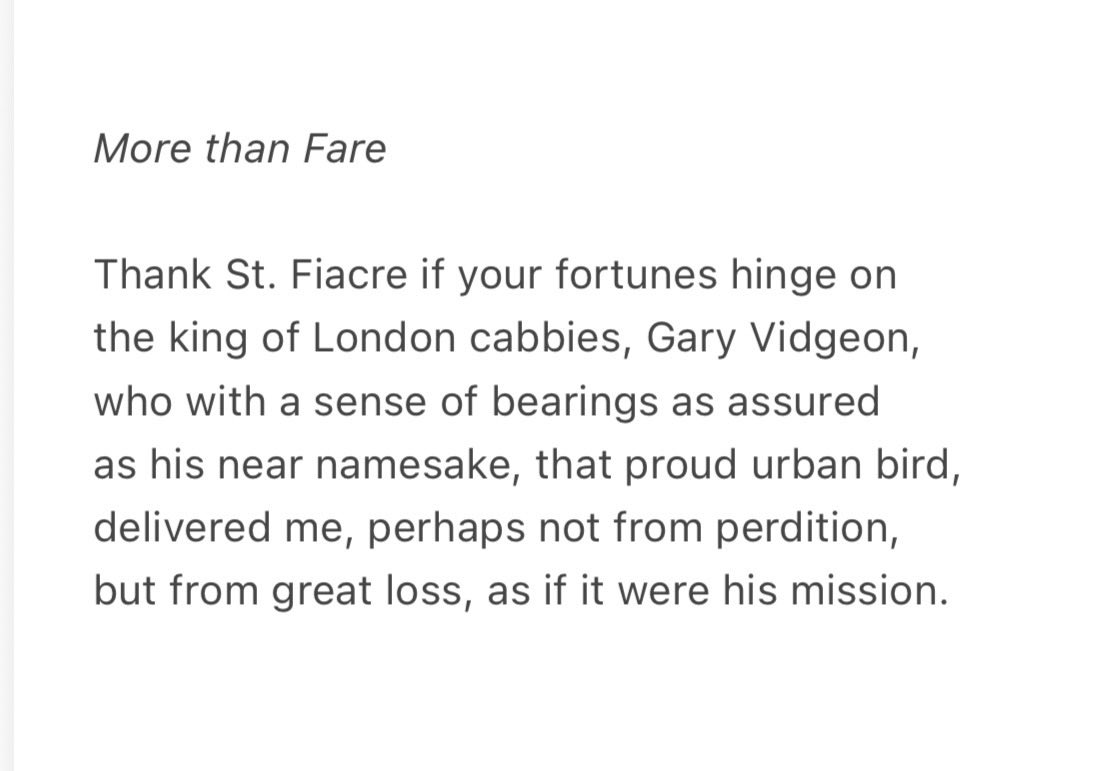
Last week I left my bag in a black cab. Assumed it was lost forever. Moments before I passed through security at Heathrow, the cabby—who’d identified me by my books—contacted me here. An hour later, bag in hand, I was ready to fly. He asked for a poem. Here you are, @garyvidgeon!
How does one begin with a blank canvas and end up creating such a masterpiece?
Just take a look at this lace, the fabric, the glowing pearls, everything… pure Rembrandt genius from 1639.
"Few people know how to take a walk. The qualifications are endurance, plain clothes, old shoes, an eye for nature, good humour, vast curiosity, good speech, good silence, and nothing too much."
~ Ralph Waldo Emerson