Contact does not always deform surfaces, especially when interacting with liquids and soft objects. However, most existing tactile sensors rely on surface deformation to infer contact.
Excited to share LightTact, a visual-tactile fingertip sensor that makes contact directly visible. It provides:
- Deformation-Independent Sensing: contact is detected optically, not inferred from surface deformation.
- High-Contrast Raw Images: non-contact pixels stay near-black.
- Pixel-Level Contact Segmentation: robust across materials, forces, appearances, and external lighting conditions.
This project was co-led with Boda (https://t.co/LknVoGsVYi). Grateful to all co-authors for their contributions, and many thanks to @yxyang1995 for the insightful discussions.
We will present LightTact at RSS 2026 in Sydney next week!
Paper: https://t.co/YX3bf9H4Vd
Open-source: https://t.co/67NTIXOuJO
Manipulation happens through surfaces. To understand contact-rich dexterous interaction, motion alone is not enough. We also need to know surface properties and contact state.
Excited to share ART-Glove, an articulated tactile glove that captures contact-grounded information while preserving human dexterity. It provides:
- Known Geometry: 16 rigid functional surfaces
- Surface Motion: 22 anatomically aligned joints
- Tactile Contact: 2048 piezoresistive taxels
Huge thanks to my advisor Ding @zhao__ding, and to Yuxiang @yxyang1995, Maria @bauzavillalonga, Marissa, and Peide @peide_huang for the valuable advice and discussions.
Paper: https://t.co/xSYCyqHrZf
We are back again :) After three weeks of quiet building.
Introducing Genesis World 1.0, our latest simulation platform, the second release in our full-stack suite. Open-sourced.
Robotics is still bottlenecked by the 1× speed of the physical world. Every model, checkpoint, and data recipe eventually needs to be tested on physical hardware, slowly, expensively, and with limited coverage.
One hour in reality can become 100 days in simulation. That is how robotics model iteration moves from a wall-clock bottleneck to a compute problem.
To make this work, simulation has to be both fast and trustworthy.
Over the past year, we rebuilt the entire stack: a GPU-accelerated cross-platform compiler, penetration-free multi-physics contact solvers, unified rigid and deformable physics, and a photo-realistic renderer purpose-built for physical AI applications.
We built Nyx, a high-performance path-traced rendering engine for robotics application.
Genesis World 1.0 achieves near realtime performance with our latest development for penetration-free IPC solver, supporting various types of deformables beyond rigid bodies. It supports contact-rich, dexterous manipulation simulation across different embodiments: unitree, sharpa, wuji, genesis hand and various types of grippers.
Under the hood is Quadrants, our effort in pushing forward cross-platform GPU-accelerated computation. Quadrants started as a fork of Taichi, and we rebuilt most of the critical parts for optimizing simulation workloads, giving 10x faster launch time and up to 4.6x runtime performance compared to the initial Genesis release.
Together, they bring us to an unprecedentedly low sim-to-real gap, enabling zero-shot real-to-sim model evaluation and much faster iteration of GENE.
All available today.
Genesis World 1.0: https://t.co/aknCM3eqws
Quadrants: https://t.co/uXqPNI4cb6
Nyx: https://t.co/R8j0djqGnV
Eka means unity -- “one,” in Sanskrit and “first” in Finnish.
We’re building intelligence for the physical world in its native language: forces.
Until now, robotics faced a tradeoff — generality or speed. The real world requires both. Robotics also faced a data problem.
Our Vision–Force–Action (VFA) model — the first of its kind — breaks the generality-speed tradeoff and the data barrier.
It's a new foundation uniting performance, generality, and safety for putting capable robots in everyone's hands.
Today, I am excited to share our journey of pushing robots beyond human limits.
Today, dexterity becomes scalable.
Today, I welcome you to the Era of Eka.
Co-founded with @haarnoja, and so thrilled and grateful to be working with a dream team at @EkaRobotics.
Learn more: https://t.co/QYQ6x2Etyi
the team that co-invented VLAs just abandoned them
what this means for robotics teams:
1. if you have enough data, you don't need to inherit someone else's foundation model. clean sheet wins.
2. the VLA approach existed because there wasn't enough robotics data. that assumption is dying fast.
3. this puts pressure on every robotics company still fine-tuning off the shelf VLMs. if from-scratch is the answer, the cost of entry just went way up.
4. goals beat methods. don't pick between VLA or world model. ask how far you can go and remove constraints one by one.
Introducing GEN-1.
Our latest milestone in scaling robot learning.
We believe it to be the first general-purpose AI model to master simple physical tasks.
99% success rates, 3x faster speeds, adapts in real time to unexpected scenarios, w/ only 1 hour of robot data.
More🧵👇
I’m so tired of writing rebuttals to this kind of “lack of novelty” review: “This paper trivially combines A, B, and C, so the algorithmic novelty is limited.”
Technically, most (if not all) robotics papers are convex combinations of existing ideas.
I still deeply appreciate A+B+C papers—especially when they deliver:
- New capabilities: the “trivial combination” unlocks behaviors we simply couldn’t achieve before
- Sensible & organic design: A+B+C is clearly the right composition—not some arbitrary A′+B+C′
- Nontrivial interactions: careful analysis of the dynamics, coupling, or failure modes between A, B, C
- Rehabilitating old ideas: A was dismissed for years, but paired with modern B/C, it suddenly works—and teaches us why
- System-level & "interface" insight: the contribution is not any single piece, but how the pieces talk to each other
- Scaling laws or regimes: identifying when/why A+B+C works (and when it doesn’t)
- Engineering clarity: making something actually work robustly in the real world is not “trivial”
- New problem formulations: sometimes the real novelty is in the reformulation—only under this view does A+B+C make sense.
Maybe worth keeping these in mind when reviewing the next A+B+C paper : )
Simplicity should be valued more. When a task can be solved equally with a simpler framework, one should not be blamed having “nothing new”.
Many unnecessary novelties are invented for the sake of novelty, while the effort of making simpler methods general is not appreciated.
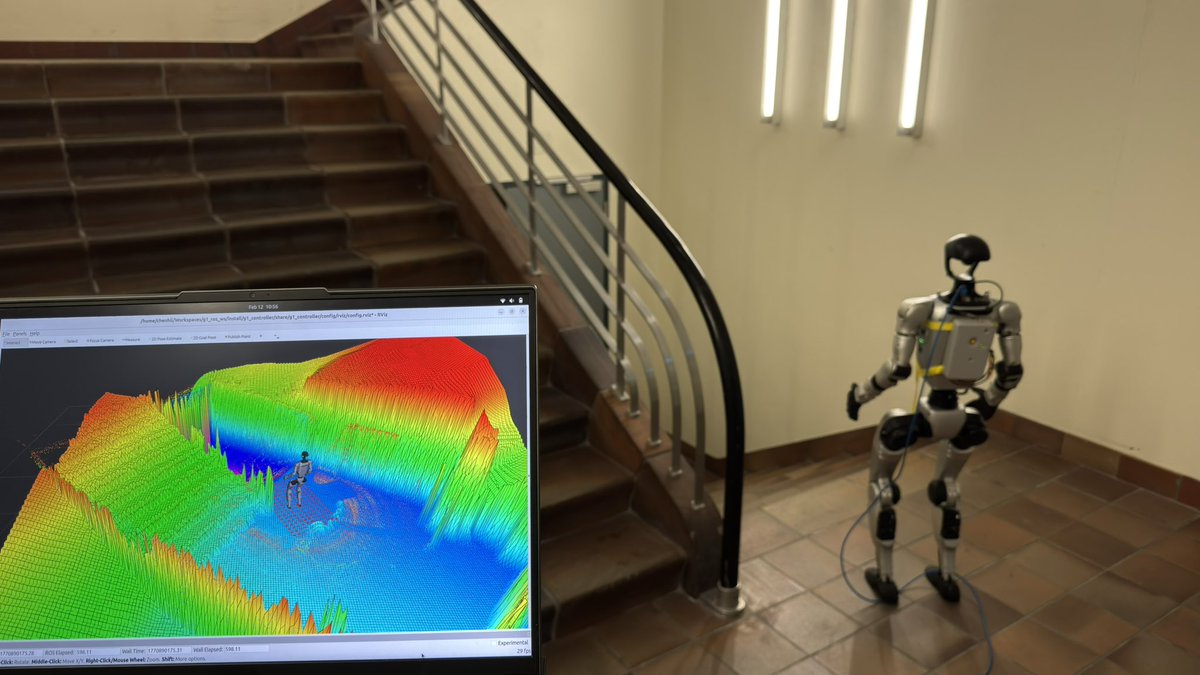
Introducing APEX — a unified policy for adaptive humanoid traversal across high platforms up to 80 cm (114% leg length).
- Without reference motion, a generalized ratchet progress reward formulation enables learning of a set of adaptive, contact-rich full-body maneuvers.
- Through distillation, we obtain a single context-aware policy that integrates these maneuvers with cyclic locomotion.
- Deployment relies on elevation mapping from a single LiDAR.
The system demonstrates robust adaptation, autonomous skill selection, and smooth multi-skill transitions.
Website: https://t.co/zxLhia5yVQ
Paper: https://t.co/jtYVE6r7WX
Huge thanks to my co-authors:@lengtx20, @changyi_lin1, @shiqiliu_67, Shir Simon, Bingqing Chen, Jonathan Francis, @zhao__ding. Also grateful to @yxyang1995 for insightful discussions and valuable feedback.
Reality of robotics: humanoid kung fu is solved before they can open doors with RGB.
Here we are.
Introducing the frontier of sim2real at NVIDIA GEAR. 100% sim data. RGB input only. Code name: 𝗗𝗼𝗼𝗿𝗠𝗮𝗻.
We are opening the sim-to-real door.
https://t.co/ar1dREHsRi
🧵
My favorite part is "Our Visual Sim2Real Journey" on the project website and the "Limitation and Discussion" section in the paper (especially the "Outlook" part below).
This project aims to understand what is the boundary of pure sim2real visual humanoid loco-manipulation: no real-world data, no human motion references, just zero-shot sim2real, with NVIDIA computing, with researchers with maximum sim2real experience, 6 months.
It works pretty well and we do get free lunch in terms of generalization & robustness, but seems like achieving general-purpose loco-manipulation via pure sim2real is likely out of scope in the foreseeable future.
That being said, I do believe sim2real will play a fundamentally important role in humanoid loco-manipulation, but it has to be integrated with other modules to fully unleash its potential: real2sim2real, skill acquisition from human data or foundation models, simulation for evaluation, simulation for data augmentation or "physics grounding", etc.