Introducing APEX — a unified policy for adaptive humanoid traversal across high platforms up to 80 cm (114% leg length).
- Without reference motion, a generalized ratchet progress reward formulation enables learning of a set of adaptive, contact-rich full-body maneuvers.
- Through distillation, we obtain a single context-aware policy that integrates these maneuvers with cyclic locomotion.
- Deployment relies on elevation mapping from a single LiDAR.
The system demonstrates robust adaptation, autonomous skill selection, and smooth multi-skill transitions.
Website: https://t.co/zxLhia5yVQ
Paper: https://t.co/jtYVE6r7WX
Huge thanks to my co-authors:@lengtx20, @changyi_lin1, @shiqiliu_67, Shir Simon, Bingqing Chen, Jonathan Francis, @zhao__ding. Also grateful to @yxyang1995 for insightful discussions and valuable feedback.
Manipulation happens through surfaces. To understand contact-rich dexterous interaction, motion alone is not enough. We also need to know surface properties and contact state.
Excited to share ART-Glove, an articulated tactile glove that captures contact-grounded information while preserving human dexterity. It provides:
- Known Geometry: 16 rigid functional surfaces
- Surface Motion: 22 anatomically aligned joints
- Tactile Contact: 2048 piezoresistive taxels
Huge thanks to my advisor Ding @zhao__ding, and to Yuxiang @yxyang1995, Maria @bauzavillalonga, Marissa, and Peide @peide_huang for the valuable advice and discussions.
Paper: https://t.co/xSYCyqHrZf
A touch-aware humanoid manipulation policy that cleans the lab for you🧹🧪
Introducing Humanoid Touch Dream: a real-world system for dexterous, contact-rich humanoid loco-manipulation.
Our key idea is simple: the policy predicts future hand forces and tactile latents alongside actions, within a single-stage training framework.
https://t.co/Pt5pXA65wm
1/7
Excited to share CoVer-VLA—a fully self-supervised action verifier for VLA models and the first work of my PhD! 🤖
We developed a lightweight verifier that assesses VLA action quality by aligning actions with text-visual features. Best of all? It requires zero failure data and scales seamlessly to large robotics datasets.
Beyond verification, CoVer learns aligned action representations via contrastive learning—opening doors for more downstream robotics tasks such as data curation and OOD detection! 🚀
Huge thanks to my amazing collaborators and advisors, and a special shout-out to @prodarhan for the help with PolaRis! Truly an incredible platform.
Please check out more details in the post, and try to CoVer your VLA policy!
Introducing APEX — a unified policy for adaptive humanoid traversal across high platforms up to 80 cm (114% leg length).
- Without reference motion, a generalized ratchet progress reward formulation enables learning of a set of adaptive, contact-rich full-body maneuvers.
- Through distillation, we obtain a single context-aware policy that integrates these maneuvers with cyclic locomotion.
- Deployment relies on elevation mapping from a single LiDAR.
The system demonstrates robust adaptation, autonomous skill selection, and smooth multi-skill transitions.
Website: https://t.co/zxLhia5yVQ
Paper: https://t.co/jtYVE6r7WX
Huge thanks to my co-authors:@lengtx20, @changyi_lin1, @shiqiliu_67, Shir Simon, Bingqing Chen, Jonathan Francis, @zhao__ding. Also grateful to @yxyang1995 for insightful discussions and valuable feedback.
You can have the humanoid G1 learn to climb a 80cm box without human reference, and deploy with one lidar elevation mapping.
The learned motions are kinda out of human's range of motion. (at least hard for me!)
Introducing LocoTouch:
Quadrupedal robots equipped with tactile sensing can now transport unsecured objects — no mounts, no straps.
The tactile policy transfers zero-shot from sim to real.
Core Task-Agnostic Features:
1. High-fidelity contact simulation for distributed tactile sensors
2. Adaptive gait reward for symmetric, frequency-adaptive locomotion
Website: https://t.co/WiycKk7NVO
Paper: https://t.co/NqRKxBcNZi
We have fully open-sourced LocoMan, including hardware files in SolidWorks format, and code for both simulation and deployment.
https://t.co/CT0UciL8Ph
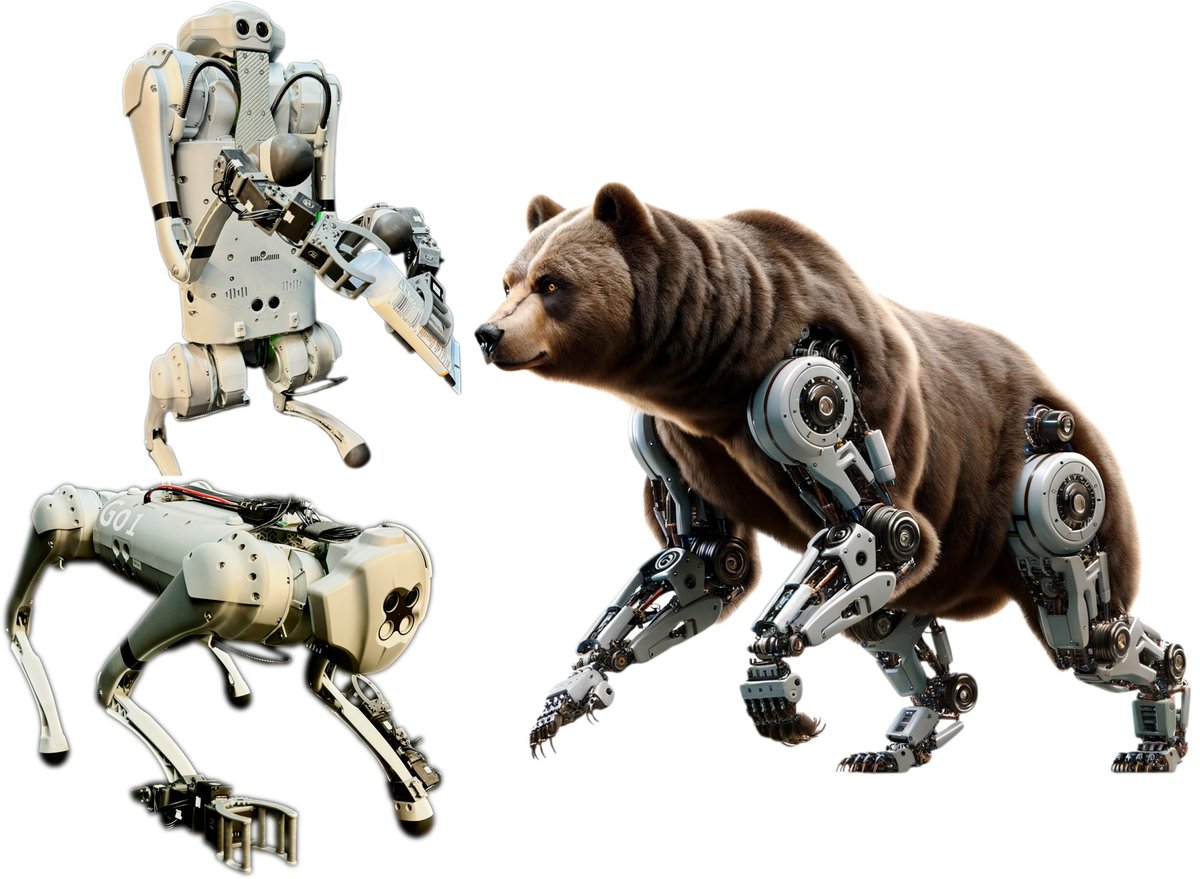
The concept of our loco-manipulators (https://t.co/19jQM6UzPK) draws inspiration from the limbs of animals like great apes🦍and bears🐻, which are adept at both locomotion and skilled manipulation. This design enhances the quadrupedal robots’ dexterity for manipulation, while maintaining their agility. Here are some advantages for loco-manipulators vs. top-mounted manipulators:
🐾Loco-manipulators: lightweight, low-cost, compact, natural bimanual manipulation (like a humanoid!), ideal for narrow or low areas
🦾Top-mounted manipulators: more powerful manipulator, larger workspace above the torso, potentially more stable operations (check out the amazing recent work from @xiaolonw's group: https://t.co/LVTAVEKMWs!)
Which one would be better for loco-manipulation of quadrupedal robots? Loco-manipulators or top-mounted manipulators? Or even a combination of two?🤯One step further, are these quadrupedal transformers more capable/efficient than humanoids in some ways?🤯
🤖 Introducing H2O (Human2HumanOid):
- 🧠 An RL-based human-to-humanoid real-time whole-body teleoperation framework
- 💃 Scalable retargeting and training using large human motion dataset
- 🎥 With just an RGB camera, everyone can teleoperate a full-sized humanoid to perform actions like pick and place, walking, kicking, boxing, etc
- 💡Unleash the potential of humanoids with human cognitive skills and adaptability
🔗: https://t.co/YbFylnIlBR
Chinese poems are the best prompts for text-to-image generation! Sincere thanks to #GenerativeAI for visualizing those beautiful verses. Below are some examples by DALLE-3.
东风夜放花千树。更吹落,星如雨。
Quadrupedal robots are mastering agile skills like running, standing, and parkouring, yet face the peril of damaging falls.
Introducing🛡️Guardians as You Fall (GYF), a safe falling and recovery framework that can actively tumble and recover to stable modes to minimize damage in highly dynamic scenarios. Fully open-sourced!
Key idea: Rather than recovering after the robot falls severely, GYF adaptively traverses different stable modes via active tumbling before irrecoverable poses.
Website: https://t.co/Tws8ox9MmN
Code: https://t.co/RS8poBu4S1
Paper: https://t.co/gUK5GxMqFK
w/ Yikai Wang, @mengdibellaxu and @zhao__ding