Our flagship global equity strategy returned 130.6%, compared to 25.6% for the S&P 500, since inception in July 2025 (calculated by our partner Plutus, an SEC-registered investment advisor).
Diversified across sectors and not exposed to AI.
Our philosophy combines identifying durable investment themes at inflection points and companies with strong fundamentals.
Investors can implement the portfolio through Plutus:
https://t.co/whK8qF0Qm6
The trade war is back, and the impact could be big on both sides of the border.
Higher tariffs should push up key commodity prices, creating winners and losers across industries. We selected the US and Canadian companies we think could benefit the most. https://t.co/NIwyLFjOhY
Just got off the phone with a big VC.
He said nobody is ready for Bezos' second act with his new startup.
Calls it the most asymmetric bet right now at sub $50B MC.
Prometheus is building an "artificial general engineer," AI that designs and manufactures physical products.
I don’t usually invest in real estate stocks. But @jeremie0117 pitch on $CSH.UN.TO ( $CWSRF) is enticing - buys properties from Cos. who overpaid, maintained low rental rates to ensure occupancy and need to sell. Chartwell pays below market prices and raise rents. @AurelionRsch
We've done substantial research on all of these themes over the last year.
Both deep-dive primers and update memos.
Quite a few are freely accessible. Not all of the themes have played out yet, and many remain high-conviction ideas for the rest of the year.
Cerebras $CBRS has appeared among the top buys of several large hedge funds in the last 13Fs, including @coatuemgmt and @GavinSBaker's Atreides.
Our recent conversation with the Head of Investor Relations should help better understand the opportunity.
https://t.co/I8bqtrG7Og
Usually it's Asian AI stocks trading at cheaper multiples than U.S. counterparts.
But $TTMI is a rare exception, and the discount doesn't seem like it will last long, especially given its trading well off its ATH while everything else bounced back hard.
The only US listed pure-play PCB maker trades at just 20x forward earnings vs. a 2x median for Asian competitors, even after printing its first $1B revenue quarter at record margins.
High-end AI circuit boards are the next major hardware bottleneck. As designs push past 50 to 100+ layers, board complexity and ASPs are surging, with PCB content cost going from $35k (in GB300) to $116k (In VR200).
Napkin math:
6,000 expected shipments of VR200 in H2 alone * $116K in PCB content = ∼$700M of PCB content revenue
40% market share of $700M = ∼$300M in revenue for $TTMI, just from one generation of rack.
Moreover, TTMI is positioned right at the center:
-> Over 40% share on NVIDIA’s VR200 platform
-> 30% share on the LPU inference rack
-> Lead supplier across switch generations for Cisco, Arista, and Mellanox
-> PCB supplier to every major AI player in the market.
->M+N architecture guided for ~$600M in H2 revenue alone
An NVIDIA senior account manager recently confirmed TTMI as one of their top five qualified suppliers, calling the partnership "strong and growing".
TTMI doesn't need to guess which AI chip wins because every architecture needs high-layer boards underneath it.
Full deep dive out now: https://t.co/ov4YBRMMOy
It's marketing. Horrible investor, amazing marketer. Even if the company makes sense long term, you can't over-lever on an already extremely volatile name. He was going to get liquidated.
But you got to give it to him, the marketing is 10/10.
This is WILD!
Leopold Aschenbrenner built one of the most concentrated, leveraged AI bets on Wall Street, it blew up spectacularly and the firm that bailed him out just finished cashing in on the rebound it arguably helped set up.
The pie chart shows Situational Awareness holding $20.2 billion in disclosed US equities as of June 30, 2026, up 48% quarter over quarter, but this is a snapshot of past positioning, filed weeks after the portfolio had already collapsed. More than 55% of the entire book sat in just two memory chip names, SanDisk at 28% ($5.7 billion) and Micron at 27.5% ($5.6 billion), an extraordinary concentration for a fund managing tens of billions. The remaining bet was on Bloom Energy at 9.6% ($1.9 billion), TSMC at 6.4% plus $24 million in calls, Nebius at 6.1% ($1.2 billion), CoreWeave at 3.7% ($745 million), and smaller stakes in Core Scientific, IREN, Applied Digital, and STMicroelectronics, plus a $5 million put on Applied Digital, suggesting Aschenbrenner was simultaneously long the AI power/hosting theme while hedging pieces of it.
Reports show that the fund was running leverage up to 4x and when AI related and semiconductor names sold off sharply in July, the portfolio lost roughly 67% of its value in a single month, collapsing from a peak near $45 billion to about $10 billion. Citadel had published a report suggesting the Fed would likely raise rates and that Citadel along with other hedge funds then shorted the market into that narrative, a combination of pressure some claim directly contributed to bringing Leopold's fund down. Facing margin calls it couldn't meet, Situational Awareness was forced to sell essentially its entire leveraged public equity book, SanDisk, Micron, and the rest, to Ken Griffin's Citadel in late July reportedly 40 to 50 cents on the dollar.
Here's where it gets messy. On August 11, roughly two weeks after absorbing Aschenbrenner's distressed portfolio, Citadel Securities derivatives strategy head Scott Rubner published a note telling clients the leverage reset has largely run its course and that systematic buyers were preparing to reload on the exact type of high beta semiconductor names that had just been liquidated, citing leveraged ETF assets crashing 42% and semiconductor linked leveraged ETFs shrinking to just $31 billion. Then this week, Griffin disclosed Citadel had already shed more than 80% of that risk through over 100 block trades worth more than $4 billion.
Citadel's own desk was warning the market of further liquidation risk in the names it had just bought cheap, then two weeks later called the bottom and told clients to buy, then quietly sold the bulk of its own distressed stake into that exact rebound it had just publicly hyped. This is why some of your favorite AI names like Nebius, Micron, and SanDisk got crushed even though the underlying thesis never changed. The selloff was not necessarily the market suddenly deciding AI infrastructure was overvalued, it was a massively leveraged fund being forced to dump billions of dollars in stock at the worst possible time. Wall Street did not panic with you but rather bought those distressed shares for pennies on the dollar, helped fuel the rebound, and then sold them right back to the market at a profit.
if you enjoyed reading this make sure to follow @MelvinInvests for more AI and market insights.
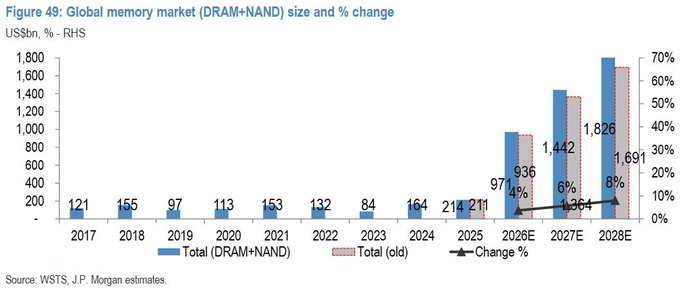
J.P. Morgan is effectively rejecting the memory peak thesis by forecasting DRAM + NAND revenue surging to ~$1.8T in 2028.
The note suggest that the market still grows another 27% in 2028 as HBM-driven mix, constrained supply and higher pricing reshape memory margins.
The market is still pricing $MU, $SKHY and $SNDK for a cycle peak that J.P. Morgan now sees extending well into 2028.
@AlphaPicks is a great follow for macro.
Completely agree on commodities. We have meaningful exposure in our portfolio. Funds often stay away from commodities, but they can be one of the best alpha generators for the few that can play them well.
Selling pressure in metals was already fading in July and the August recovery was underway before Bessent took a shot at the dollar.
Lower short term yields and strengthening physical demand are also a tailwind.
Metal/Crypto/Uranium guys, don't jinx it! Plz resist the urge to flex your green PnL guys... I’m begging you, don't jinx this runner. I want this trend to go the full distance...
We've made our India Primer freely accessible.
The team sees many growth drivers and think the AI risk is actually a net positive. We included an equity basket made by (@jeremie0117 & @leo_research1) for long-term diversification and upside optionality.
https://t.co/09pzyMrkoM
One of my favorite ways to stay up to date on market themes.
Below is practically: all the investment themes ranked by YTD return.
SaaS, commodities, drone & defense, and healthcare are picking up nicely this month. Maybe looking to add defense or drone names soon.
Aurelion Research (@AurelionRsch) publishes independent equity research and a model portfolio. We do not manage money. Investors can choose to replicate the portfolio through Plutus, a SEC-registered investment adviser.
Our flagship global equity strategy returned 130.6%, compared to 25.6% for the S&P 500, since inception in July 2025 (calculated by our partner Plutus, an SEC-registered investment advisor).
Diversified across sectors and not exposed to AI.
Our philosophy combines identifying durable investment themes at inflection points and companies with strong fundamentals.
Investors can implement the portfolio through Plutus:
https://t.co/whK8qF0Qm6