I've built an 8 figure holding company with $0 of outside capital called Late Checkout.
Today, I’ll share our playbook. Maybe it’ll be helpful to someone.
Step 1: Find audience
We focus on influential, high value customer audiences.
We’re like the anti-Mr.Beast. Less glory but I’m okay with it.
We get ideas for those on what’s trending on places like Reddit and X.
We use automation and AI to get those insights quickly and clearly.
We observe what’s beginning to take off.
Write it down.
And most importantly, we ask "why now".
Our most successful businesses had a strong why now.
We write these ideas in our idea pages within Notion.
Review it weekly.
Step 2: social account
Instead of building a product that we sell first, we begin with a social account.
Counter-intuitive, I know.
But our thesis is that distribution is harder than building a product.
We look at what other accounts in the space are doing.
And try to do the opposite.
The opposite is an important point because you're trying to create "scroll stopping" content. If it looks like everything else, they'll keep scrolling.
No bueno.
Tactically, that might mean going more visual. Or telling stories that aren’t told.
We get good at finding that format.
It’s the only way to stand out.
And we only focus on 1 platform.
Multiple platforms at this stage is a distraction.
Every major platform has hundreds of millions of customers. That's enough to validate.
Step 3: grow account
We wait until we get to 10,000 followers before we usually build anything.
In B2B, if you have 10,000 followers, you're the Mr. Beast of your category.
10,000 potential customers is massive.
Each platform has unique ways to grow.
We’re particularly excited about You Tube right now.
The “hack” right now is longer form, more raw videos and posting daily.
On X, being a reply guy is the best way to 10,000 followers.
Step 4: Free community
I’ve been burned enough by algorithms changing to do this before moving on to building a product.
People don’t want another community.
But they do want value.
We look to bundle a ton of value in a free community in order to get people’s phone numbers or emails.
We overload them with value to get them where they want to get to.
What’s worked really well is creating communities around “challenges”.
Example:
You’ve got a popular Keto diet social account. Join the 90 keto challenge.
Best part of this step is having this group of customers tell you what to build.
These communities are your north star.
They are your anchor.
And if you don't want to build a community, that's okay.
Build a bunch of lead magnets.
Step 5: Build a product
We don’t spend more than 30 days to build a product.
Start small.
Sometimes we’ll partner with existing business here.
Sometimes we’ll partner with a founder who has his zone of genius in this space but lacks the infrastructure and audience to go big.
This has worked well.
Step 6: Product/market fit.
Now, product/market fit starts hitting and high fives all around.
Copycats come in. But it’s okay.
We keep going. The community keeps telling us what to build.
And we’ve got systems in places to build quickly, test, learn and make it beautiful.
Then you just gotta keep going.
It compounds all of it. The audience, the community, the product.
Step 7: the future
Once the product is really at product/market fit.
We start thinking about adjacent products. We either buy or incubate those.
This increases lifetime value of the customer.
Sometimes we’ll find existing businesses or founders to come under this company.
This is when this business turns into a holding company in itself.
It starts incubating, buying businesses.
This when I feel like the student has become the teacher.
The business is all grown up.
That's the basic playbook.
I don't know if this sorta stuff is interesting to you, but let me know if its.
The more you share/reply, the more I know what to keep writing on.
I gotta say -- the most fun I've ever had in my career has been building this holdco.
Its really creative, less stressful than a VC-backed startup and I'd like to inspire 100+ multipreneurs.
If I was in my 20s, I'd do this. By the time you're in youre 30s, the compounding is crazy.
And it's just fun to be able to learn about new niches, and hop on trends.
Enjoy.
--
* Pardon the typos. I wrote this highly-caffeinated on my phone
You can follow a few of our holdco companies below (and hire them)
@latecheckoutplz - holdco updates
@boringmarketer - using AI to get organic customers with SEO
@imboringads - coming soon. ai-assisted ads optimization agency. If you need help with ads, DM them.
@DesignScientist - conversion focused design agency
@gregisenberg - me, real-time learnings along the journey
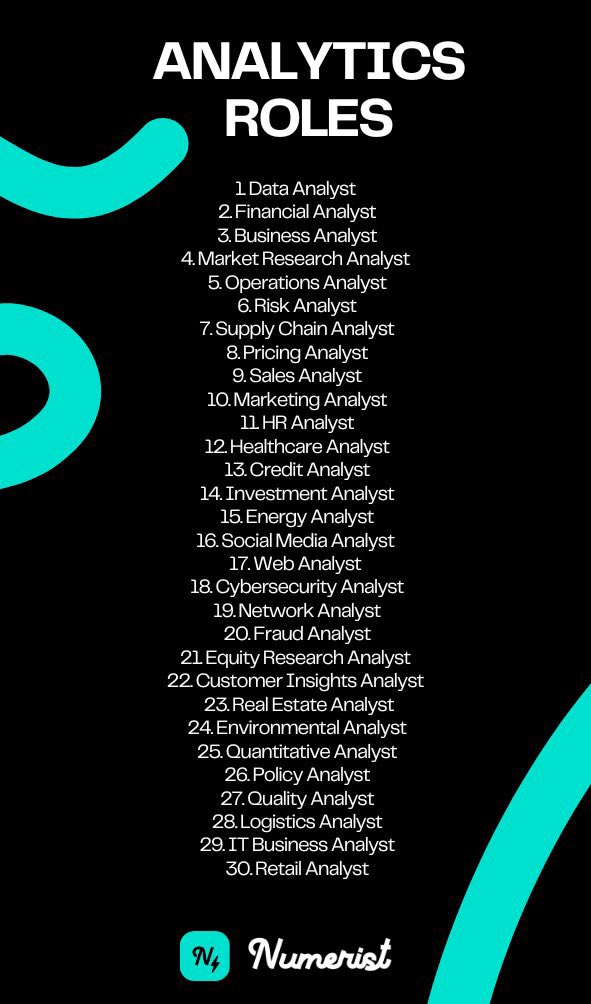
Someone complained of a data analyst roles not being easily accessible and another replied with people searching for ONLY “data analyst”.
I can’t see that thread again
Industries have move on from only data analyst as a job title.
@the_numerist created this below and can help
If you want to learn more, I talk more about how we work flexibly on YouTube–including a walkthrough of how we use Figma, Notion, GitHub, and Slack: https://t.co/pfpGN45oDm
Beyond creating more creators, we would love to help create more flexible companies!
I've shared tons of free/inexpensive material for learning data science and ML (and not just the basics).
Combined, their value is easily greater than a $100k+ data science degree.
Here are some of my favorites:
I have a college degree
But I've learned more about investing from watching Youtube than I did in school
Here are 10 Youtube channels that will make you a better investor: