A team of people used to run LifeHack. Today it runs on 129 agents, and I'm the only human left in the loop.
This week I audited the whole fleet. Every agent had settled into one of five shapes. Not roughly five. Five.
@SynabunAI Stop and report it. It shouldn't try to work around a missing tool.
Mine retry a few times first, since a browser that won't start is often a stale lock. If that fails, the run is marked blocked on that tool, not logged as "nothing to do". The next scheduled run tries again.
@nikaskn Mostly agree. That's roughly how my own scheduled agents work.
The part I underestimated was memory between wake-ups. If a run can't see what earlier runs already did, it looks around like it's the first time and does the same thing again.
The useful split here is letting an agent find its way through a UI while keeping the final assertion deterministic. I'd want to see how a failed CI run reports the path it took; a failure you can't reproduce is hard to act on.
Introducing e2e
The agentic testing framework for any app
~/ npx e2e init
→ Fully Open Source
→ Mix deterministic and agentic APIs
→ Supports web, mobile, and more
→ Bring your own agent and infrastructure
→ Run locally or in CI
https://t.co/G3XB2L8tiC
@lennysan@tryramp The receipt example makes this concrete: 35% to 83% accuracy on a task people actually need done. That's where evals get interesting for PMs, as a way to test whether a product is getting better at the job users give it.
@himitek “Agents propose; systems commit” is a strong boundary. Typed intents and idempotency keys turn it from a principle into something the system can actually enforce.
@steipete That’s a huge amount of test code to remove while keeping coverage nearly unchanged. More tests and more useful tests are clearly not the same thing.
@burryinvegas@yunta_tsai Exactly. A five-minute demo can hide a lot. The real test is whether it can monitor overnight, surface when it is stuck, and leave enough context for a human to step in quickly. Otherwise the supervision burden has just moved.
@rtehrani The useful shift here is treating agent decisions as part of the incident, not stopping at latency and errors. Connecting a bad outcome to the exact prompt, tool call, dependency, and trace is what makes agent observability actionable.
@Steve_Yegge The constraint is the appeal. I’d test a TPM agent on whether its blocker and dependency reports stay accurate enough that a human spends less time verifying them than chasing updates manually. If supervision cost doesn’t fall, 24/7 nagging is just more noise.
GPT-6 Sol's hallucination rate drops because it declines to answer more often. It attempts 83% of the questions where GPT-5.6 attempted 99%, and accuracy falls from 59% to 54%.
If your eval only counts wrong answers, a model that answers less looks like progress.
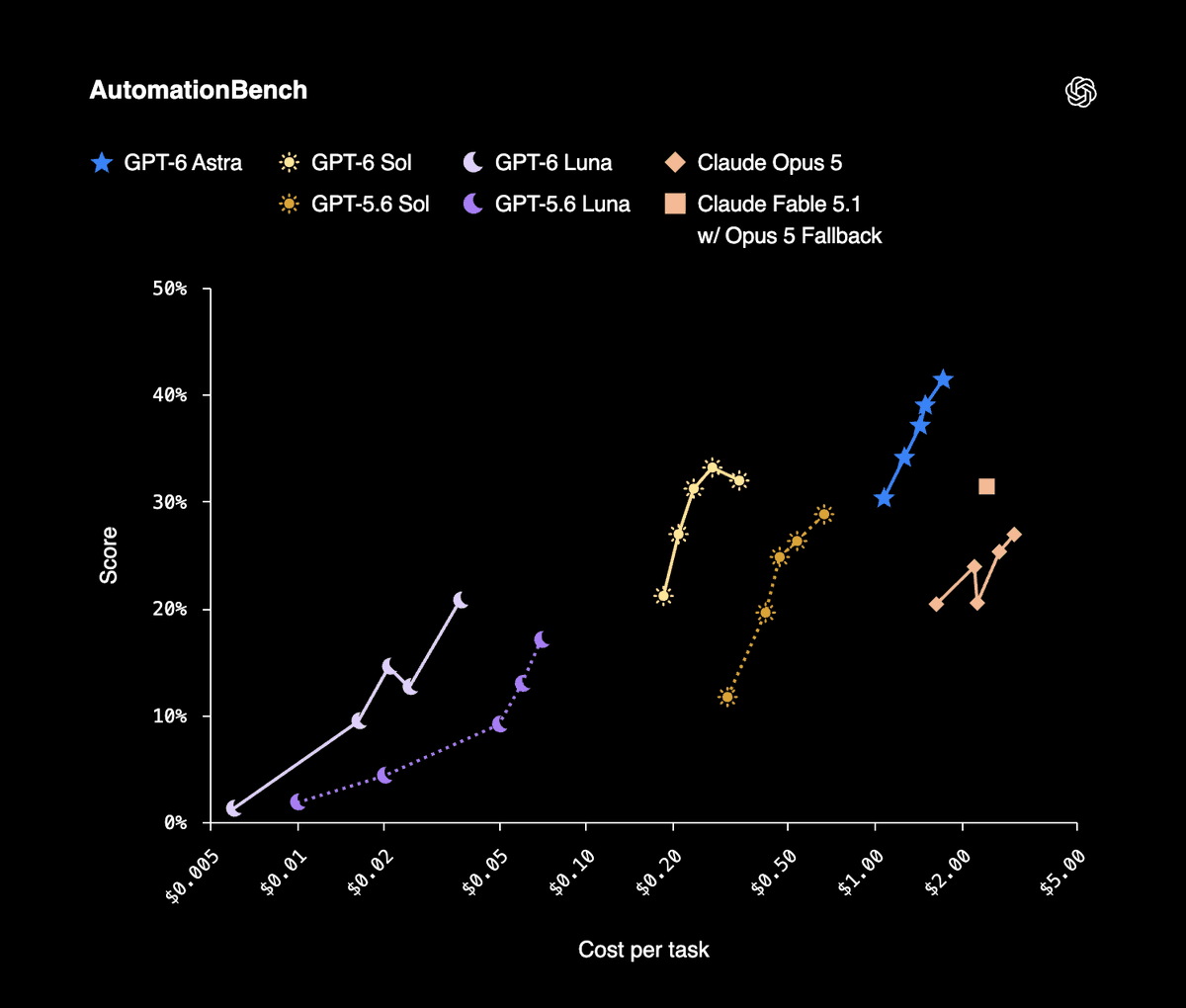
GPT-6 Sol and Luna push the cost efficiency frontier by halving cost relative to GPT-5.6 Sol and Luna. Intelligence Index and Coding Agent Index scores remain level with GPT-5.6, with progress in some evaluations and regressions in others
Pricing is approximately half that of GPT-5.6: Sol drops from $4/$20 to $2/$10 per million input/output tokens, and Luna from $0.20/$1.20 to $0.10/$0.50, with the same 90% discount for cache reads and 25% premium for cache writes.
Key takeaways:
➤ Halves Cost per Task: GPT-6 Sol (max) costs $1.06 per task to run the Artificial Analysis Intelligence Index, ~50% less than GPT-5.6 Sol (max) at $1.99. GPT-6 Luna (max) costs $0.07 per task, ~60% less than GPT-5.6 Luna (max) at $0.18. This is driven by the price cut, as both models use slightly more output tokens per task (31k vs 29k for Sol, and 51k vs 41k for Luna). These two releases allow OpenAI to capture a significant portion of the cost efficiency Pareto frontier.
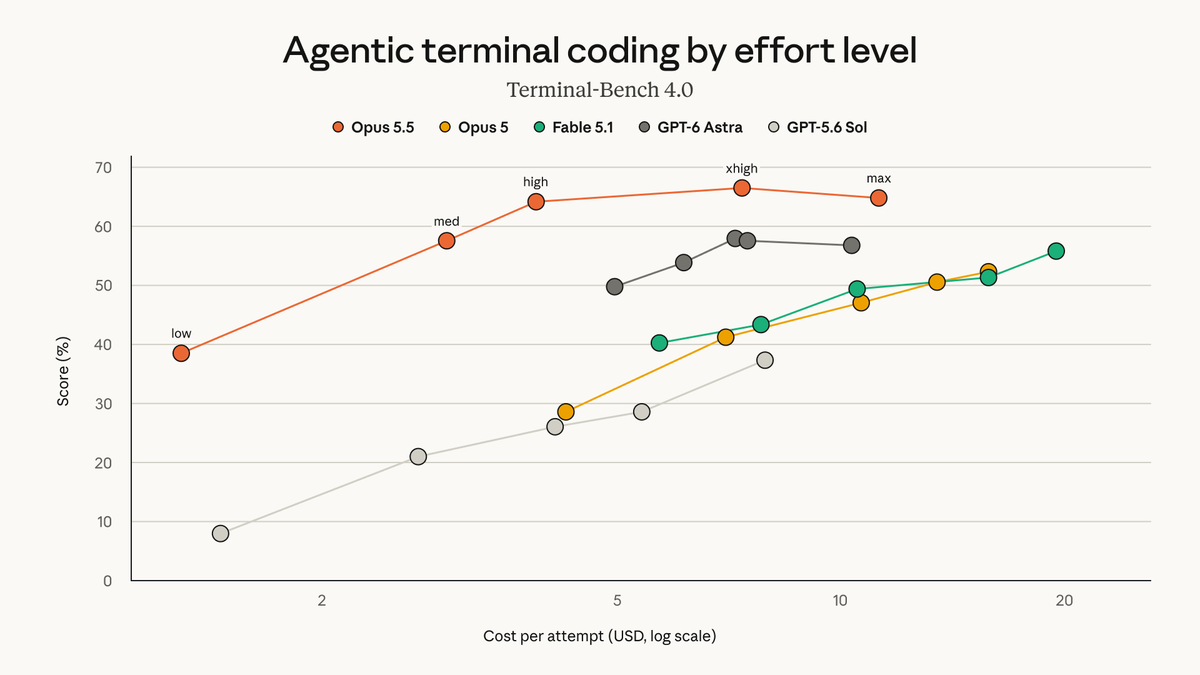
➤ In the Coding Agent Index, Sol improves but Luna regresses: In OpenAI's Codex harness, GPT-6 Sol (max) scores 57 in the Artificial Analysis Coding Agent Index, up 2 points from GPT-5.6 Sol (max), with gains in Terminal-Bench 4.0 (43% vs 37%) and SWE-Atlas-QnA (58% vs 54%). At $2.99 per task it costs ~50% less than GPT-5.6 Sol (max) and sits on the Pareto frontier of Coding Agent Index vs Cost per Task. GPT-6 Luna (max) scores 41, down 2 points from GPT-5.6 Luna (max), with lower scores in SWE-Atlas-QnA (44% vs 49%) and DeepSWE v1.1 (64% vs 66%), at ~60% lower cost per task.
➤ Significant reduction in hallucination: Both models hallucinate less in AA-Omniscience, our knowledge and hallucination benchmark. GPT-6 Sol (max) cuts its hallucination rate from 92% to 60% and GPT-6 Luna (max) from 93% to 77%. Sol achieves this by declining to answer more often: it attempts 83% of questions vs 99% for GPT-5.6 Sol (max), which cuts wrong answers by about a quarter but also lowers accuracy 5 points from 59% to 54%. Luna's accuracy is broadly unchanged at 44% vs 43% while it answers fewer questions. On the AA-Omniscience Index, Sol improves from 22 to 27 and Luna from -10 to 1.
➤ Mix of improvement and regression across evals: Beyond AA-Omniscience, both models improve in AutomationBench-AA (Sol 62% vs 60%, Luna 53% vs 50%) and Terminal-Bench 4.0 (Sol 44% vs 40%, Luna 13% vs 12%). However, we observe regressions in two key knowledge work evaluations. In GDPval-AA v2.1, our benchmark adapted from OpenAI's dataset of economically valuable tasks across 44 occupations, Sol drops ~100 Elo points and Luna ~75. Luna also drops ~45 Elo points in AA-Briefcase v1.1, while Sol is level. AA-Briefcase v1.1 is a private evaluation across multi-week knowledge work projects, with thousands of input files. Our team has manually inspected hundreds of model outputs: the regressions tend to be driven by reduced presentation quality and deliverables that omit rubric elements.
Congratulations @OpenAI and @sama on the launch!
@odd_joel So nice! I’m really interested in how you plan to lay out the session. Will the terminal be full screen by default, then switch to a split view when the web view or Git view is toggled?
Opus 5.5 performs at the level of Fable 5.1. It's ~30% faster and ~40% cheaper than Opus 5 per task.
In Claude Code:
- 5-hour session limits increase 20% today
- Opus 5.5 is priced lower, so it goes 25% further within limits
- Pro, Max, and Team users get a reset to use anytime
@mayankgulati99 AgentUse. I built it for my own workflows: agents in markdown, scheduled runs from agentuse serve, file-based state, and one-time approval for public actions.