Entertainment to pacify the populace, distract, and maintain power. It implies a populace trading civic duty for superficial comfort and immediate satisfaction.
So many outrages we can’t keep up. Will anything, at long last, be too much for the Trumpers? A $400m plane from a foreign govt that Trump gets to keep when he leaves office? Hundreds of millions of TAXPAYER $$ spent upgrading the plane that Trump gets to take with him? That should offend the sensibilities of every American. But Trump has dumbed down our standards so much that there’s only muted protest.
BREAKING: Israel is conducting massive airstrikes across southern Lebanon this morning, with 16 people already killed, despite the US claiming attacks would stop due to the new ceasefire, violating the US-Iran MOU first clause once again, per Al Jazeera.
Iran says it will continue to reject negotiations unless attacks permanently stop, Israel permanently withdraws from southern Lebanon and the US implements other commitments, including frozen funds release and sanction relief.
So far, the oceans have absorbed more than 90% of the excess heat human activity has trapped on our planet. Now that’s changing and the harm is showing up as more frequent and intense marine heatwaves.
Earth is storing heat faster and faster.
https://t.co/DymyoLnXCd
Here's what's driving it. And it's the kind of number that only shows up at extremes.
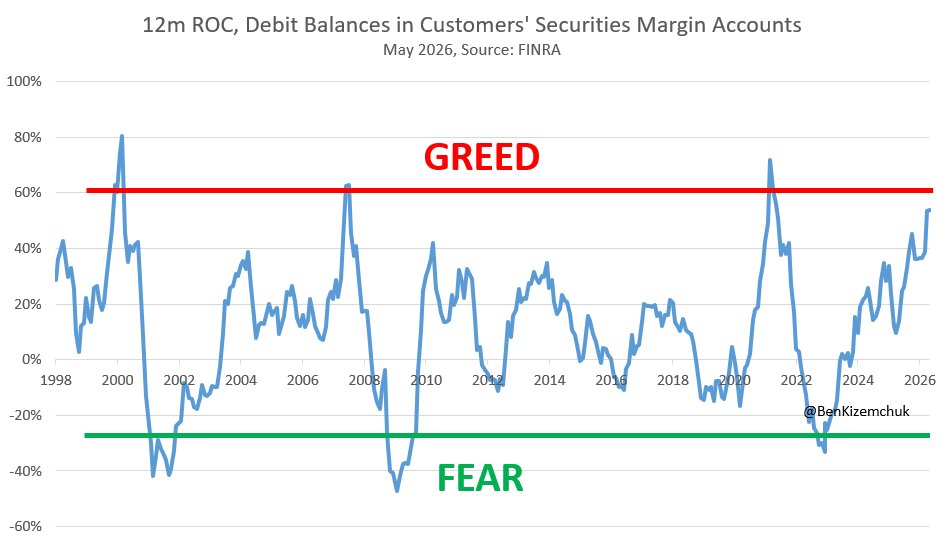
Momentum stocks just went full tilt. The spread between momentum and low-volatility names hit a 5-standard-deviation overshoot above trend. The largest in the history of the series.
Five sigma is not "stretched." It's a once-in-a-generation reading. The only other times the line spiked anywhere close: March 2000. June 2008. February 2021.
Look at what followed each of those dates.
Momentum works until the moment everyone is crowded into the same trade. Then it becomes the fastest unwind in markets. The further it stretches from trend, the harder the snap back.
Should Iran respond to Israel's violations of the ceasefire in Lebanon and take the risk to return to an all-out war ?
*considering the US-Israeli axis does not have much air defense interceptors left, and are mostly blind due to long-range radars lost.
The Reflecting Pool is a perfect metaphor for the Trump administration:
- Ignore experts and science
- Overspend
- Declare early, historic victory
- "THE LEFT HATE THIS"
- Ends in total failure
- Unfounded conspiracies about sabotage
- MAGA pretends it doesn't actually matter
It's only Tuesday and Trump has fucked up a pool for $14 Million, lost a war agreeing to pay Iran $300 Billion, and ballooned his already expensive ballroom budget by another $200 Million.
Where are the Republicans screaming about "waste, fraud and abuse"?
Like I said in January 2024, with everybody building the same thing, there is no moat.
That’s been catching to OpenAI ever since. The numbers don’t lie.
BREAKING: Iran's IRGC has launched multiple drones at commercial vessels in the Strait of Hormuz every night since the US-Iran deal was electronically signed Sunday, including yesterday, to enforce Iranian control over Hormuz shipping, per NBC News citing a US official.
Meanwhile multiple loaded Iranian oil tankers have left the port of Chabahar and crossed the US blockade line today, without being stopped, per MarineTraffic.
Iran is operationally exercising its full sovereign authority over the Strait of Hormuz while simultaneously receiving $400 billion in total deal funds across frozen assets and reconstruction funds, fulfilling IRGC Commander Vahidi's framework of "we take the money" while retaining the missile program, proxy network, rebuild capacity and control over Hormuz.
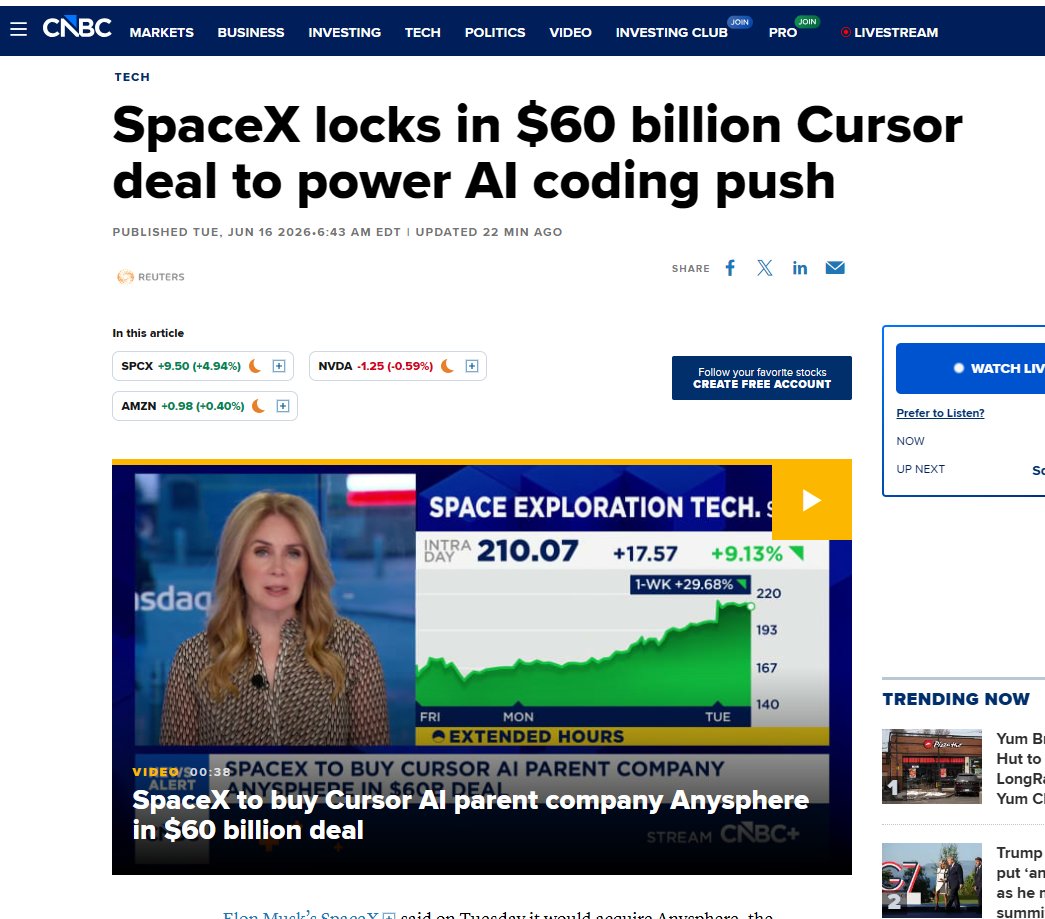
SpaceX just bought a $60 billion company without spending a dollar.
The deal for Cursor, the AI coding tool, is all stock. No cash. SpaceX prints new shares, hands them over, done.
Now connect it to what happened last week.
SpaceX went public by floating just 4% of itself. 556 million shares against 13 billion. The tiniest free float a mega-cap has ever listed with. Index funds were forced to buy it. Retail piled in. Tiny supply, enormous demand, and the stock rocketed past $200.
Here's the part that should make you sit up.
The price SpaceX pays for Cursor is set by its own share price in the seven days before closing. The higher the stock, the fewer shares it has to print to cover $60 billion.
So the engineered scarcity that pumped the stock now makes the acquisition cheaper. The squeeze pays for the shopping spree.
A company losing $4 billion a quarter is now buying AI startups with paper it manufactured out of a 4% float.
This isn't aerospace. It isn't even AI.
It's the finest financial engineering of the century, and it's only getting started.
Trump: "Qatar is the closest to Iran, physically. With other countries, I noticed they had to travel about 45 minutes to get there. With you, you could walk right across the border."
There's no land border between Iran and Qatar. They're separated by the Persian Gulf.
Higher meat intake was associated with less cognitive decline and lower dementia risk in APOE e4 carriers, a group at higher risk of Alzheimer's disease and dementia.
Those who ate ~2 servings of meat per day had a better 10-year cognitive trajectory and a 55% lower dementia risk compared to people eating less than a half a serving per day.
That pattern wasn't seen in the non-APOE e4 carriers and was NOT observed for processed meat. Unprocessed red meat alone was also linked to lower dementia risk in APOE e4 carriers.
My take is not “everyone should eat more meat.”
But a few servings per day of unprocessed meat (as observed in this study) is perfectly healthy for most people.
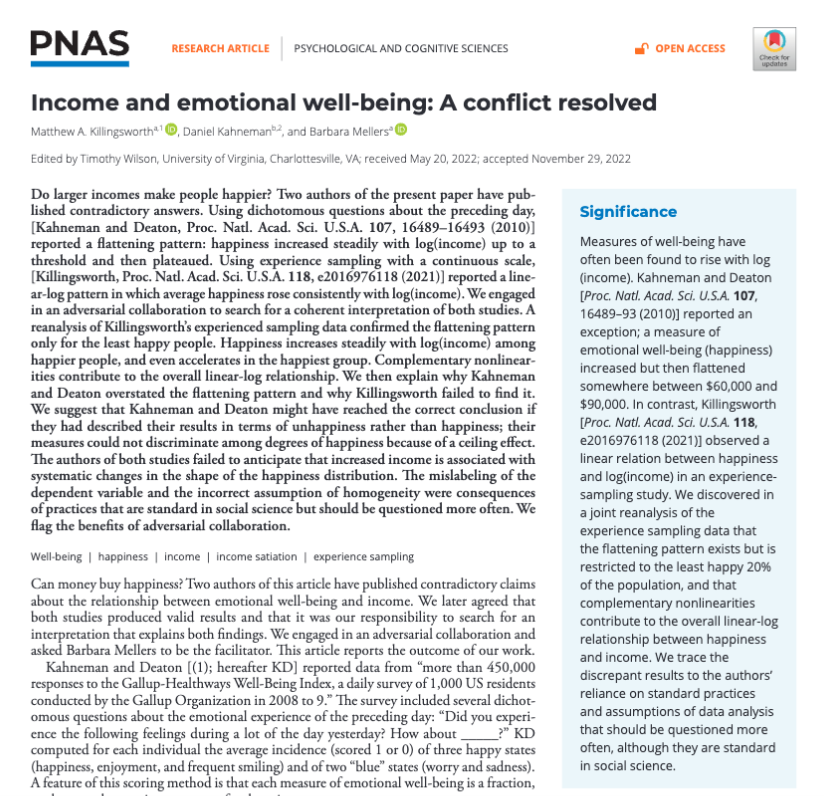
Does money buy happiness? A Princeton Nobel laureate said no above $75,000. A Penn researcher with 1.7 million data points said yes. The day they sat down together to settle the fight, the answer they reached should change how you think about your own life.
The Nobel laureate is Daniel Kahneman. The Penn researcher is Matthew Killingsworth.
The fight between them lasted 13 years, and the way it ended is one of the cleanest examples in modern science of two smart people being wrong in opposite directions about the same question.
In 2010 Kahneman and his Princeton colleague Angus Deaton published a paper that became one of the most quoted findings in the history of social science.
They analyzed 450,000 responses to the Gallup-Healthways Well-Being Index and concluded that emotional well-being rose steadily with income up to about $75,000 a year, and then flattened out completely. Above that line, the extra money was not buying any more daily happiness.
The headline traveled around the world. Every news outlet ran the number.
A CEO in Seattle famously cut his own salary to raise his employees to that exact threshold. The 75,000 dollar figure became cultural shorthand for the idea that the rich are not actually any happier than the rest of us once basic needs are met.
For 11 years almost nobody seriously challenged it. Kahneman had a Nobel Prize in Economics, the sample size was massive, and the conclusion was emotionally satisfying in a way that made everyone feel a little better about not being wealthy.
Then in 2021 a 33 year old researcher at the University of Pennsylvania published a paper that quietly destroyed the entire finding. His name is Matthew Killingsworth.
He had spent the previous decade building a smartphone app called Track Your Happiness that pinged users at random moments during their day and asked them a simple question.
How do you feel right now, on a scale from very bad to very good. The app was designed to catch happiness in the act, not to ask people to recall it later.
By 2021 he had collected over 1.7 million real-time happiness reports from 33,000 adults. When he plotted income against in-the-moment well-being, there was no plateau anywhere.
The line just kept rising. People earning $200,000 were happier on average than people earning $100,000. People earning $400,000 were happier than people earning $200,000. The curve flattened slightly but never stopped climbing.
The famous $75,000 ceiling that the world had been quoting for 11 years simply did not exist in his data.
Now there were two Nobel-quality findings sitting in direct contradiction with each other. One of them had to be wrong, and neither researcher was willing to walk away.
What happened next is the part of the story almost nobody knows.
Kahneman called Killingsworth and proposed something rare in academic science. He called it an adversarial collaboration. The two of them, joined by Penn psychologist Barbara Mellers as a neutral referee, would sit down together and reanalyze the raw data from both studies, line by line, until they figured out which one of them was wrong.
The paper they co-authored was published in March 2023 in the Proceedings of the National Academy of Sciences. And the answer they reached was not what either of them had expected.
Both of them had been right at the same time. They had been measuring two different populations without realizing it.
When the team broke Killingsworth's 1.7 million data points apart by baseline happiness, the picture clarified completely. For the happiest 70 percent of people, more money kept buying more happiness all the way up to $500,000 a year, with no sign of slowing down.
For people in the middle, the same pattern held. But for the bottom 20 percent of the sample, the ones who were already unhappy before the question of money even came up, the curve flattened almost exactly where Kahneman's original paper had said it would. Above roughly $100,000 a year, adjusted for inflation, more money did nothing for them.
This is the finding that changes how the question should be asked.
If you are not already unhappy, money keeps buying happiness for a much longer stretch than Kahneman's original paper suggested. The runway is wider than the world has been telling itself for a decade.
If you are already unhappy, money does almost nothing past a certain point. There is a ceiling, but the ceiling is not about income. It is about the underlying state of the person collecting it.
The deeper insight in Killingsworth's original research, the one almost nobody talks about, is the part that should sit with you longer than the income numbers. The Track Your Happiness app had been telling him for years that the single biggest predictor of in-the-moment well-being is not money at all. It is whether your mind is on the thing you are doing.
His most cited paper, written with Daniel Gilbert at Harvard, is titled A Wandering Mind Is an Unhappy Mind. The data from the app showed that people are mentally absent from what they are doing 47 percent of the time, and that mental absence is one of the strongest predictors of unhappiness in the entire dataset. More predictive than income. More predictive than the activity itself. More predictive than almost any demographic variable you could measure.
Which means the unhappy 20 percent that Kahneman's plateau actually described were probably not unhappy because they did not have enough money. They were unhappy for reasons that more money could not reach.
The reason the curve flattened for them at $100,000 a year is the same reason it would have flattened at $300,000 or $700,000. The thing they were missing was not buyable.
The most uncomfortable line in the entire 2023 paper is the one that nobody on the internet quotes. The authors note that the relationship between income and happiness, while real, is much weaker than the relationship between attention and happiness. A person earning $40,000 who is fully present in their own life will, on average, report higher in-the-moment well-being than a person earning $400,000 whose mind is somewhere else.
The fight about money was the wrong fight the entire time.
The two researchers spent 13 years arguing over whether the dollar ceiling was at $75,000 or $500,000, and the data from Killingsworth's own app was sitting there the whole time saying the ceiling was not about dollars at all. The ceiling is whether you can hold your attention on the life you actually have.
You can run the experiment yourself the next time you catch your mind drifting. Stop. Put your phone down. Look at the room you are in, the person across from you, the food in front of you, the work you are actually doing. That is the part the apps cannot sell you and the salary cannot buy you.
The data has been clear for over a decade. The plateau is not in your bank account. It is in your attention.