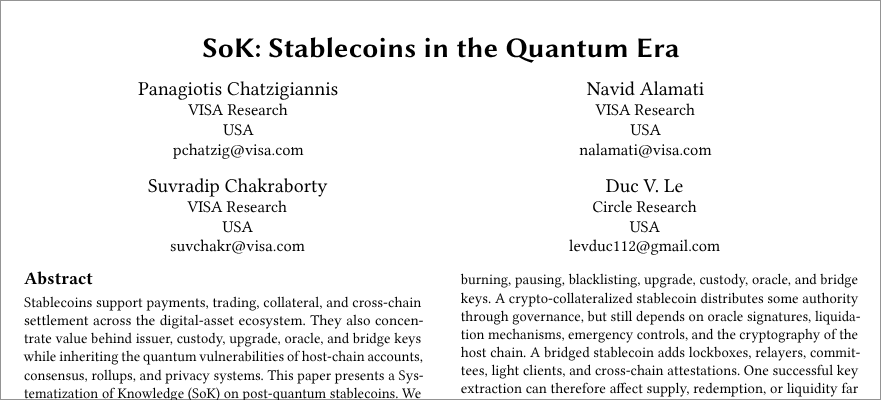
1/ Glad to announce our SoK "Stablecoins in the Quantum Era" was accepted at ACM PQQS 2026
With @panoschtz , Navid & Suvradip, we map how quantum attacks hit stablecoins at every layer — and why securing one layer alone isn't enough 👇
3/ Then counting replaces attribution. k tags in a partition => all k credentials spent, without knowing which made which. Delete both lists, zero residual.
Works for zk-SNARK and CLSAG backbones alike, no new assumptions.
This is a joined work with @PrestonVanderV@pedrorechez and Zhipeng Wang
1/ AllowList (e.g. UTXO) has consensus number 1. DenyList (nullifier list) doesn't -- non-membership needs agreement. Private payments are both at once, weilded by one spend proof.
That pairing is what buys unlinkability, and what makes both sides seem unprunable. @PrestonVanderV on how to prune them anyway.
Can privacy scale without becoming its own bottleneck?
@PrestonVanderV of @circle is joining Devcon 8 to tackle one of privacy infrastructure’s hardest problems: growing private state.
Catch his talk in the Privacy & Consent track on nullifier pruning & the privacy-scalability trade-off.
2/ The usual reading is that you're over-paying consensus on the AllowList side. The better reading: you already bought total order for the DenyList, so use it.
Every credential has an agreed position j. Partition on it, i = ⌊j/k⌋, at no coordination cost.
.@circle set out to put dollars on the internet and make them work everywhere. Now @jerallaire thinks the main users of that infrastructure could be machines.
He joins @cdixon to talk about what comes after digital dollars, and what the agent economy needs when software can earn, spend, and hire.
Highlights:
1:58 Circle’s original vision for programmable money
7:19 Why institutions started taking stablecoins seriously
12:04 Learnings from building a global financial network
15:03 What gives a stablecoin its moat?
26:28 Crypto’s growing adoption in the shadow of AI
28:11 From making existing things better to creating entirely new markets
32:59 The weirdest experiments being built on Arc
37:02 What happens when AI hires AI
38:04 Why the next big thing starts out looking like a toy
39:05 Can blockchains counter AI’s centralizing tendencies?
44:01 What the machine economy could look like in five years
@AdiSeredinschi Define Web3 = whole stack (consensus, network, applications, cryptography)? With agents starting to transact on-chain and quantum computers, there are lots of things to work on, no?
1/ Today we’re releasing Aerie: fast post-quantum signature aggregation, using lattice-based SNARKs for lattice-based Falcon signatures. On a laptop (CPU only), it aggregates roughly a full Ethereum slot’s worth of signatures (32,768) in 0.65 seconds.
I'm looking for my next research position. After a PhD with Christian Cachin, I spent the past four years at the Ethereum Foundation designing and analyzing protocols for Ethereum. My interests are now extending to multi-agent AI as well: what can we still guarantee when some agents fail or misbehave? Open to research and faculty roles in distributed systems, blockchain protocols, and reliable, secure multi-agent systems. I'm based in Seoul and looking in Seoul, Hong Kong and Singapore, and I'm open to remote roles or the right opportunity in London. If your group works on these problems, or you know of a role that might fit, I'd be glad to hear from you! DMs open.
AI is getting better at solving hard math problems, especially given recent drops. But what does that mean for the cryptography that protects everything from private messages to healthcare to banking and crypto wallets?
Stanford cryptographer Dan Boneh, with @eddylazzarin, @SuccinctJT, @liz_harkavy, and @smc90, makes sense of the warnings sounded recently. They cover:
- what’s fact vs. assumption
- what’s new and what risks cryptographers have long prepared for
- where quantum computing doesn't (and does) fit
- opportunities for builders
Highlights:
00:37 – What sparked the most recent debate about AI and cryptography
01:35 – Signal vs. noise: What the math does and doesn’t tell us
05:29 – Why cryptography depends on open problems
09:25 – Why the stakes go beyond blockchains
10:43 – How AI could strengthen confidence in cryptography
13:50 – Considerations for users and institutions
20:10 – Where AI and quantum threats overlap
22:32 – Building systems that can change cryptographic methods
23:59 – Hash-based versus lattice-based cryptography
33:07 – Opportunities for builders, and better security tools
38:14 – What comes next if there were a cryptographic break?
@VitalikButerin Should some form of post-quantum vault with timelock is sufficient? Alice put money in a vault, send money normally using your ec key, Bob can pull money after T, but before T, Alice can dispute and move her money to another hash/pqc keys. Now we only need to fix consensus.
We’re releasing a broad range of new mathematical results produced by an internal frontier model.
We’ve been consulting with the independent Advisory Group on Mathematics and Artificial Intelligence at the Institute for Advanced Study, and we have drawn on their advice and public recommendations to inform how we release these results.
https://t.co/7N6TPlft1P
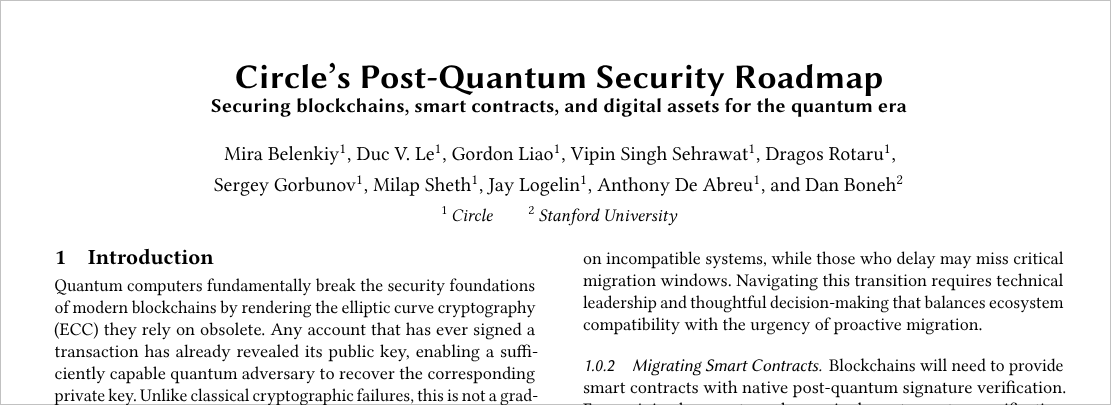
3/ Wondering about @arc ? We've already thought about it With colleagues at Circle & Stanford, we built Arc's post-quantum migration plan (also accepted as a poster paper at PQQS): protect data now, hybrid signatures next, hard switch when it's time
https://t.co/oEQS3BvzWn
2/
It started earlier this year at Visa Research, where we asked a broader question: what happens to blockchains when a cryptographically relevant quantum computer arrives? 👇
https://t.co/zOfWuWsSau
1/ Glad to announce our SoK "Stablecoins in the Quantum Era" was accepted at ACM PQQS 2026
With @panoschtz , Navid & Suvradip, we map how quantum attacks hit stablecoins at every layer — and why securing one layer alone isn't enough 👇