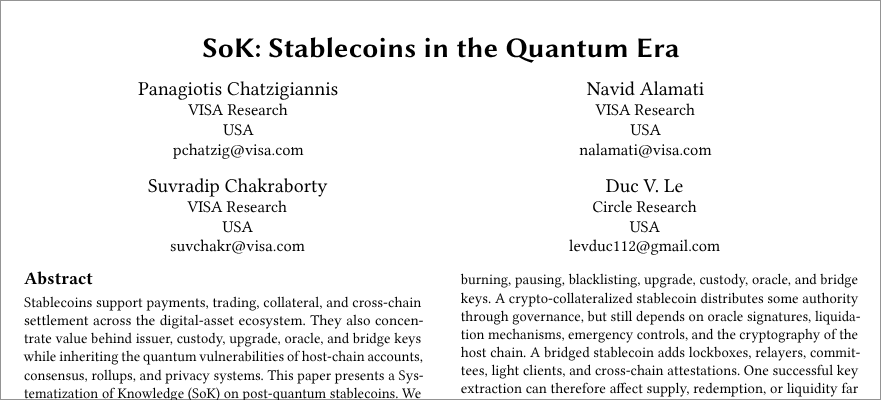
1/ Glad to announce our SoK "Stablecoins in the Quantum Era" was accepted at ACM PQQS 2026
With @panoschtz , Navid & Suvradip, we map how quantum attacks hit stablecoins at every layer — and why securing one layer alone isn't enough 👇
Paper: https://t.co/6jTYpthW8W Interested in feedback from researchers and standards folks on whether this kind of human-derived key derivation could be standardized as an optional wallet-level mechanism! #recovery@Visa@ethmagicians@erc4337@ethereum@VitalikButerin
5/5
We’ve been exploring a human-centric key derivation approach where cryptographic keys are deterministically derived from rich human memory, and the same process can be re-run later for recovery.
🧵: 1/5
This seems especially relevant for smart-contract wallets and account-abstraction flows, where key policies, retries, and delays already exist.
The design is fully opt-in, off-chain, and does not require changes to base-layer protocols.
4/5
If you’re an exchange running Proof of Reserves, choose Walrus.
In the past, we identified a critical vulnerability: exchanges could publish different solvency commitments on their websites, allowing them to secretly update or selectively serve different proofs to each user. This loophole could let them bypass solvency audits entirely.
Here is the paper, 👀 section 4.4 : https://t.co/rxuyXu6I6e
Our paper, "A Composability Analysis Framework for Web3 Wallet Recovery Mechanisms," was presented at IEEE S&P 2025!
Explore our work on enhancing web3 wallet security: https://t.co/D2UwKL67mp
#Web3#Blockchain#Security#IEEE#wallets
Excited to announce our paper "A Composability Analysis Framework for Web3 Wallet Recovery Mechanisms" has been accepted at @IEEESSP 2025! We set new standards in web3 wallet security by providing a thorough and reliable method for evaluating wallet recovery mechanisms: 🧵1/6
Such an inspiring interview, definitely worth to listen to it in its entirety! Also at timestamp 1:09:05 Kostas mentions about our work in blockchain key and account recovery https://t.co/yTpCjvYac6
The Greek economic crisis is likely why many engineers and scientists in the country were pushed to explore crypto
Today, you'll find a high density of them at the top of their fields in industry & academia. I wrote about the Greek crypto landscape here:
https://t.co/p5XTNslEOc
🚀 The TUM Blockchain Conference just had their first keynote of day 2 by none other than Kostas Chalkias - the co-founder of Sui - on “Key Recovery, What Can We Do if We Ever Lose Access to Our Private Key?”.
✨ In this interview, he highlights that key recovery via traditional methods is not feasible in secure cryptographic systems. Instead, he points to KELP, a reactive key recovery solution via a commit-reveal-sign process that requires a backup to be set up beforehand.
🌟 Watch the entire interview to hear his insights on the topic and the major challenges associated with it.
🎟 If you haven’t yet, get your ticket now! https://t.co/g9yw2YB4HB
🗓 Date: 12 and 13th September 2024
📍Location: Forum der Zukunft
@kostascrypto@SuiNetwork@Mysten_Labs
@kostascrypto The last bullet about node on RPi has been done with full node, although it brings it to its limits -> @EthereumOnARM
Mobile has battery/thermal constraints (plus network usage if on data plan), so would be interesting to see something there
It seems NDSS has been desk rejecting several applied crypto papers that lean more towards the theoretical side this year. One of my papers, which improved on last year’s NDSS paper, was also desk rejected. Is this a new trend or just a one-time occurrence? @NDSSSymposium