Today, w/ Andrew Ferguson's group at @UChiPritzker: we're able to simulate entire enzyme systems with explicit solvent (O(100k) atoms) at near-quantum accuracy, matching real experimental measurements for enzyme activity.
~1,000x faster than SOTA QM/MM.
Speed made it possible. Working w/ the @PyTorch team, 3ns/day for 1,000 atoms on one H200 GPU node, plus distributed inference that scales to any GPU count.
Paper: https://t.co/h55tioLFXP
We’re releasing it in our codebase today: https://t.co/8vN5r4cu5G
Open Molecules 2025 just got even better! We’re pleased to announce today that we significantly expanded OMol25 with 40M new datapoints. We also present our collaboration with Lawrence Livermore National Lab and Lawrence Berkeley National Lab on the Open Polymer 2026 dataset.
Open Polymers 2026 (OPoly26) features over 6M DFT calculations on systems up to 360 atoms. These feature a variety of traditional polymers, copolymers, polymer electrolytes, optical polymers, peptoids, other large macromolecules like lipids, and more!
@EvanAntoniuk These data were used to train the next iteration of our flagship UMA models. Check out our latest UMA-S-1.2, now ~50% faster, while being even more (40+%) accurate than our previous UMA-S-1.1 model.
@EvanAntoniuk The new OMol data covers more heavy main-group chemistry, main group clusters (e.g. polyhedral boranes), intermediate spin metal complexes, ionized small molecules, exotic protonation states, and multi-molecular organic clusters. We dramatically improve on redox calcs.
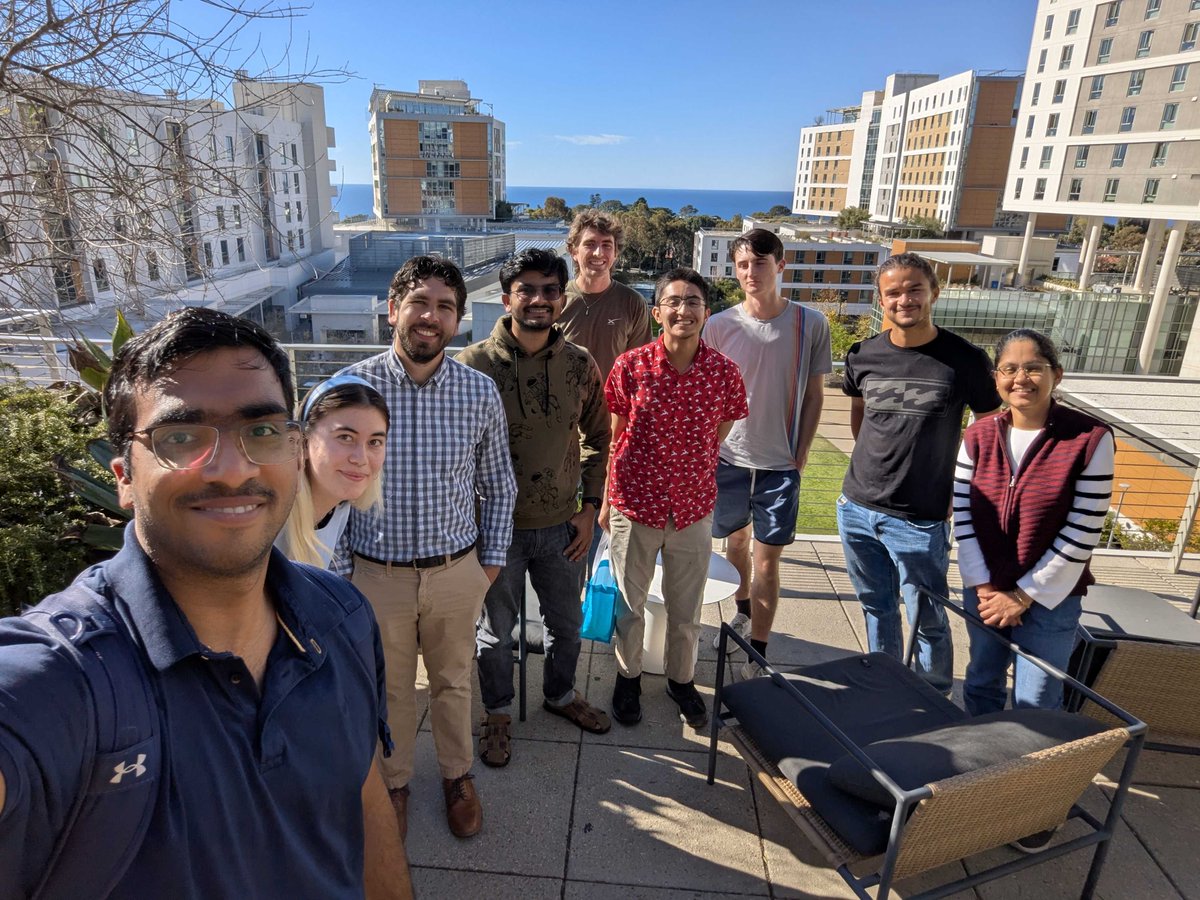
Great visit today from Dr. Daniel Levine (@Meta FAIR), who shared the latest advances on the #UMA universal models for atoms!
Fantastic discussion about how #machinelearning models can reshape molecular simulations across chemistry and materials science. Exciting times ahead for #compchem!
@UCSanDiego@UCSDPhySci@UCSDChemBiochem@HDSIUCSD@SDSC_UCSD
@toddjmartinez @mhg_group We don't argue that Pauli repulsion weakens bonds, rather that Pauli renders KE-based explanations of bonding not universal. The C-C bond of ethane has much more Pauli than H2, but the bond strength is similar.
After many years and 8 reviewers, our paper w/@mhg_group on the origin of the covalent bond, where we question some prevailing wisdom, is finally out. This topic is like religion: no one can really prove they're right but people have very strong opinions. https://t.co/xJqWo0B60K
A mere two years after finishing all of the coding, this paper finally out. Check it out if you've always wanted to do CASSCF on your system of 50 electrons but didn't have several age-of-the-universes to wait. https://t.co/k9HNvPuMCR