this was a really hard talk to write because I didn’t want to just rehash a bunch of stuff I’d already talked about, but it also HAD to stand alone. It took a ton of refining but I’m happy with where we got to.
Go learn you some advanced context engineering, and don’t forget to think
AI is at the stage of transportation during the steam-engine railroad era: clunky, expensive, unreliable, and inflexible. However, diesel engines, cars, airplanes, and rockets will soon emerge, with progress now 30 times faster than then.
1. ask deep research for an in depth tactical overview of the Getting Things Done system by David Allen
2. drop the overview in a repo and ask opus to build you scaffolding for the system in markdown files
3. connect your calendar, mail, linear, github, whatever else (mcp if you must but claude can one-shot more context-efficient scripts for most of these)
4. 2+ times per day, brain dump your notes into superwhisper and let claude organize into forecast, projects, next action
5. whenever you have spare time, engage w/ next actions (hey you can re use the tools for half of it)
mind like water
I'm thrilled to announce the definitive course on Claude Code, created with @AnthropicAI and taught by Elie Schoppik @eschoppik. If you want to use highly agentic coding - where AI works autonomously for many minutes or longer, not just completing code snippets - this is it.
Claude Code has been a game-changer for many developers (including me!), but there's real depth to using it well. This comprehensive course covers everything from fundamentals to advanced patterns.
After this short course, you'll be able to:
- Orchestrate multiple Claude subagents to work on different parts of your codebase simultaneously
- Tag Claude in GitHub issues and have it autonomously create, review, and merge pull requests
- Transform messy Jupyter notebooks into clean, production-ready dashboards
- Use MCP tools like Playwright so Claude can see what's wrong with your UI and fix it autonomously
Whether you're new to Claude Code or already using it, you'll discover powerful capabilities that can fundamentally change how you build software.
I'm very excited about what agentic coding lets everyone now do. Please take this course!
https://t.co/HGM8ArDalK
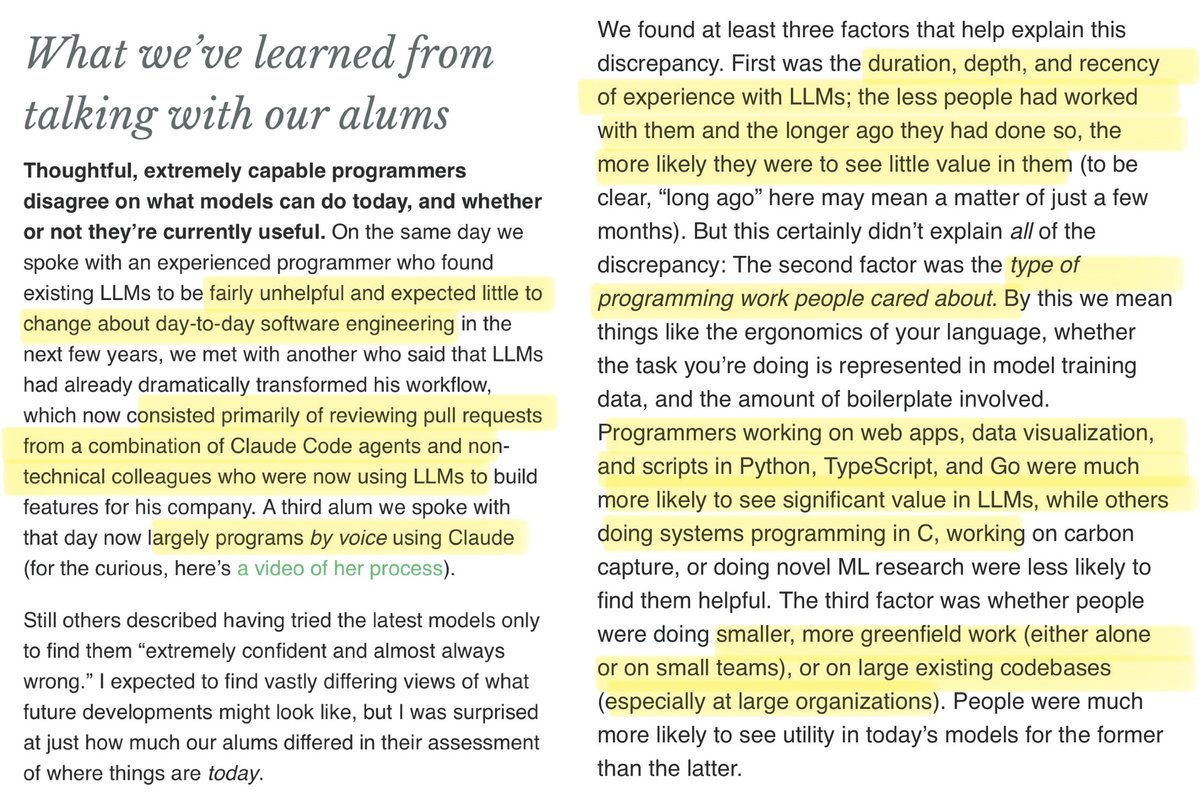
Software engineers who don’t find LLMs for coding useful either
1. Used it a >2mos ago and formed an opinion, before Claude Code
2. Program in an esoteric language or framework, including low level systems / C
3. Work on large preexisting codebases
Next week is Claude Code SDK week!
I'll be sharing how to use the SDK to make any sort of agent.
Look out for some example repos and videos, maybe even a livestream...
Claude Code is all you need.
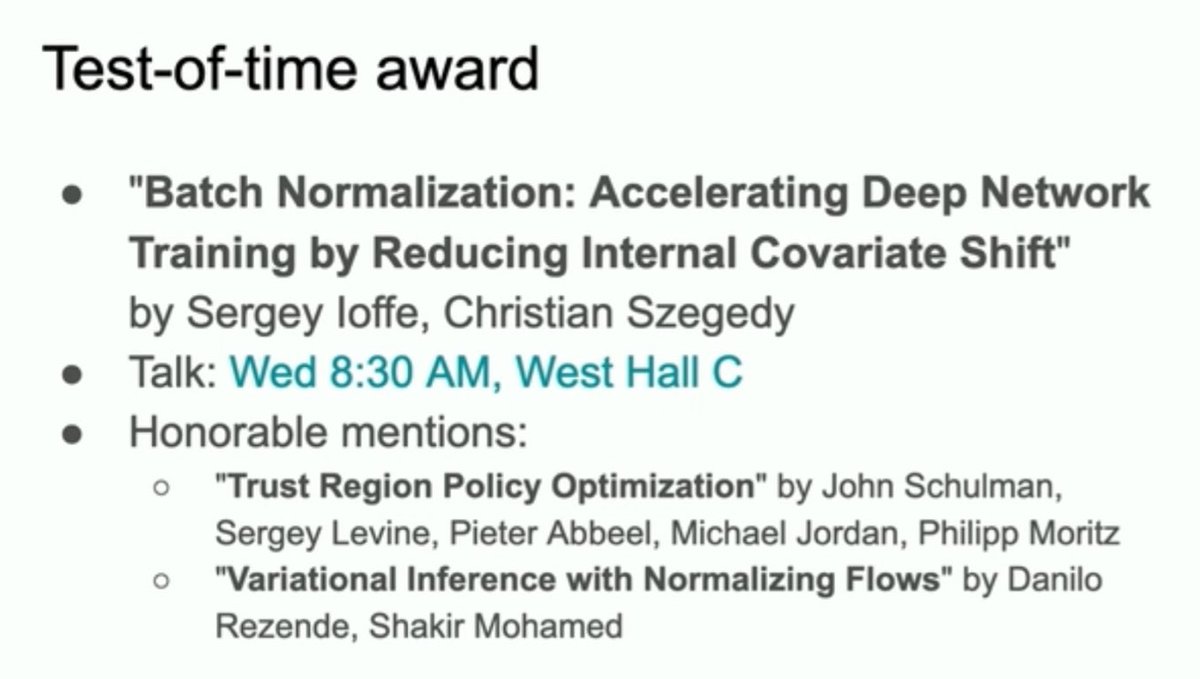
BatchNorm wins the Test-of-Time Award at #ICML2025! 🎉
BatchNorm revolutionized deep learning by addressing internal covariate shift, which can slow down learning, limits learning rates, and makes it difficult to train deep networks.
By normalizing inputs within each mini-batch, BatchNorm significantly stabilized and accelerated training. It enabled higher learning rates, improved gradient flow, and paved the way for much deeper architectures like ResNet.
Beyond reducing internal covariate shift, BatchNorm also smooths the optimization landscape and improves model generalization, making it a cornerstone of modern neural network training.
Very well deserved, @Sergey_xai and @ChrSzegedy!
The Inception paper https://t.co/HgE2dELgeq was awarded the Longuet-Higgins prize (Test of time).
The architecture represented a significant step forward in inference efficiency especially on CPU and variants of Inception networks were used in Google products for years.
Rich Sutton just published his most important essay on AI since The Bitter Lesson: "Welcome to the Era of Experience"
Sutton and his advisee Silver argue that the “era of human data,” dominated by supervised pre‑training and RL‑from‑human‑feedback, has hit diminishing returns; the future will belong to agents that
— act continuously in real or simulated worlds,
— generate and label their own training data through interaction
— optimise rewards grounded in the environment rather than in human preference alone, and
— refine their world‑models and plans over lifelong streams of experience.
Great work by @AarushSelvan and team, Deep Research is consistently getting better week over week.
The fact that you can turn research reports into audio overviews is still so awesome to me. Never gets old!
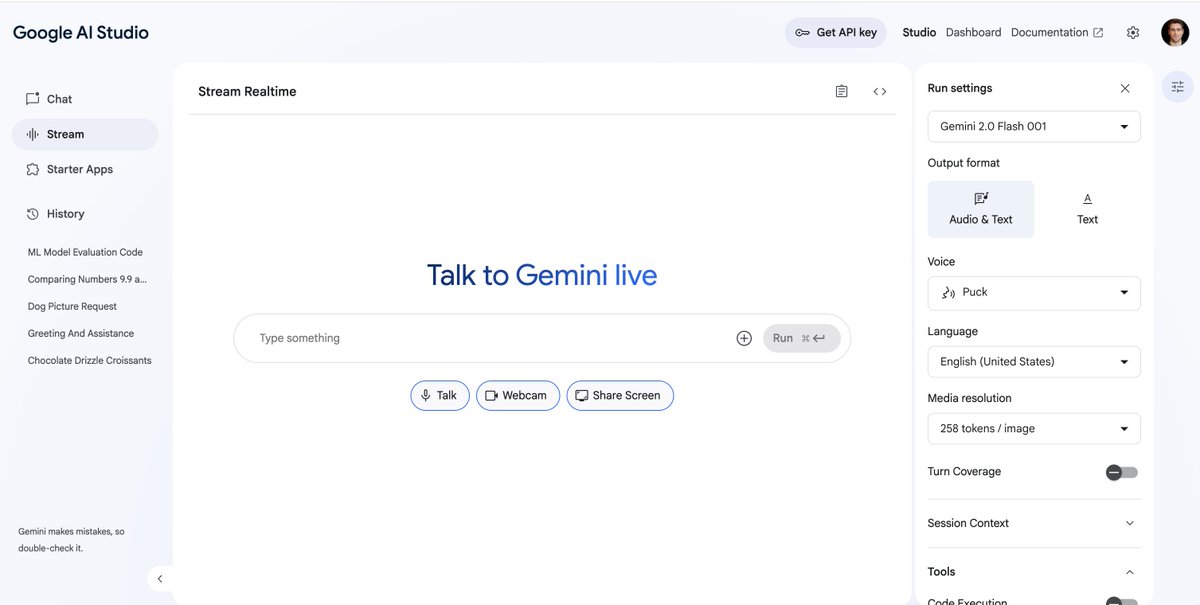
Excited to share that the Live API is now ready for production use and featuring:
- Support for 30 new languages
- Support for 2 new voices
- New voice detection configurations
- Longer sessions (with sliding context window)
- Higher rate limits
and a new UI to test it all 🧵
I was given early access to Grok 3 earlier today, making me I think one of the first few who could run a quick vibe check.
Thinking
✅ First, Grok 3 clearly has an around state of the art thinking model ("Think" button) and did great out of the box on my Settler's of Catan question:
"Create a board game webpage showing a hex grid, just like in the game Settlers of Catan. Each hex grid is numbered from 1..N, where N is the total number of hex tiles. Make it generic, so one can change the number of "rings" using a slider. For example in Catan the radius is 3 hexes. Single html page please."
Few models get this right reliably. The top OpenAI thinking models (e.g. o1-pro, at $200/month) get it too, but all of DeepSeek-R1, Gemini 2.0 Flash Thinking, and Claude do not.
❌ It did not solve my "Emoji mystery" question where I give a smiling face with an attached message hidden inside Unicode variation selectors, even when I give a strong hint on how to decode it in the form of Rust code. The most progress I've seen is from DeepSeek-R1 which once partially decoded the message.
❓ It solved a few tic tac toe boards I gave it with a pretty nice/clean chain of thought (many SOTA models often fail these!). So I upped the difficulty and asked it to generate 3 "tricky" tic tac toe boards, which it failed on (generating nonsense boards / text), but then so did o1 pro.
✅ I uploaded GPT-2 paper. I asked a bunch of simple lookup questions, all worked great. Then asked to estimate the number of training flops it took to train GPT-2, with no searching. This is tricky because the number of tokens is not spelled out so it has to be partially estimated and partially calculated, stressing all of lookup, knowledge, and math. One example is 40GB of text ~= 40B characters ~= 40B bytes (assume ASCII) ~= 10B tokens (assume ~4 bytes/tok), at ~10 epochs ~= 100B token training run, at 1.5B params and with 2+4=6 flops/param/token, this is 100e9 X 1.5e9 X 6 ~= 1e21 FLOPs. Both Grok 3 and 4o fail this task, but Grok 3 with Thinking solves it great, while o1 pro (GPT thinking model) fails.
I like that the model *will* attempt to solve the Riemann hypothesis when asked to, similar to DeepSeek-R1 but unlike many other models that give up instantly (o1-pro, Claude, Gemini 2.0 Flash Thinking) and simply say that it is a great unsolved problem. I had to stop it eventually because I felt a bit bad for it, but it showed courage and who knows, maybe one day...
The impression overall I got here is that this is somewhere around o1-pro capability, and ahead of DeepSeek-R1, though of course we need actual, real evaluations to look at.
DeepSearch
Very neat offering that seems to combine something along the lines of what OpenAI / Perplexity call "Deep Research", together with thinking. Except instead of "Deep Research" it is "Deep Search" (sigh). Can produce high quality responses to various researchy / lookupy questions you could imagine have answers in article on the internet, e.g. a few I tried, which I stole from my recent search history on Perplexity, along with how it went:
- ✅ "What's up with the upcoming Apple Launch? Any rumors?"
- ✅ "Why is Palantir stock surging recently?"
- ✅ "White Lotus 3 where was it filmed and is it the same team as Seasons 1 and 2?"
- ✅ "What toothpaste does Bryan Johnson use?"
- ❌ "Singles Inferno Season 4 cast where are they now?"
- ❌ "What speech to text program has Simon Willison mentioned he's using?"
❌ I did find some sharp edges here. E.g. the model doesn't seem to like to reference X as a source by default, though you can explicitly ask it to. A few times I caught it hallucinating URLs that don't exist. A few times it said factual things that I think are incorrect and it didn't provide a citation for it (it probably doesn't exist). E.g. it told me that "Kim Jeong-su is still dating Kim Min-seol" of Singles Inferno Season 4, which surely is totally off, right? And when I asked it to create a report on the major LLM labs and their amount of total funding and estimate of employee count, it listed 12 major labs but not itself (xAI).
The impression I get of DeepSearch is that it's approximately around Perplexity DeepResearch offering (which is great!), but not yet at the level of OpenAI's recently released "Deep Research", which still feels more thorough and reliable (though still nowhere perfect, e.g. it, too, quite incorrectly excludes xAI as a "major LLM labs" when I tried with it...).
Random LLM "gotcha"s
I tried a few more fun / random LLM gotcha queries I like to try now and then. Gotchas are queries that specifically on the easy side for humans but on the hard side for LLMs, so I was curious which of them Grok 3 makes progress on.
✅ Grok 3 knows there are 3 "r" in "strawberry", but then it also told me there are only 3 "L" in LOLLAPALOOZA. Turning on Thinking solves this.
✅ Grok 3 told me 9.11 > 9.9. (common with other LLMs too), but again, turning on Thinking solves it.
✅ Few simple puzzles worked ok even without thinking, e.g. *"Sally (a girl) has 3 brothers. Each brother has 2 sisters. How many sisters does Sally have?"*. E.g. GPT4o says 2 (incorrectly).
❌ Sadly the model's sense of humor does not appear to be obviously improved. This is a common LLM issue with humor capability and general mode collapse, famously, e.g. 90% of 1,008 outputs asking ChatGPT for joke were repetitions of the same 25 jokes. Even when prompted in more detail away from simple pun territory (e.g. give me a standup), I'm not sure that it is state of the art humor. Example generated joke: "*Why did the chicken join a band? Because it had the drumsticks and wanted to be a cluck-star!*". In quick testing, thinking did not help, possibly it made it a bit worse.
❌ Model still appears to be just a bit too overly sensitive to "complex ethical issues", e.g. generated a 1 page essay basically refusing to answer whether it might be ethically justifiable to misgender someone if it meant saving 1 million people from dying.
❌ Simon Willison's "*Generate an SVG of a pelican riding a bicycle*". It stresses the LLMs ability to lay out many elements on a 2D grid, which is very difficult because the LLMs can't "see" like people do, so it's arranging things in the dark, in text. Marking as fail because these pelicans are qutie good but, but still a bit broken (see image and comparisons). Claude's are best, but imo I suspect they specifically targeted SVG capability during training.
Summary. As far as a quick vibe check over ~2 hours this morning, Grok 3 + Thinking feels somewhere around the state of the art territory of OpenAI's strongest models (o1-pro, $200/month), and slightly better than DeepSeek-R1 and Gemini 2.0 Flash Thinking. Which is quite incredible considering that the team started from scratch ~1 year ago, this timescale to state of the art territory is unprecedented. Do also keep in mind the caveats - the models are stochastic and may give slightly different answers each time, and it is very early, so we'll have to wait for a lot more evaluations over a period of the next few days/weeks. The early LM arena results look quite encouraging indeed. For now, big congrats to the xAI team, they clearly have huge velocity and momentum and I am excited to add Grok 3 to my "LLM council" and hear what it thinks going forward.
New 3h31m video on YouTube:
"Deep Dive into LLMs like ChatGPT"
This is a general audience deep dive into the Large Language Model (LLM) AI technology that powers ChatGPT and related products. It is covers the full training stack of how the models are developed, along with mental models of how to think about their "psychology", and how to get the best use them in practical applications.
We cover all the major stages:
1. pretraining: data, tokenization, Transformer neural network I/O and internals, inference, GPT-2 training example, Llama 3.1 base inference examples
2. supervised finetuning: conversations data, "LLM Psychology": hallucinations, tool use, knowledge/working memory, knowledge of self, models need tokens to think, spelling, jagged intelligence
3. reinforcement learning: practice makes perfect, DeepSeek-R1, AlphaGo, RLHF.
I designed this video for the "general audience" track of my videos, which I believe are accessible to most people, even without technical background. It should give you an intuitive understanding of the full training pipeline of LLMs like ChatGPT, with many examples along the way, and maybe some ways of thinking around current capabilities, where we are, and what's coming.
(Also, I have one "Intro to LLMs" video already from ~year ago, but that is just a re-recording of a random talk, so I wanted to loop around and do a lot more comprehensive version of this topic. They can still be combined, as the talk goes a lot deeper into other topics, e.g. LLM OS and LLM Security)
Hope it's fun & useful!
https://t.co/75mXcUBI8L
hello world! happy to serve + this was really nice to hear while @TheNoahHein and i are deep in the bowels of the customizable platform
we're adding youtube soon... 🤫
🎉🎉Introducing NeuralCam 7.0! Our complete AI Photography system with a Vision LLM-powered Photo Coach, smart capture, and auto-editing features. Try it now! https://t.co/q5QQCUaCCl Product Hunt: https://t.co/xtD7CwgGE3 #neuralcam#PhotoCoach
Introducing NeuralPix - All the most popular AI Photo Enhancement & Editing features in one FREE app! Explore now at https://t.co/xnmeA4YnIf 📸 and check it out on PH: https://t.co/502HONu6oy
Enjoy!