How and when are sediment, carbon and pollutants flushed along submarine channels to build lobes at their termini? We explore this using a decade of repeat seafloor surveys along the entirety of a submarine channel-lobe system. OA paper: https://t.co/871NqZDxxF
@annebernhardt_ @MikeAClare Yes - will definitely get more complicated! Will be interesting to see to what extent the predictive power reduces and what other factors come into play!
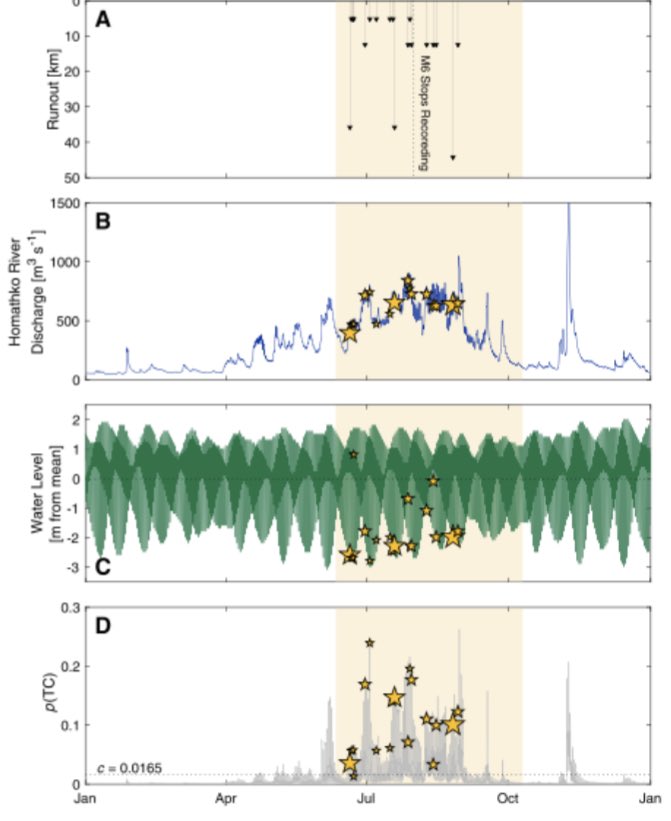
@lew_bailey just gave a great talk at @INCISE_net (all the more impressive in light of tech issues) Q: Can we predict turbidity currents? A: Yes we can!* *albeit w some caveats for some system types! Where rivers & tides dominate his model performs v well.
Thanks @Shtacy_Phillips for featuring our work with your Lego art! See you all at 13:30 for what is bound to be a great session on Hazard cascades from source 2 sink, convened by @WaterSHEDLab @sedi_life et al.
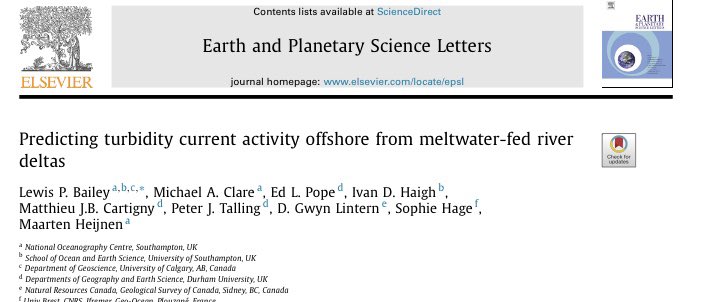
I will present an overview of our recently published paper on the role of preconditioning for turbidity current initiation and ongoing work on producing a model to predict the exact timing of flows.
https://t.co/RT1pfZtzii
Looking forward to presenting in the @ItnSlate Seminar series today at 11 UK time on the controls on turbidity current activity. Details and zoom link are below:
https://t.co/OvmPb0FLv7
Really enjoyed day 1 of @brit_seds#bsrg2020. Looking forward to kicking off day 2 with the turbidity current forecast at 8:30am. Make sure you tune in!
Just had a great Skype with @lew_bailey who has made a massive breakthrough in his PhD project training a model to predict the timing of turbidity currents. Very exciting stuff - this has made my week!