DeepSeek founder Liang Wenfeng rarely speaks publicly. During the funding round he spent 4 hours with investors, and the 34,000-character transcript leaked (via Yicai).
Why he open-sources his best models, what comes after agents, and why NVIDIA is "digging its own grave."
@elonmusk This isn't accurate. The mapping from a high-level language to machine code is deterministic, so there's no need to review it to know the exact output. Natural language to code isn't deterministic. There's no way to know whether the AI built what you had in mind.
@badlogicgames@dexhorthy@0xblacklight@humanlayer_dev On "maintainability has no fast oracle": the oracle isn't missing, it's just slow. A senior engineer gets it months later by living with the decision, and keeps it. A model can't use a signal on that timescale without continual learning. No harness can close that gap.
@JensenHuang@nvidia NVIDIA, Meta, Microsoft and Hugging Face all signed for open weights. The leaked DeepSeek transcript has the part none of them can say: "I only earn 6x margin, so deploying our models is unprofitable for third parties. Open source only hurts if you want 100x."
DeepSeek's Liang Wenfeng said a next-generation model has to be capable of continual learning.
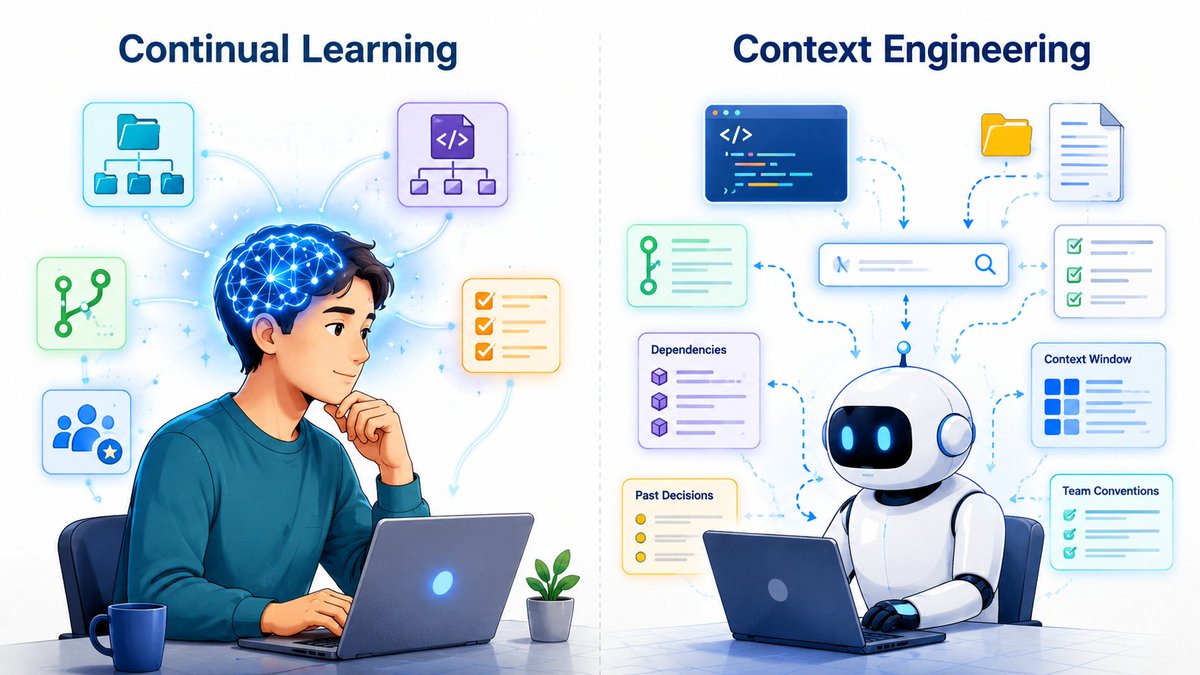
I got to the same place from the engineering side. The memory we build into the harness works, and context engineering keeps improving it. But it works by handing the agent the facts again before every task, and none of it becomes something the agent knows. The knowledge has to end up in the weights.
Three months in, a new hire just knows which two files have to change together, which field named status isn't a status, and why the worse-looking design is the one that shipped. None of it is written down. Nobody thinks it should be. They didn't look it up, they absorbed it.
I don't write code with the conventions doc and a gotchas list open beside me either. That stuff is part of me now.
An agent gets neither. No three months, and we make it work the way I don't: docs open, checking as it goes. Every piece has to be remembered and supplied by someone else. Knowledge in the weights needs none of that. It is there on every token.
The bottleneck is deciding what to put in
First, most of that knowledge was never written down. Nothing was in place at the time to judge that it was worth keeping. A person doesn't judge. They just remember.
Second, even for what did get written down, retrieval ranks by similarity, and what is actually relevant often isn't similar. Its connection to the thing in front of you is causal or historical, not topical.
A bigger window doesn't fix it
Work keeps producing new facts, and today's decision is needed tomorrow. No fixed window survives a timeline that keeps running. Making it bigger trades a capacity problem for a signal to noise problem.
And it doesn't accumulate. The same team conventions, injected three hundred times today, three hundred times as if for the first time.
The same model already holds centuries of human knowledge. The weights are the one place we can't add to as we go.
One thing to concede
The weakness of context is also its strength. Because someone put every piece there, every piece is editable, revocable, and when something breaks you can point at the exact line. Nobody is giving that up soon.
Everything we call context engineering is a prosthetic for a model that can't keep learning. Prosthetics work. Nobody has built the alternative yet, so today they are mandatory. But the ceiling is not in the prosthetic.
@zephyr_z9 DeepSeek V3 was trained on NVIDIA chips but off the NVIDIA stack, on their own compiler TileLang, at a 1-2% execution cost. That makes Huawei a retarget, not a rebuild.
@AngelicaOung He reaches for almost the same image: "What's in front is sesame seeds. The watermelon comes later." The berries do get picked up, just never at the cost of stopping.
@pstAsiatech The chip math is unusually concrete for a Chinese lab: four Huawei 950s to one GB300, two years behind. He expects the ecosystem question settled within a year, leaving capacity as the only constraint.
@nabeelqu On the open source commitment: "I don't fear rivals deploying our models. I fear them deploying badly." The open weights are the same ones they serve, no weaker version held back.
@bookwormengr The anti-monopoly bit isn't idealism in his telling, it's arithmetic: "AI could take 10% of world GDP. With stakes that big, anyone trying to keep it all will be cast aside by history."
@poezhao0605 His own answer is that no one gets to live there: "I absolutely don't think model companies can take most of the profit. The gap between them is only time and cost. No one gets windfall profits."
So 6x isn't just discipline, it's where he thinks price competition lands.
@ShakeelHashim He scopes that narrowly: capacity is the only part he calls unsolved. The software side he treats as done. V3 trained on NVIDIA chips but not the NVIDIA ecosystem, via their own compiler TileLang, which leaves almost no CUDA lock-in to unwind. The bottleneck is fabs, not code.
In short: restraint as strategy, continual learning next, compute the only gap he respects, and domestic chips closing in.
Quotes translated and condensed from the full Yicai transcript. If enough people want it, I'll publish a full translation.
What surprised you most?
DeepSeek founder Liang Wenfeng rarely speaks publicly. During the funding round he spent 4 hours with investors, and the 34,000-character transcript leaked (via Yicai).
Why he open-sources his best models, what comes after agents, and why NVIDIA is "digging its own grave."
Zooming out:
"China will very likely be one of the three poles of AI. Our manufacturing capacity is the largest, our electricity the most."
"Like Chinese goods today: quality close to American, but cheaper. Systemically cheaper, like every other industry China serves."