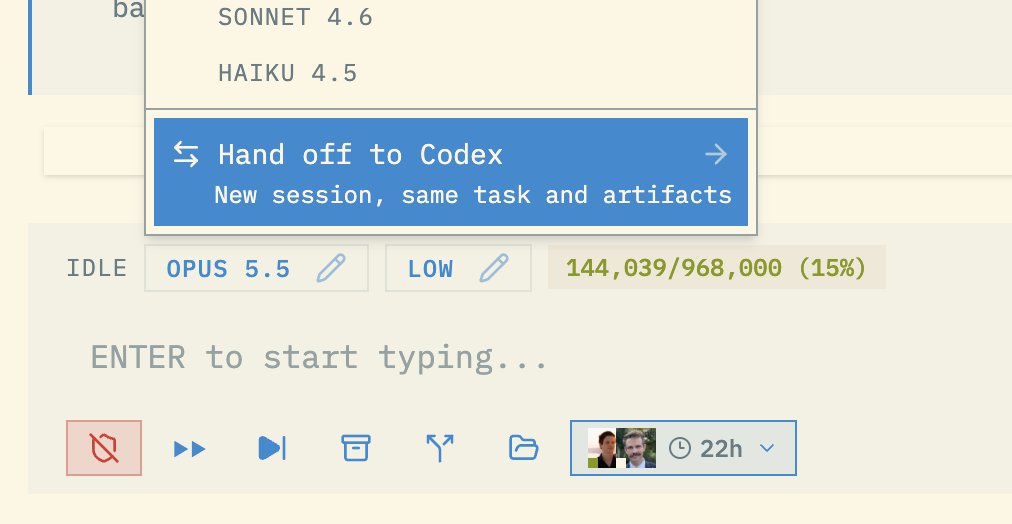
a @p3pijn_jasper special that is rapidly becoming one of my favorite @humanlayer_dev features:
hand off a session from claude to codex
perfect for when you get sick of claude's nonsense halfway through a session
crazy new drop - you can now use humanlayer directly from Pi agent or @opencode - bring your harness, use it how you like, and make every session collaborative and remote-controllable!
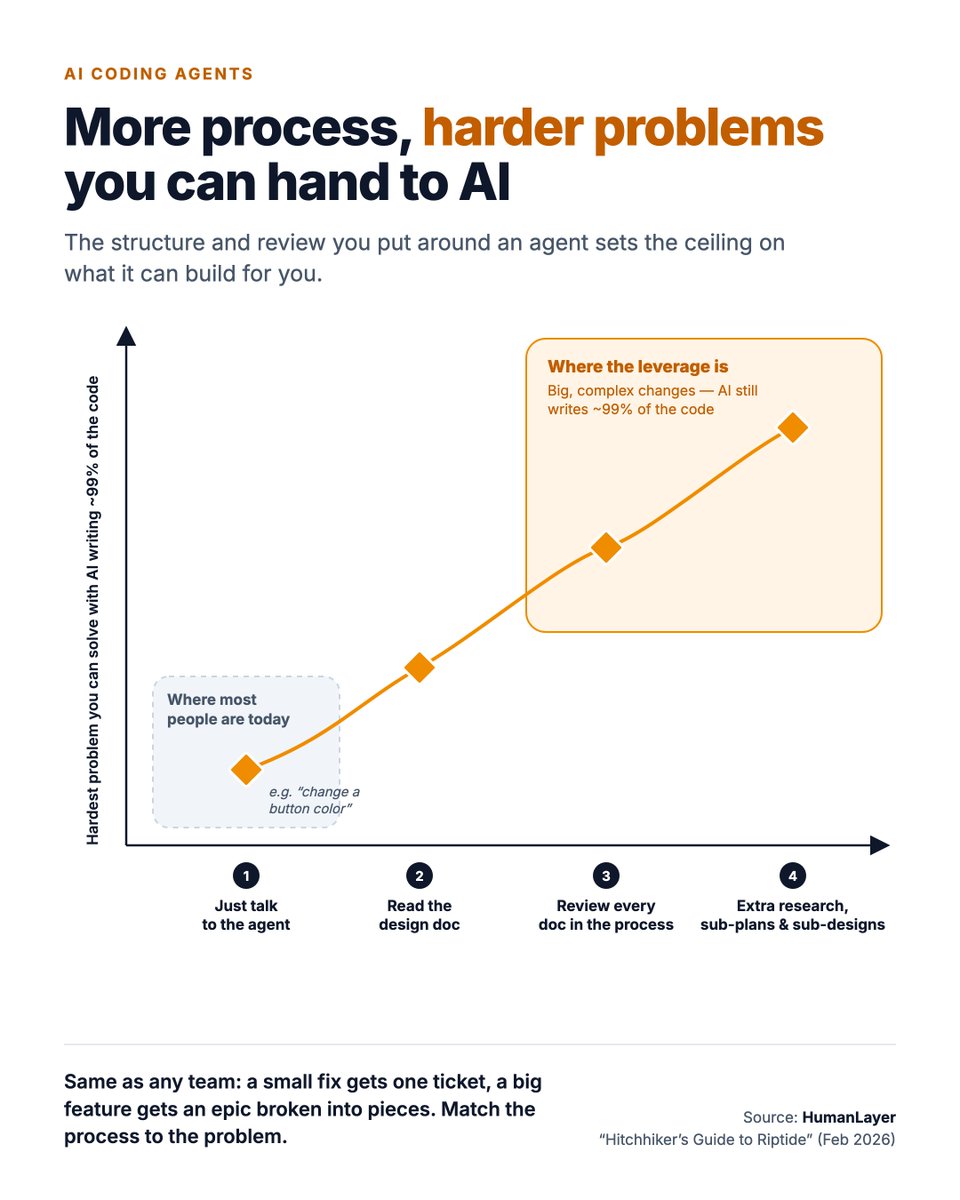
The hardest problem you can give an AI coding agent isn't set by the model. It's set by your process.
Chart based on HumanLayer's "Hitchhiker's Guide to Riptide" (Feb 2026). @humanlayer_dev
Getting hands-on with HumanLayer.
@humanlayer_dev
From what I’ve seen so far, I’d describe it as a software factory, it can plan, research, and drive implementation.
Excited to build an agent harness using HumanLayer and explore what’s possible.
Would love to hear your thoughts on this!
The almighty @saasmakermac shared his dev process with me yesterday.
Here's some of mine. Messy, constantly changing, but fun! Featuring @AmpCode@humanlayer_dev@coderabbitai and AL 🫡
Also probably outdated by the time this video is encoded.
cool product out of riffing w/ @mattpocockuk this week - decided to open source the pull request skill that bundles with @humanlayer_dev - /show-me bundled with some steering to cut out a lot of the slop and noise that comes with most agent prs
It's a small piece of a much larger puzzle, but rather than just share the SKILL.md contents with Matt, I figured we'd just give it to all of you 🙂 enjoy
npx skills add humanlayer/skills --skill visual-pr
coming soon to a humanlayer new you:
live multiplayer prompting - co-author a single prompt with your team.
A few weeks ago we shipped "send a prompt to your colleague's session" - now we made each individual prompt collaborative.
No cloud agents required, works wherever you run your agent - across laptops, mac minis, cloud compute, we even have this working in coding agent sessions that run in disposable compute like github actions.
built on durable streams and @rivet_dev actors on ECS - incredible work from @0xblacklight
That's in addition to all the other things we made collaborative in the last 2 months:
- live google-docs style commenting on plans, right in the IDE, or plan/collab from your phone
- diffs stream live as the coding agent is working, so you can comment on changes wayyy before PR
shift collaboration left, shift alignment left, go check it out @humanlayer_dev - free for small teams go check it out today
@dexhorthy has fresh evidence that unattended coding agents still turn healthy codebases into radioactive spaghetti.
At @humanlayer_dev, a lightly supervised software factory metastasized into 30,000 to 40,000 lines with an "insanely complicated state machine" running four Unix processes. They archived the whole thing.
His new SlopCodeBench data shows every model accumulated defects as challenges piled up. That is the pattern.
He is presenting "There Is No Software Factory Without Better Verifiers" at AGNTCon + MCPCon NA in San Jose on Oct 22.
https://t.co/rYjCmOxuNj
One of our most useful skills @autumnpricing today is called /explain (based on /show-me from @humanlayer_dev)
It started off just for code explanations, but I've found myself using it in every interaction today.
Wanted to share some thoughts on a couple of the form factors which were the most intuitive! 🧵
I think @humanlayer_dev has been telling everyone this for close to 9 months now
1. Many folks CORRECTLY understood that LLMs can operate much more effectively in complex (and even bad) codebases than humans can
2. They therefore MISTAKENLY inferred that code quality & complexity and program design no longer matter
3. What they missed was that LLMs can also create much more bad code and much more complex systems faster than humans can.
4. The derivative of (3) is MUCH LARGER than the derivative of (1). Models do get better at working in bad codebases with each new generation. But they get a lot better at running unsupervised for a long time and producing exceptionally complicated programs.
5. The debt associated with (4) compounds superlinearly on large teams
one of the biggest Agentic Engineering videos on youtube
instead of watching Netflix tonight, watch this 58 minute masterclass
you will be ahead 99% of people