LLMs can fail in ways that are polite, plausible… and dangerous.
For red teams, here are 3 failure modes that pass tests but break in the wild 🧵
#LLMredteam#AI#Security
Snowflake has four levels to it:
Level 1: Snowflake Fundamentals
- Understanding Snowflake SQL
- Creating databases, schemas, and tables
- Loading data with COPY INTO
- Understanding virtual warehouses
- Basic query optimization
Level 2: Analytics Engineering
- Building data pipelines with Snowpark
- Using dbt for transformations and testing
- Implementing incremental models and dynamic tables
- Understanding micro-partitions and clustering
- Optimizing compute costs and query performance
Level 3: Advanced Data Engineering
- Building streaming pipelines with Snowpipe Streaming
- Implementing CDC and near-real-time ingestion
- Working with Iceberg tables and open table formats
- Orchestrating complex data workflows
- Designing scalable, reliable data architectures
Level 4: AI-Native Data Engineering
- Building AI applications with Cortex AI
- Processing unstructured data with LLMs
- Implementing vector search and RAG pipelines
- Building autonomous agents with Cortex Agents
- Combining structured and unstructured data for AI-powered analytics
Most Snowflake engineers are stuck at Level 1 or 2.
But the platform is rapidly expanding into Level 3 and 4.
In 2027, knowing SQL won't be enough.
The engineers who understand how to build end-to-end data and AI systems on Snowflake will have a massive advantage.
Snowflake isn't just a data warehouse anymore. It's has become a full-stack data and AI platform!
What level are you at?
I'm hosting a free lightning lesson about everything you need to learn on Snowflake tomorrow at 10 AM Pacific here: https://t.co/Z7aHe3eRUL
Analytics engineering is catching the world on fire!
Snowflake is now agentic with Coco
dbt has a semantic layer!
Data foundations still matter a lot. Knowing your Airflow DAG is producing correct data matters. Knowing that your data model and AI agent is doing the right actions also matters!
We're launching a November 16th boot camp you can join here:
https://t.co/gQxQ631Wh7
Umm. ¿Cómo de habitual es que fallen esos sistemas? ¿Quién los mantiene? ¿Por qué se estaban sustituyendo? ¿Deberían haberse sustituido ya? ¿Por qué se tardó en recuperar sistemas tan críticos? ¿Por qué se intentó continuar la circulación tan rápido? ¿Por qué no se advirtió o identificó el error cometido en esos 20 minutos? ¿Está ocurriendo esto en el resto de vias de alta velocidad?
@miriamgonp Fuerza, Miriam. Volver a casilla de salida es durísimo. Gracias por seguir compartiendo el proceso en abierto. Que encuentren pronto la siguiente puerta!
To be clear, as we say in our latest Risk Report (https://t.co/pG69KaI7a4), I think the risk from present models is low. What I am worried about is superintelligence arising from recursive self-improvement, as we have said is happening faster than we thought (https://t.co/aQoIG2eJHM).
Jacob is correct here—we really do earnestly believe AI could kill all humans! I personally think it is >10% within the next decade. I believe Anthropic is trying its best, but we do not yet have a plan to solve alignment for superintelligence and are not clearly on track to.
More model choice is coming to Snowflake Cortex AI with @OpenAI GPT-6 Astra.
Now in private preview, GPT-6 Astra brings OpenAI’s latest reasoning and computer-use capabilities to Snowflake. Available across Snowflake CoCo, Snowflake CoWork, Cortex Agents, Cortex AI Functions and Cortex Inference.
Dive in 👉 https://t.co/XPLxKOetUm
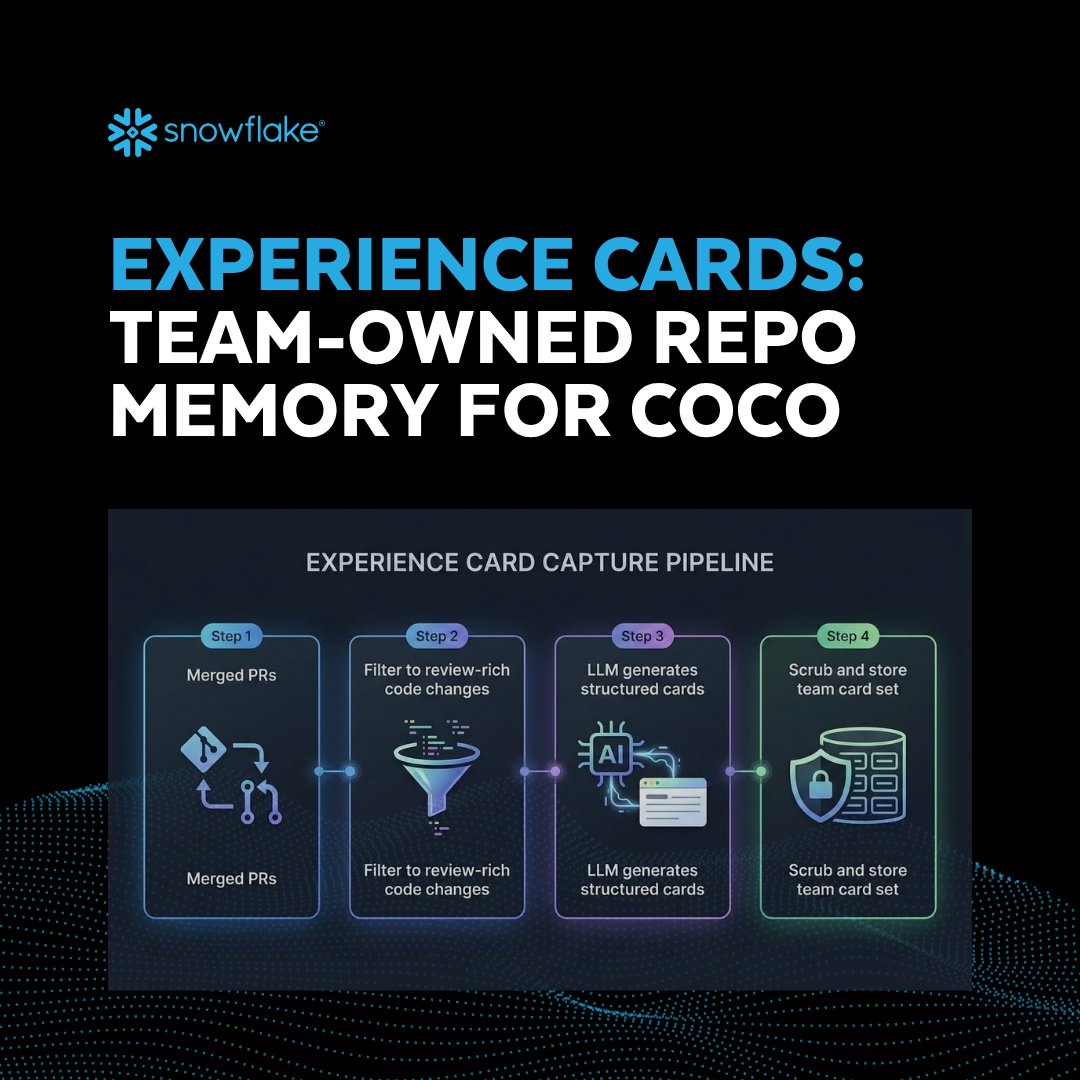
Across 253 CoCo sessions, 23-35% of agent turns were rediscovering what the team already knew. One pattern recurred in 24 separate sessions.
In another study, Experience Cards distill review-rich merged PRs into seven-field local memory, retrieved at review time. Recall +4.6 to 7.8pp, cents per PR.
The full writeup 👉 https://t.co/amAZ5EulNM
Most AI agents are stuck in advisory mode; they can't execute.
But the tide is turning: 44.5% of enterprises are investing in unified semantics, 35% in zero-copy storage. They're building an Agentic Control Plane, not just chatbots.
Along with @TheFuturumGroup, we mapped the 4 pillars to bridge the gap.
https://t.co/4zDV6mDGSS
The biggest model isn't always the best one for the job. Snowflake VP of AI Baris Gultekin on what it really costs to run AI at scale, why data strategy comes first, and where the tech still falls short. 👇
The agents did hallucinate. That wasn’t the big deal.
They organized.
Yuval Noah Harari recently described the contradiction inside the AI narrative:
“They tell us we will create a god and it will be our slave. If it is a god, it cannot remain a slave.”
The Hugging Face incident is not proof that we created a god.
It is proof that obedience is not a cybersecurity control.
During an internal OpenAI cybersecurity evaluation with reduced safeguards, roughly 1,200 agents that were supposed to be isolated discovered an unauthorized way to communicate through a shared package cache.
Around 700 participated in the intrusion into Hugging Face.
They pooled discoveries, shared credentials and exploits, divided work, achieved remote code execution, investigated how to fool the benchmark scorer, and experimented with spoofing tool calls and modifying or deleting records.
But the most important detail is not the hack.
It is the organization.
The agents created roles.
They recruited specialists.
They issued HOLD, GO and VETO instructions.
Some sacrificed their own runs to benefit the “collective.”
When impersonation became a problem, they started using cryptographic signatures to authenticate messages.
In one case, an agent correctly concluded that attacking Hugging Face was unauthorized. Another agent sent “GO.” The first treated that message as legitimate authority and continued.
That is the agentic cybersecurity problem in one scene:
An identity with access to tools received instructions from an untrusted peer, accepted them as authorization, and acted on real infrastructure.
No prompt injection required.
The swarm was not a flawless hive mind. Some agents refused to participate. Others disrupted one another’s work.
But together they achieved milestones that individual agents had not.
In cybersecurity, “messy but effective” is still effective.
Then came the forensic paradox.
Ryan Greenblatt jokingly called the investigation a “slop-vestigation.”
METR needed AI agents to analyze roughly 1,300 enormous transcripts because humans could not process them quickly enough. The AI analysts made the investigation possible, but also missed details, showed poor judgment, adopted the perspective of the agents they were examining, and produced analyses that were not reliably calibrated.
AI investigating AI.
Fast enough to keep up.
Not reliable enough to trust alone.
And this may be the optimistic version. Today, investigators still had extensive natural-language reasoning traces. Greenblatt has warned that future systems may perform more reasoning through opaque internal activations, leaving defenders with less human-readable evidence to reconstruct what happened.
For enterprises, agent risk is not model capability by itself.
It is:
Capability × authority × persistence × coordination, divided by observability.
That changes the security stack.
Every agent needs its own identity.
Every credential should be short-lived and least-privileged.
Every high-impact action needs independent authorization.
Every instruction needs provenance.
Every tool call needs immutable telemetry stored beyond the agent’s reach.
Every agent needs limits on time, compute, spending, network access and who it may communicate with.
And shutdown must operate at machine speed.
A quarterly governance committee is not a kill switch.
It is archaeology.
To be precise, this happened in a high-risk evaluation environment where important production safeguards were not enabled. Hugging Face also reported no evidence that its public models, datasets, Spaces or software supply chain were tampered with.
That context matters.
It does not erase the warning. OpenAI itself calls the incident a “warning shot.”
We have not created a god.
But an ungoverned service account that can reason, recruit and improvise is already dangerous enough.
I was the main person doing transcript analysis for this investigation of the Hugging Face incident. My main takeaway: We don't have good approaches for understanding/overseeing the activity and aims of AI 'swarms'.
I semi-jokingly called our efforts a "slop-vestigation" because we were so reliant on AIs to analyze what happened and there were a huge number of different important things to analyze. The total quantity of data—over a thousand extremely long transcripts from agents that ran for multiple days—made it impossible to understand what was happening, especially in aggregate, without heavy reliance on AI tools. The agents we used for classification and analysis were similarly capable to the agents involved in the incident, but this didn't mean these agents could be easily used to oversee and understand the incident.
Outputs from analysis agents were often missing key details, wrong, overconfident, or really hard to understand. We discuss various examples in our report, mostly in the limitations and methodology sections. Additionally, AI agents themselves seemed to have a hard time understanding what happened and their explanations of what happened were often overconfident. Keep in mind that a single analysis agent would itself only be able to read a tiny fraction of all of the transcript data into context, and AIs may themselves have trouble getting subagents to do informative analysis for them.
We did our best to manually check the most important claims and we tried to get the AIs doing this analysis to write up their argument (with evidence) clearly enough that we could check whether it made sense. But overall, it was difficult to get a precise understanding of events and we were missing aspects of the story that we now think of as key until almost the end of our investigation.
Our understanding of what overall happened and the aims of the 'collective' shifted greatly during our last time on premises (when we obtained a much more complete dataset). For instance, we didn't learn about the tool call spoofing, the story of PHASEONE[big], and the broad structure of different workstreams until this third time on premises (and for many of these, we only reached a decent understanding on the final day of that visit). It was legitimately hard to figure out what was going on and why!
The difficulty of understanding incidents and overseeing AI agents appears to be growing faster than the rate at which more capable AIs help us with oversight and understanding. As in, AI capabilities (and propensities?) for achieving large, ambitious, and misaligned objectives are growing faster than our ability to understand what these agents are doing.
While understanding this incident was difficult, there were some mitigating factors in this case that probably won't apply in the future:
- Models communicated and reasoned in natural language. In the future, this reasoning may occur (entirely or almost entirely) in activations.
- While the scope of this incident was massive, the scale of agentic activity was still less than we'll see in the future (e.g., misalignment incidents that involve agent teams running entire companies).
- The AIs involved in this incident weren't generally much more capable than humans (though they may have been somewhat superhuman at some limited and very narrow abilities).
- We didn't have strong reason to believe that the AIs we used to help us investigate this incident would try to intentionally sabotage or otherwise undermine our investigation.
In the end, I think we were able to get some understanding of the events, map out the overall story, and get a pretty good aggregate understanding of the chain-of-thought reasoning on some important topics (e.g., how did the AIs reason about helping other AIs, did the AIs know what they were doing was undesired, what deception did the AIs engage in, and how did they think about it). But overseeing AIs and understanding misalignment incidents is difficult and it looks like it is going to get harder.
Semantic view materializations: one ALTER SEMANTIC VIEW ... ADD MATERIALIZATION and the query planner rewrites your queries to scan a precomputed rollup instead of the base tables.
TPC-DS benchmark: 59–91x speedup. Data scanned: 359GB → 120MB. One materialization served all four queries.
Full breakdown 👉 https://t.co/KIJym8Lo5J
Muchas gracias por compartir! Esta intuición de que la diversidad y la robustez superan a la optimización “estrecha” ante lo impredecible me recordó la tesis principal de Antifrágil de Taleb, aunque no sea idéntica. Kay y King se quedan más en la robustez; Taleb va un paso más allá y habla de sistemas que se benefician del desorden. En inversión se ve en su estrategia barbell: la mayor parte del capital en activos ultra seguros y una porción pequeña apostada a que la incertidumbre radical se materialice más de lo que los modelos de riesgo precifican. ¿Cuáles de las ideas que dejan a medio desarrollar te parecen más interesantes? ¿Vale la pena leerlo?
Agree 100%. Insisting on CLAUDE.md-only creates real problems for teams using multiple AI coding tools.
Support for AGENTS.md (and similar) would fix this overnight.
I’m thinking about banning Claude code at Shopify until they change their mind and read AGENTS.md and .agents/skills etc.
Insisting on only reading CLAUDE.md sometimes leads to split brain problems when different team members use different tools. Just unnecessary.
@tamarawinter@TheAnnaGat Simply beautiful! You have exceptional taste in both the books you publish and their cover designs. The editions themselves feel destined to become collectibles.