Today, @ekindogus and I are excited to introduce @periodiclabs.
Our goal is to create an AI scientist.
Science works by conjecturing how the world might be, running experiments, and learning from the results.
Intelligence is necessary, but not sufficient. New knowledge is created when ideas are found to be consistent with reality. And so, at Periodic, we are building AI scientists and the autonomous laboratories for them to operate.
Until now, scientific AI advances have come from models trained on the internet. But despite its vastness — it’s still finite (estimates are ~10T text tokens where one English word may be 1-2 tokens). And in recent years the best frontier AI models have fully exhausted it.
Researchers seek better use of this data, but as any scientist knows: though re-reading a textbook may give new insights, they eventually need to try their idea to see if it holds.
Autonomous labs are central to our strategy. They provide huge amounts of high-quality data (each experiment can produce GBs of data!) that exists nowhere else. They generate valuable negative results which are seldom published. But most importantly, they give our AI scientists the tools to act.
We’re starting in the physical sciences.
Technological progress is limited by our ability to design the physical world.
We’re starting here because experiments have high signal-to-noise and are (relatively) fast, physical simulations effectively model many systems, but more broadly, physics is a verifiable environment. AI has progressed fastest in domains with data and verifiable results - for example, in math and code. Here, nature is the RL environment.
One of our goals is to discover superconductors that work at higher temperatures than today's materials. Significant advances could help us create next-generation transportation and build power grids with minimal losses. But this is just one example — if we can automate materials design, we have the potential to accelerate Moore’s Law, space travel, and nuclear fusion.
We’re also working to deploy our solutions with industry. As an example, we're helping a semiconductor manufacturer that is facing issues with heat dissipation on their chips. We’re training custom agents for their engineers and researchers to make sense of their experimental data in order to iterate faster.
Our founding team co-created ChatGPT, DeepMind’s GNoME, OpenAI’s Operator (now Agent), the neural attention mechanism, MatterGen; have scaled autonomous physics labs; and have contributed to some of the most important materials discoveries of the last decade. We’ve come together to scale up and reimagine how science is done.
We’re fortunate to be backed by investors who share our vision, including @a16z who led our $300M round, as well as @Felicis, DST Global, NVentures (NVIDIA’s venture capital arm), @Accel and individuals including @JeffBezos , @eladgil , @ericschmidt, and @JeffDean. Their support will help us grow our team, scale our labs, and develop the first generation of AI scientists.
Reliable, efficient, and correct AI infrastructure has been one of the biggest challenges in creating Periodic.
That’s why I’m excited to see RadixArk bring serious capital to open-source infrastructure like SGLang.
When that layer gets stronger in the open, companies like Periodic can move faster, and the new wave of companies can take on ambitious work that used to require a large-scale infra team from day one.
Today, we are thrilled to officially launch RadixArk with $100M in Seed funding at a $400M valuation. The round was led by @Accel and co-led by @sparkcapital.
RadixArk exists to make frontier AI infrastructure open and accessible to everyone. Today, the systems behind the most capable AI models are concentrated in a small number of companies. As a result, most AI teams are forced to rebuild training and inference stacks from scratch, duplicating the same infrastructure work instead of focusing on new models, products, and ideas.
RadixArk was founded to change that. We are building an AI platform that makes it easier for teams to train and serve the best models at scale.
RadixArk comes from the open-source community. We started with SGLang, where many of us are core developers and maintainers, and expanded our work to Miles for large-scale RL and post-training. We will continue contributing to both projects and working with the community to make them the strongest open-source infrastructure foundations for frontier AI.
We would like to thank our long-term partners, contributors, and the broader SGLang community for believing in this mission. We're also grateful to @Accel and @sparkcapital, NVentures (Venture capital arm of @nvidia), Salience Capital, A&E Investment, @HOFCapital, @walden_catalyst, @AMD, LDVP, WTT Fubon Family, @MediaTek, Vocal Ventures, @Sky9Capital and our angel investors @ibab, @LipBuTan1, Hock Tan, @johnschulman2, @soumithchintala, @lilianweng, @oliveur, @Thom_Wolf, @LiamFedus, @robertnishihara, @ericzelikman, @OfficialLoganK, and @multiply_matrix among others.
Thanks for the exclusive interview with @MeghanBobrowsky at @WSJ about our vision.
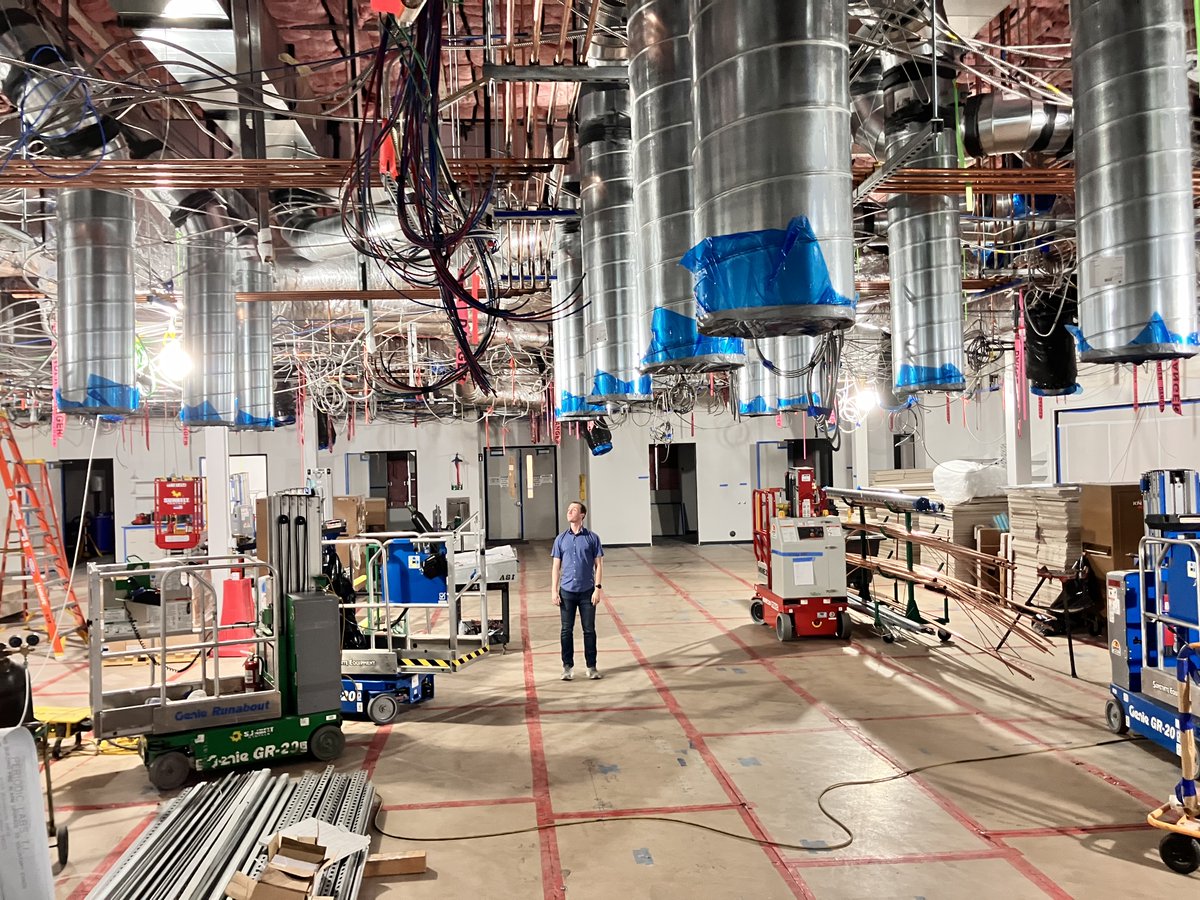
As we ramped up our first lab at Periodic, we were surprised by how quickly we became intelligence-bottlenecked.
The challenge shifted from conducting more experiments to understanding what we had actually made.
@agarwl_’s talk gives a glimpse into the research + infra behind scaling high-compute RL on real experimental data. Early results suggest scientific analysis has nice scaling properties too.
I gave a talk at ICLR 2026 about how we are scaling RL on frontier LLMs with 1T+ parameters, on experimental data from our physical lab at Periodic!
Here's a rough recording of the talk:
Computation is physical: better materials → better chips → smarter models → better materials
Periodic is hiring our first FDE to help close the loop. This role can be based in Taiwan. Apply here!
@periodiclabs is hiring the world's first Forward Deployed Engineer for LLM Systems of Atoms. You'll work closely with many top LLM systems engineers and researchers from the frontier labs — together with our semiconductor customers, to deploy and optimize frontier LLM systems in real industrial workflows. What we're looking for:
1. Hands-on experience with LLM system deployment and optimization
2. Passionate about optimizing the system end-to-end — from GPU kernels to orchestration
3. Good understanding of semiconductor processing
=========================================
(We are open to hire from Taiwan too!)
Periodic Labs 正在招聘全球首位 LLM Systems of Atoms 的 Forward Deployed Engineer。你將與許多來自前沿實驗室的優秀 LLM 系統工程師與研究員 — 以及我們的半導體客戶緊密合作,把前沿大模型系統真正部署並優化到工業級工作流程中。我們希望你具備:
1. LLM 系統部署與優化的實戰經驗
2. 熱衷於從 GPU kernel 到 orchestration 的端到端系統優化
3. 對半導體製程有良好理解
https://t.co/2zjQNWqrJ6
Feel free to me / @LiamFedus / @kdelpaine directly if interested
There’s a huge capability overhang in connecting today’s agents to high-throughput physical science labs
Can’t wait to see what pops out once we close that loop
After 1 year at @xai, I'm joining @periodiclabs to build the RL system for atoms.
xAI was a once-in-a-lifetime experience: building the inference stack at megascale from zero, countless late-night debugging sessions, endless memes and Slackmojis with the team. I'm deeply grateful for the trust xAI leaders (@lm_zheng@ying11231@Guodzh@makro_ai) placed in me, and for the incredible people I got to build alongside. AGI really is the friends we made along the way.
Digital AI has come incredibly far, and I have no doubt physical AI will go through the same revolution, starting from the fundamentals: atoms and labs. Born and raised in Taiwan, I deeply understand how transformative materials are to technology — and how much is still left to explore.
Periodic Labs has an unmatched combination of elite scientists and research engineers, tackling one of the most ambitious problems out there. I'll be focused on building the world's first and best RL system for atoms. So excited to work with @LiamFedus@ekindogus@AnjneyMidha to build a better future for humanity!
Bonus: we'll be building on a lot of open source technology and contributing back generously — feels incredible to be back in the OSS community again.
Periodic Labs cofounder Liam Fedus on why so many physicists are working on AI:
"I think [physics is] a great way to think about the world. It's very principled, very hard-nosed scientists, very careful. And I think it's just such an incredible field. You have such high leverage in computer science, in AI. And so I think a lot of physicists were seeing that."
"After the discovery of the Higgs, I think a lot of high energy physicists were sort of looking for what's next."
"Ultimately it becomes bottlenecked on the new apparatus for pushing the next energy frontier."
"And I think a lot of physicists were looking at their skillset and looking at the progress elsewhere and saying like, hey, I think I could be a huge contributor elsewhere."
@LiamFedus on @NoPriorsPod with @eladgil
Congrats, Andrew, and all in the new launch! Almost 10 years ago now Andrew and I were working on generative adversarial models for text and I’m excited what they do now
After almost 12 years in Brain/DeepMind, I’ve finally decided to take the leap. My cofounders: @yinfeiy, Seth and I have kicked-off @ElorianAI. The first multimodal reasoning lab founded and led by former LLM pretraining, data and multimodal leads. https://t.co/XHcEtvl9F9 (1/n)
Machine self-improvement is already here for AI software engineering systems. The last version is increasingly helping build the next one.
But this doesn't generalize infinitely. Rolling this improvement loop forward, we should expect incredible software engineering systems, but not that it will suddenly grok biology or physics.
Also, the reasoning strategies learned to be effective in software development aren't necessarily sufficient in other scientific domains that face ambiguous evidence or incomplete understanding.
when do we see self-improvement in AI research vs. biology? @LiamFedus, Cofounder @periodiclabs and former lead of post-training OpenAI, on @NoPriorsPod